Top Django Interview Questions
The ultimate guide to Django interview questions for all skill levels.


Django, a popular high-level Python web framework, is widely used for developing secure and scalable web applications. Known for its simplicity, feature and rapid development capabilities, Django has become a favorite among developers and companies alike.
Hi, my name is CyCoderX and today, in this article, we’ll cover some of the most frequently asked Django interview questions, ranging from basic to advanced, to help you prepare for your next interview.
Let’s dive in!
I’d appreciate your support by following me and in case you missed part one feel free to click the link here or the one below! 😊
Basic Django Questions
Here are some of the fundamental Django questions you may encounter in an interview:
1. What is Django?
- Django is a high-level Python web framework designed to promote rapid development and clean, pragmatic design. It simplifies web development by providing tools and features like an ORM, URL routing, and template engines.
2. What are some key features of Django?
- Object-Relational Mapping (ORM): Allows developers to interact with the database using Python objects.
- Admin Interface: A built-in admin dashboard for managing application data.
- Scalability: Django is designed to handle high traffic and scale efficiently.
- Security: Built-in features to prevent common security threats like SQL injection and XSS.
- Modular Structure: Django apps are reusable and easily maintainable.
3. What is the difference between a project and an app in Django?
- Project: A collection of settings and configurations for a web application.
- App: A module within a project that performs a specific function (e.g., a blog, authentication system).
4. What is the MVT architecture in Django?
Django follows the Model-View-Template (MVT) pattern:
- Model: Manages database structure and operations.
- View: Contains the business logic and processes requests.
- Template: Handles the presentation layer, rendering data into HTML.
Intermediate Django Questions
As you progress in an interview, you may encounter questions that test your understanding of Django’s architecture and core functionalities. Here are some commonly asked intermediate-level questions:
1. What is Django’s MVT architecture, and how does it work?
Django’s architecture is based on the Model-View-Template (MVT) pattern:
- Model: Represents the database schema and handles data management using Django ORM.
- View: Manages the logic and interaction between models and templates. It processes HTTP requests and returns responses.
- Template: Defines the presentation layer, generating HTML output based on dynamic data passed from the view.
The View acts as the bridge between the Model and Template, making the architecture modular and easy to maintain.
2. What is Django ORM, and why is it important?
Django ORM (Object-Relational Mapping) is a feature that allows developers to interact with the database using Python objects instead of writing SQL queries.
Benefits of Django ORM:
- Simplifies database operations (CRUD).
- Ensures database-agnostic code, making it easier to switch between databases.
- Automatically generates queries and manages relationships between tables.
Example:
# Define a model
class Employee(models.Model):
    name = models.CharField(max_length=100)
    salary = models.DecimalField(max_digits=10, decimal_places=2)

# Query using ORM
employees = Employee.objects.filter(salary__gte=50000)
What is the difference between get() and filter() in Django ORM?
get(): Returns a single object that matches the query. RaisesDoesNotExistif no match is found andMultipleObjectsReturnedif more than one match exists.
employee = Employee.objects.get(id=1)filter(): Returns a queryset containing all objects that match the query. If no match is found, it returns an empty queryset.
employees = Employee.objects.filter(salary__gte=50000)What are migrations in Django?
Migrations are Django’s way of propagating changes made to models into the database schema.
Key commands:
python manage.py makemigrations: Creates migration files based on model changes.python manage.py migrate: Applies the migrations to the database.
5. How does Django handle static files?
- Django provides the
STATIC_URLandSTATICFILES_DIRSsettings for serving static files like CSS, JavaScript, and images during development. - For production,
collectstaticis used to gather all static files into a single directory for deployment.
Connect with me on LinkedIn and X to stay ahead of industry trends and for more tips and tricks!
Advanced Django Questions
Advanced questions often dive deeper into topics like middleware, REST APIs, or performance optimization. Here are some examples:
1. What is middleware in Django?
Middleware is a framework of hooks that process requests and responses at a global level before they reach the view or after the response leaves the view.
Common middleware examples:
SecurityMiddleware: Adds security headers to requests and responses.SessionMiddleware: Manages sessions across requests.AuthenticationMiddleware: Associates users with requests.
Example of custom middleware:
class CustomMiddleware:
    def __init__(self, get_response):
        self.get_response = get_response

    def __call__(self, request):
        # Code executed before the view
        response = self.get_response(request)
        # Code executed after the view
        return response
2. What are Django signals?
Signals allow decoupled components to communicate with each other by notifying certain events.
Get CyCoderX’s stories in your inbox
Join Medium for free to get updates from this writer.
Example:
pre_save: Triggered before a model is saved.post_save: Triggered after a model is saved.
Example of a post_save signal:
from django.db.models.signals import post_save
from django.dispatch import receiver
from .models import Employee

@receiver(post_save, sender=Employee)
def employee_saved(sender, instance, created, **kwargs):
    if created:
        print(f"New employee {instance.name} added!")
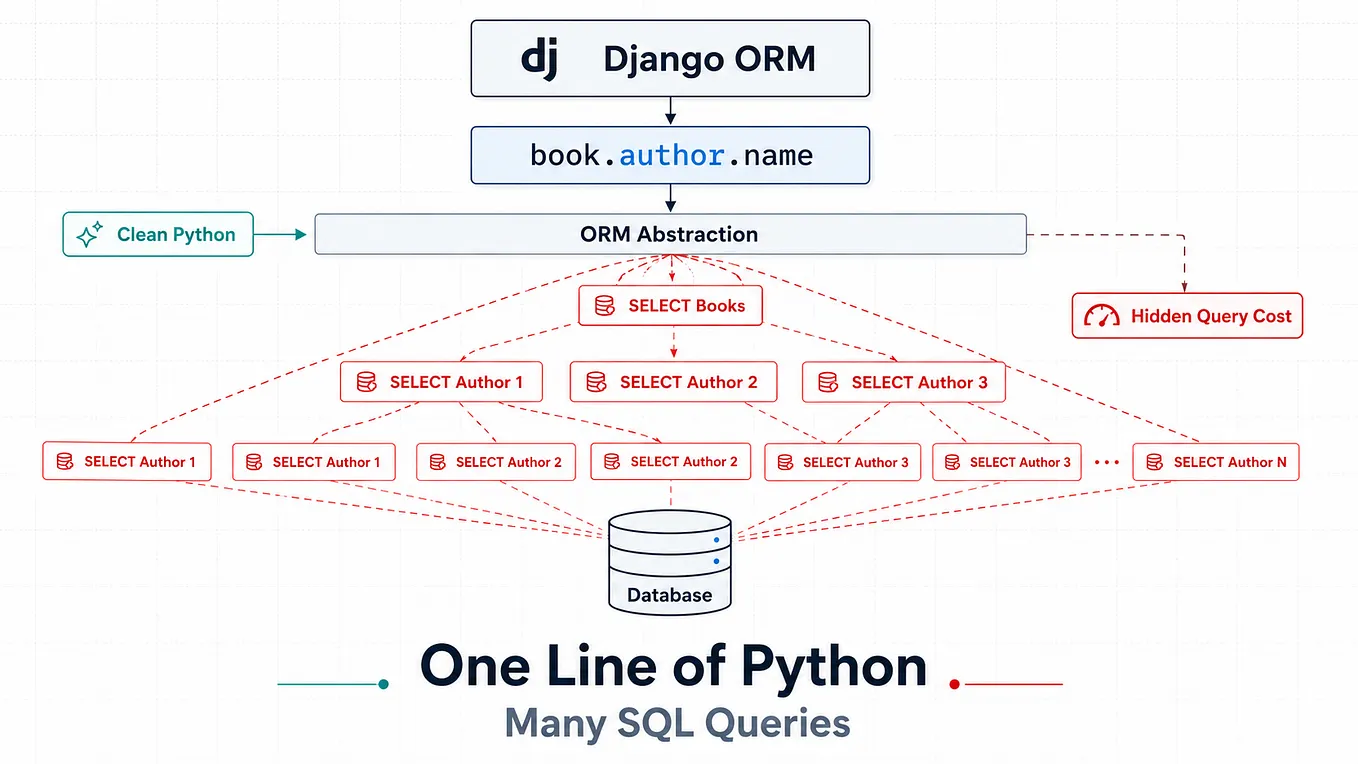
3. How can you optimize Django ORM queries?
- Use
select_relatedandprefetch_relatedfor optimizing queries involving related models. - Example:
employees = Employee.objects.select_related('department').all()- Avoid querying unnecessary data by filtering early.
- Use
only()ordefer()to load specific fields only when needed.
4. How does Django implement REST APIs?
Django REST Framework (DRF) is commonly used to build RESTful APIs in Django.
Key components of DRF:
- Serializers: Convert data between complex Python objects and JSON.
- Views: Handle API requests and responses.
- Routers: Automate URL routing for API endpoints.
5: Scenario-Based Questions
Scenario-based questions test your practical knowledge and problem-solving abilities. Here are some common examples:
1. How would you handle file uploads in Django?
- Use Django’s built-in file handling capabilities by setting up a
FileFieldorImageFieldin your model. - Example:
from django.db import models

class Document(models.Model):
file = models.FileField(upload_to='uploads/')- Configure
MEDIA_URLandMEDIA_ROOTinsettings.py:
MEDIA_URL = '/media/'
MEDIA_ROOT = BASE_DIR / 'media'- In the view, handle the uploaded file:
from .forms import DocumentForm

def upload_file(request):
    if request.method == 'POST':
        form = DocumentForm(request.POST, request.FILES)
        if form.is_valid():
            form.save()
    else:
        form = DocumentForm()
    return render(request, 'upload.html', {'form': form})
2. How would you implement user authentication in Django?
- Django provides a built-in authentication system, including user registration, login, and logout functionalities.
- Use
Usermodel for authentication and create views for login/logout:
from django.contrib.auth import authenticate, login, logout

def login_view(request):
    if request.method == 'POST':
        username = request.POST['username']
        password = request.POST['password']
        user = authenticate(request, username=username, password=password)
        if user is not None:
            login(request, user)
            return redirect('home')
        else:
            return HttpResponse("Invalid credentials")
    return render(request, 'login.html')
3. How would you implement pagination in Django?
- Django provides a
Paginatorclass for paginating data. - Example:
from django.core.paginator import Paginator

def view_products(request):
    products = Product.objects.all()
    paginator = Paginator(products, 10)  # 10 products per page
    page_number = request.GET.get('page')
    page_obj = paginator.get_page(page_number)
    return render(request, 'products.html', {'page_obj': page_obj})
4. How would you secure sensitive data in a Django project?
- Best practices include:
- Using environment variables to store sensitive data (e.g., database credentials).
- Setting
DEBUG = Falsein production. - Restricting allowed hosts with
ALLOWED_HOSTS. - Using Django’s
SECURE_*settings for HTTPS and secure cookies.
5. How would you handle large datasets in Django?
- Use pagination to fetch data in smaller chunks.
- Optimize queries with
select_related()andprefetch_related(). - Consider using Django’s streaming HTTP responses for downloading large files.
Conclusion
Preparing for Django interviews involves understanding its core concepts, architecture, and best practices. From mastering the MVT pattern to working with Django ORM, middleware, and REST APIs, knowing both theoretical and practical aspects can set you apart as a candidate.
To ace your Django interview:
- Practice common questions: Revise basic, intermediate, and advanced topics.
- Understand real-world scenarios: Be ready to discuss practical solutions.
- Hands-on coding: Familiarize yourself with Django’s built-in tools by working on projects.
Django is a powerful framework, and showcasing your knowledge of its features and practical usage will position you as a skilled developer ready to tackle complex web applications.
Good Luck!
Final Words:
Thank you for taking the time to read my article. Article first published on Medium by CyCoderX.
Hi, I’m CyCoderX! An engineer passionate about sharing knowledge, I write articles about Python, SQL, Data Science, Data Engineering and more!
Socials
In Plain English 🚀
Thank you for being a part of the In Plain English community! Before you go:
- Be sure to clap and follow the writer ️👏️️
- Follow us: X | LinkedIn | YouTube | Discord | Newsletter | Podcast
- Create a free AI-powered blog on Differ.
- More content at PlainEnglish.io