


U.S. Customs and Border Protection (CBP), the Drug Enforcement Administration (DEA), and scores of state and local law enforcement agencies have installed a massive dragnet of automated license plate readers (ALPRs) in the US-Mexico borderlands.
In many cases, the agencies have gone out of their way to disguise the cameras from public view. And the problem is only going to get worse: as recently as July 2025, CBP put out a solicitation to purchase 100 more covert trail cameras with license plate-capture ability.
Last month, the Associated Press published an in-depth investigation into how agencies have deployed these systems and exploited this data to target drivers. But what do these cameras look like? Here's a guide to identifying ALPR systems when you're driving the open road along the border.
Special thanks to researcher Dugan Meyer and AZ Mirror's Jerod MacDonald-Evoy. All images by EFF and Meyer were taken within the last three years.
ALPR at Checkpoints and Land Ports of Entry
All land ports of entry have ALPR systems that collect all vehicles entering and exiting the country. They typically look like this:

ALPR systems at the Eagle Pass International Bridge Port of Entry. Source: EFF
Most interior checkpoints, which are anywhere from a few miles to more than 60 from the border, are also equipped with ALPR systems operated by CBP. However, the DEA operates a parallel system at most interior checkpoints in southern border states.
When it comes to checkpoints, here's the rule of thumb: If you're traveling away from the border, you are typically being captured by a CBP/Border Patrol system (Border Patrol is a sub-agency of CBP). If you're traveling toward the border, it is most likely a DEA system.
Here's a representative example of a CBP checkpoint camera system:

ALPR system at the Border Patrol checkpoint near Uvalde, Texas. Source: EFF
At a typical port of entry or checkpoint, each vehicle lane will have an ALPR system. We've even seen border patrol checkpoints that were temporarily closed continue to funnel people through these ALPR lanes, even though there was no one on hand to vet drivers face-to-face. According CBP's Privacy Impact Assessments (2017, 2020), CBP keeps this data for 15 years, but generally agents can only search the most recent five years worth of data.
The scanners were previously made by a company called Perceptics which was infamously hacked, leading to a breach of driver data. The systems have since been "modernized" (i.e. replaced) by SAIC.
Here's a close up of the new systems:

Frontal ALPR camera at the checkpoint near Uvalde, Texas. Source: EFF
In 2024, the DEA announced plans to integrate port of entry ALPRs into its National License Plate Reader Program (NLPRP), which the agency says is a network of both DEA systems and external law enforcement ALPR systems that it uses to investigate crimes such as drug trafficking and bulk cash smuggling.
Again, if you're traveling towards the border and you pass a checkpoint, you're often captured by parallel DEA systems set up on the opposite side of the road. However, these systems have also been found to be installed on their own away from checkpoints.
These are a major component of the DEA's NLPRP, which has a standard retention period of 90 days. This program dates back to at least 2010, according to records obtained by the ACLU.
Here is a typical DEA system that you will find installed near existing Border Patrol checkpoints:

DEA ALPR set-up in southern Arizona. Source: EFF
These are typically made by a different vendor, Selex ES, which also includes the brands ELSAG and Leonardo. Here is a close-up:

Close-up of a DEA camera near the Tohono O'odham Nation in Arizona. Source: EFF
Covert ALPR
As you drive along border highways, law enforcement agencies have disguised cameras in order to capture your movements.
The exact number of covert ALPRs at the border is unknown, but to date we have identified approximately 100 sites. We know CBP and DEA each operate covert ALPR systems, but it isn't always possible to know which agency operates any particular set-up.
Another rule of thumb: if a covert ALPR has a Motorola Solutions camera (formerly Vigilant Solutions) inside, it's likely a CBP system. If it has a Selex ES camera inside, then it is likely a DEA camera.
Here are examples of construction barrels with each kind of camera:

A covert ALPR with a Motorola Solutions ALPR camera near Calexico, Calif. Source: EFF
These are typically seen along the roadside, often in sets of three, but almost always connected to some sort of solar panel. They are often placed behind existing barriers.

A covert ALPR with a Selex ES camera in southern Arizona. Source: EFF
The DEA models are also found by the roadside, but they also can be found inside or near checkpoints.
If you're curious (as we were), here's what they look like inside, courtesy of the US Patent and Trademark Office:

Patent for portable covert license plate reader. Source: USPTO
In addition to orange construction barrels, agencies also conceal ALPRs in yellow sandbarrels. For example, these can be found throughout southern Arizona, especially in the southeastern part of the state.

A covert ALPR system in Arizona. Source: EFF
ALPR Trailers
Sometimes a speed trailer or signage trailer isn't designed so much for safety but to conceal ALPR systems. Sometimes ALPRs are attached to indistinct trailers with no discernible purpose that you'd hardly notice by the side of the road.
It's important to note that its difficult to know who these belong to, since they aren't often marked. We know that all levels of government, even in the interior of the country, have purchased these set ups.
Here are some of the different flavors of ALPR trailers:

An ALPR speed trailer in Texas. Source: EFF
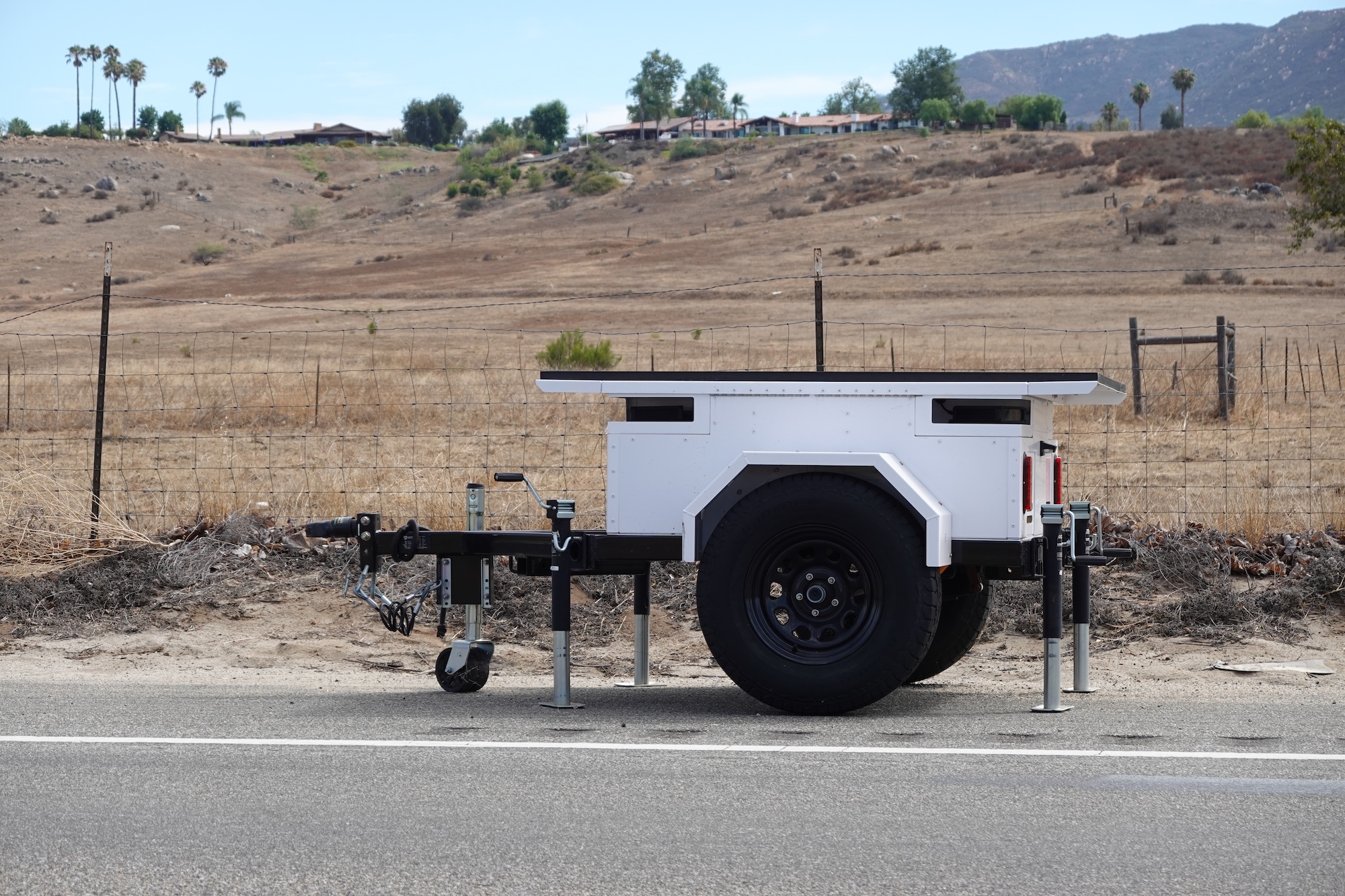
ALPR trailer in Southern California. Source. EFF

ALPR trailer in Southern California. Source. EFF
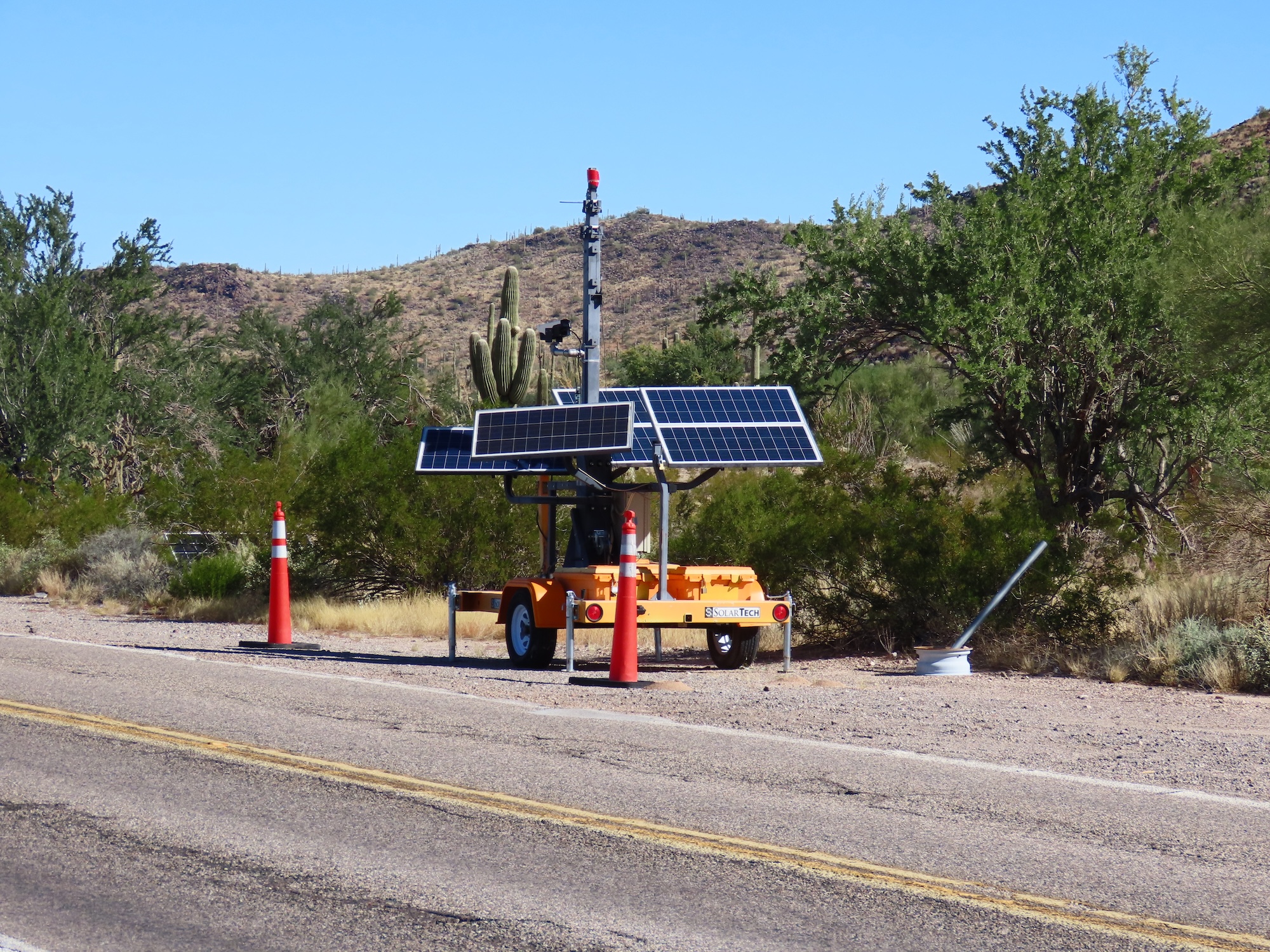
An ALPR unit in southern Arizona. Source: EFF

ALPR unit in southern Arizona. Source: EFF

A Jenoptik Vector ALPR trailer in La Joya, Texas. Source: EFF
One particularly worrisome version of an ALPR trailer is the Jenoptik Vector: at least two jurisdictions along the border have equipped these trailers not only with ALPR, but with TraffiCatch technology that gathers Bluetooth and Wi-Fi identifiers. This means that in addition to gathering plates, these devices would also document mobile devices, such as phones, laptops, and even vehicle entertainment systems.
Stationary ALPR
Stationary or fixed ALPR is one of the more traditional ways of installing these systems. The cameras are placed on existing utility poles or other infrastructure or on poles installed by the ALPR vendor.
For example, here's a DEA system installed on a highway arch:
The lower set of ALPR cameras belong to the DEA. Source: Dugan Meyer CC BY
ALPR camera in Arizona. Source: Dugan Meyer CC BY
Flock Safety
At the local level, thousands of cities around the United States have adopted fixed ALPR, with the company Flock Safety grabbing a huge chunk of the market over the last few years. County sheriffs and municipal police along the border have also embraced the trend, with many using funds earmarked for border security to purchase these systems. Flock allows these agencies to share with one another and contribute their ALPR scans to a national pool of data. As part of a pilot program, Border Patrol had access to this ALPR data for most of 2025.
A typical Flock Safety setup involves attaching cameras and solar panels to poles. For example:

Flock Safety ALPR poles installed just outside the Tohono O'odham Nation in Arizona. Source: EFF

A close-up of a Flock Safety camera in Douglas, Arizona. Source: EFF
We've also seen these camera poles placed outside the Santa Teresa Border Patrol station in New Mexico.
Flock may now be the most common provider nationwide, but it isn't the only player in the field. DHS recently released a market survey of 16 different vendors providing similar technology.
Mobile ALPR
ALPR cameras can also be found attached to patrol cars. Here's an example of a Motorola Solutions ALPR attached to a Hidalgo County Constable vehicle in South Texas:

Mobile ALPR on a Hidalgo County Constable vehicle. Source: Weslaco Police Department
These allow officers not only to capture ALPR data in real time as they are driving along, but they will also receive an in-car alert when a scan matches a vehicle on a "hot list," the term for a list of plates that law enforcement has flagged for further investigation.
Here's another example:

Mobile ALPR in La Mesa, Calif.. Source: La Mesa Police Department Facebook page
Identifying Other Technologies
EFF has been documenting the wide variety of technologies deployed at the border, including surveillance towers, aerostats, and trail cameras. To learn more, download EFF's zine, "Surveillance Technology at the US-Mexico Border" and explore our map of border surveillance, which includes Google Streetview links so you can see exactly how each installation looks on the ground. Currently we have mapped out most DEA and CBP checkpoint ALPR setups, with covert cameras planned for addition in the near future.