How to Build a Winning B2B Sales Strategy: Proven Frameworks + Examples


Article Key Takeaways
- A B2B sales strategy documents who you sell to, why they would switch to you, which channels you run, and the numbers that prove the plan works.
- Proven outcomes: SPIN selling grew Scientifica’s win rate from 10% to 23%, IBM onboarded ~30,000 sellers to a single platform, and DoorDash saved 3 days per email campaign.
- B2B buyers average 10 interaction channels, making single-channel strategies inadequate.
- Use a quarterly reviewed template: goals, ICP, positioning, channels, sequences, tools, and metrics.
- Consider automating outbound campaigns via signal-triggered LinkedIn and email sequences with sentiment sorting.
How to Build a Winning B2B Sales Strategy: Proven Frameworks + Examples


Has your B2B pipeline stalled? Or failed to take off entirely? That’s not uncommon. Most businesses report they’re facing larger buying committees, longer sales cycles, and contending with multiple interaction channels, making generic outreach close to ineffective. The difference between teams that consistently hit their quotas and those that scramble to close the gap usually comes down to structure. Building a repeatable, scalable B2B sales strategy is the only way to turn inconsistent prospecting into a predictable revenue engine.
A winning B2B sales strategy answers 4 questions in writing:
- Which accounts do we target?
- Why do those buyers choose us?
- Which channels carry the conversation?
- How do we measure whether deals are moving?
Our own platform data shows what structure is worth: across 70,000+ campaigns, outreach triggered by a buying signal replies at 13.4-14.21%, against a 10.3% average for all LinkedIn DMs.
Here’s what this guide covers:
- Four proven frameworks (strategic, SPIN, account-based, and value-based selling), each with a real company and real numbers behind it.
- 12 steps for building a B2B sales strategy from scratch.
- A free B2B sales strategy template you can fill in this week.
- The four mistakes that stall B2B pipelines fastest.
What are the components of a winning B2B sales strategy?
A winning B2B sales strategy relies on 4 core components: a precise Ideal Customer Profile (ICP) to target the right buyers, a clear Value Proposition defining your unique return on investment, a structured Sales Process/Methodology with defined pipeline stages, and robust Sales Enablement & Tools to empower your team.
- Ideal Customer Profile (ICP): A precise definition of the accounts you target, detailing the right industries, roles, and buying signals to focus your team on high-intent prospects.
- Value Proposition & Messaging: A clear statement of the unique ROI your solution delivers, explaining why buyers should choose you over their current status quo.
- Sales Process & Methodology: A structured approach with defined pipeline stages that ensures every rep follows a repeatable path from first outreach to closed deal.
- Enablement, Tech Stack & Metrics: The robust tools (like CRM, data intelligence and automation) and continuous training required to empower your team and measure performance against goals.
Why do you need a B2B sales strategy?
Start with the quota math: 64% of sales reps report falling short of their most recent quota, per our State of LinkedIn Outreach H1 2026 report. Miss quota once and it’s a bad quarter. Miss it three quarters running and the problem usually isn’t talent — it’s reps chasing the wrong accounts with inconsistent messaging and no shared plan to work from.
A documented B2B sales strategy is a structured plan that defines who you sell to, which channels you use to reach them, and how success gets measured. Without one, prospecting defaults to volume and guesswork. With one, it attacks the quota gap in four ways.
- Predictable pipeline growth:
- With a defined ICP and channel plan, SDRs spend their hours on accounts with a real chance of closing.
- Prospecting stops being a volume contest and starts producing opportunities you can forecast.
- Stronger relationships with the buying committee:
- Most B2B deals now involve 6-10 decision-makers, each with their own concerns.
- Buyers do the majority of their research before ever speaking to a rep.
- A strategy forces you to map every stakeholder and address each one’s specific concerns early.
- Buyers who feel understood keep responding, and champions sell for you internally.
- Sales and marketing are pulling in the same direction:
- A strategy aligns messaging across every touchpoint — the content a prospect reads before demo, the pitch they hear on the call, the follow-up they get after.
- Without alignment, buyers get a different story at each stage and stall out.
- Revenue that compounds:
- Qualified leads, nurtured through a long cycle, convert into customers who renew and refer.
- A documented strategy ties activity to specific metrics (deal velocity, conversion rate, retention) so you see which parts are working and fix the ones that aren’t.
- Keeps the machine consistent when reps change or quarters get tight.
What are the different types of B2B sales strategies?
Your sales strategy shapes almost everything downstream of it: how reps open conversations, which channels carry the weight, and how deals move through your CRM. Most teams don’t run one type in isolation; they pick a primary motion and layer in others depending on the segment, deal size, and account.
Here’s a quick comparison before we break each one down:
| Type | Best for | Typical cycle |
|---|---|---|
| Inbound | Established brand, steady traffic, clear ICP | Long — compounds over quarters |
| Outbound | Named-account targeting, new or low-traffic markets | Fast — weeks, not quarters |
| Hybrid | Mid-market/enterprise, multiple decision-makers | Long, multi-stakeholder |
| Account-based selling (ABS/ABM) | Large deals, long cycles, several stakeholders | Long |
| Solution selling | Buyer already knows their problem | Medium |
| Consultative selling | Complex purchases, buyer still shaping criteria | Medium-long |
| Channel/partner | Limited direct sales capacity, new regions or verticals | Varies by partner |
The most common B2B sales strategies are inbound and outbound sales but the strongest teams run multiple strategies simultaneously.
Here is how each one earns its place.
1. Inbound sales strategy
An inbound sales strategy attracts buyers to you.
You publish content that answers the questions your ICP is already researching, such as guides, benchmark reports, and teardown videos, then convert that attention into conversations.
Inbound costs less per lead and pre-qualifies buyers through their own research.
The trade-off is time: content compounds over quarters, so inbound alone starves a pipeline that needs deals this quarter.
Best for: companies with existing brand recognition, consistent site traffic, and a well-defined ICP.
2. Outbound B2B sales strategy
A B2B outbound sales strategy is the proactive counterpart: you pick the accounts and open the conversation through cold email, calls, and LinkedIn outreach.
Run well, outbound lead generation fills pipeline in weeks and gives you full control over which logos enter it.
The execution bar is higher, though. Buyers ignore generic touches, so outbound lives or dies on targeting, personalization, and timing, which the 12 steps below cover in order.
One more distinction worth naming: a B2B digital sales strategy runs either motion entirely through digital channels such as email, LinkedIn, webinars, and self-serve purchasing.
For SaaS companies, where a B2B SaaS sales strategy pairs product trials with demo-led outbound, the digital-first version is now the default.
Best for: teams with a tightly defined ICP, named-account targeting, or entering a market where inbound demand hasn’t built up yet.
3. Hybrid sales strategy
A hybrid strategy doesn’t force a choice between the two. It runs continuous inbound alongside a focused outbound push on your highest-value target accounts. Inbound keeps a baseline of pipeline flowing while outbound goes after the logos you actually want.
This is the default motion for most mid-market and enterprise teams, since those deals typically involve more than one decision-maker and a longer path to close than either channel handles well on its own.
Best for: mid-market and enterprise sales with multi-threaded buying committees and longer cycles.
4. Account-based selling (ABS/ABM)
Account-based selling, sometimes called account-based marketing when marketing is fully looped in, flips the usual funnel. Instead of generating leads and qualifying down, you start by naming the accounts you want and build a tailored plan for each one.
That plan usually means multi-threading into several stakeholders at the account rather than a single contact, with the goal of getting executive-level engagement before the deal stalls at a lower level.
Best for: large deals with long cycles and several stakeholders who each need their own case made.
5. Solution selling
Solution selling starts from the buyer’s problem, not your product. You diagnose what they’re actually trying to fix, then position your offering as the direct answer to that specific pain point.
It works because it meets buyers where they already are: they know they have a problem and are shopping for whoever can solve it credibly.
Best for: buyers who’ve already identified their problem and are actively evaluating vendors.
6. Consultative selling
Consultative selling puts the rep in an advisor role rather than a pitch role. Instead of leading with product, you ask questions that help the buyer figure out what they need; sometimes before they’ve fully worked that out themselves.
This earns trust in complex deals where the buyer’s criteria are still forming, and it’s often the difference between winning the RFP and never getting invited to write one.
Best for: complex purchases where the buyer hasn’t yet nailed down their own buying criteria.
7. Channel/partner sales strategy
A channel or partner strategy means you’re not selling alone. Resellers, implementation partners, or marketplaces carry some or all of the selling and delivery motion on your behalf.
Done well, it extends your reach into regions or verticals you couldn’t cover with a direct team, and it borrows the partner’s existing trust with their customer base.
Best for: companies with limited direct sales capacity, or products that need implementation help to land well.
12 steps to build a winning B2B sales strategy in 2026
Building a winning B2B sales strategy from scratch comes down to 12 decisions. Get the order wrong and later steps undo the earlier ones. Here’s the sequence that works:
1. Set measurable goals
Decide what the strategy must achieve before you pick tactics.
- “Grow company revenue through LinkedIn outreach” is a wish.
- “Add 30 new customers by Q2” or “lift annual revenue 20%” is a goal your team can plan backward from.
Concrete targets also tell you how much B2B sales pipeline you need at each stage.
If you close 20% of qualified opportunities and want 10 new deals, the plan needs to source 50 opportunities, and now every upstream number has a target too.
2. Understand your target audience
Your ICP (ideal customer profile) is the company type that gets the strongest results from your product, defined by industry, headcount, tooling, and the trigger events that make them buy.
Once you’ve defined the company, map the people inside it. Three roles matter most, and each needs different proof:
- Economic buyer: controls budget, needs ROI proof
- End user: will use the product daily, needs proof it fits their workflow
- Blocker: can veto the deal, needs their specific objection addressed early
Skip this step and every later one degrades: messaging goes generic, channels get chosen by habit, and reps burn hours on accounts that were never going to close.
3. Align sales and marketing efforts
When sales and marketing run separate playbooks, leads leak in the handoff.
The fix is one shared system:
- A single ICP definition: both teams targeting the same company profile
- Agreed qualification criteria: a clear, shared line for when a lead counts as qualified
- A standing feedback loop: sales reports back which leads turned into revenue, so marketing knows what’s actually working
Alignment turns marketing into a genuine pipeline source. It also sharpens positioning, because objections reps hear on calls flow back into the content marketing produces.
4. Use data-driven insights to find the right prospects
The highest-converting prospect lists start from buying signals rather than static filters.
Job changes, funding rounds, new hires on a team, and engagement with relevant content all mark accounts that are in motion, and accounts in motion answer.
The strongest B2B prospecting methods are built around these triggers.
Alex Fine, co-founder of Understory, a sales and marketing agency for SaaS companies, described his trigger workflow in a GTM Society interview:
“So you can say if someone’s engaging with this post, they match my ICP, push it to an Expandi campaign, and then you can send it out immediately. And what that does is it shows relevance. You don’t have to worry about deliverability like you do with email. And you’re going to land in the primary inbox every time and people are going to read your messages.” — Alex Fine, Understory
That workflow is what Expandi automates for LinkedIn lead generation: a signal fires, the matching lead enters a campaign, and the outreach lands while the trigger is still fresh.
5. Personalize your outreach at scale
Generic messages get skimmed and archived.
Personalized ones reference something true about the prospect:
- A pain point tied to their role.
- A post they published.
- A change at their company.
That relevance is what earns the reply.
- Doing this for a thousand prospects a month takes structure.
- Dynamic placeholders handle name, role, and company.
- Segment-level angles handle the message itself.
Our guide on how sales teams scale personalization breaks this system down.
One caution from our State of LinkedIn Outreach H2 2026 report: unedited AI messages underperformed the same accounts’ human-written templates by 12% on acceptance, so treat AI output as a first draft and finish it with what you know about the prospect.
6. Opt for multi-channel prospecting
Your buyers already work across channels, so single-channel outreach misses them by default.
McKinsey’s 2024 B2B Pulse survey found B2B customers use an average of ten interaction channels in their buying journey, up from five in 2016, and over half will switch suppliers after a rough cross-channel experience.
Practically, that means sequencing touches across LinkedIn, email, and phone so each channel reinforces the others.
- A connection request warms up the email.
- The email references the LinkedIn thread.
- The call closes the loop.
7. Try social selling on LinkedIn
LinkedIn is where B2B buying committees spend work hours, which makes LinkedIn social selling the cheapest trust-building motion available to a sales team.
- Post solutions and content your ICP cares about.
- Comment where they already discuss problems you solve.
- Engage with prospects’ content before you pitch anything.
Benchmark your results against real numbers.
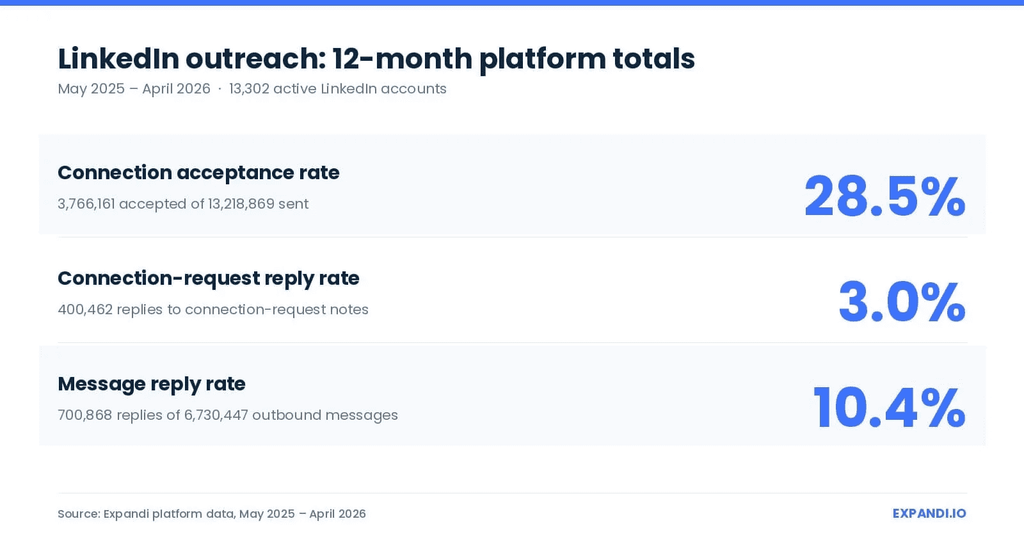
Our LinkedIn outreach benchmarks, drawn from 13.2 million connection requests, put average acceptance at 28.5% and message replies at 10.4%. If your warmed-up outreach sits below those lines, the targeting or the message needs work before the volume does.
Posting pays off here too: in our H2 2026 data, accounts posting consistently to 1,000+ followers accepted connection requests at 30.5%, against a 27-29% platform average.
Be sure to keep an eye on your LinkedIn SSI score to get the most out of this tactic.
8. Nurture your leads
B2B deals mature slowly.
Our State of LinkedIn Outreach data shows sales cycles stretching past six months. A prospect who ignored you in March may be in a buying window by September, and nurture is how you stay in the room until then.
Keep the thread alive with a rhythm your team can sustain:
- Follow-up emails spaced weeks apart, each adding something new.
- Ongoing LinkedIn engagement with the prospect’s posts.
- Case studies and industry reports matched to their situation.
This is also where inbound and outbound merge into one B2B lead generation motion: content nurtures the leads outbound opened.
9. Lead with outcomes over features
Buyers pay for outcomes. A feature list describes your product. An outcome statement describes their next quarter, and only one of those gets budget approved.
Translate every feature into the result it produces for the specific role you’re addressing.
“Automated sequencing” becomes “your SDRs run 3x the touches without working weekends.”
Back the claim with a case study or a customer number, because the committee will forward your one-pager to people you never meet.
10. Use the right sales tools
Manual execution caps how far any strategy scales. A working stack covers four jobs:
- Prospecting tools, like Expandi, to find and engage qualified leads.
- Data enrichment tools to surface valid emails and firmographics.
- Sales engagement tools to run and track sequences.
- A CRM to hold the pipeline together.
Consolidate where you can, and pick platforms that talk to each other.
Our roundup of AI sales tools covers which categories deserve budget first. The tool matters less than the operator, though: buy for the workflow your team will run every day.
11. Continuously train your sales team
Your reps execute the strategy, so their skills set its ceiling.
Sales enablement gives them the materials and the reps the practice: playbooks, persona one-pagers, and battlecards for reference, plus role-plays, objection-handling drills, and call reviews to build the muscle.
Make training continuous rather than a quarterly event. Markets shift, messaging evolves, and the teams that rehearse weekly close the deals that surprise everyone else.
12. Track and optimize your performance
You improve what you measure. Track reply rate, meeting rate, sales cycle length, average deal size, and stage-to-stage conversion, and review them on a fixed cadence so drift gets caught early.
A/B test the variables that move replies:
- Subject lines and opening hooks.
- Message tone and length.
- The CTA you close with.
Then close the loop with humans. Rep feedback tells you where the process grinds. Customer feedback tells you why deals really closed or died.
B2B sales strategy framework: 4 proven models + real examples
A B2B sales strategy framework is a repeatable model for how reps run deals, from first question to close. Here’s how the four compare:
| Framework | How it works | Real example | Result |
|---|---|---|---|
| Strategic selling | Map every decision-maker in the account and advance the deal by satisfying each one | IBM | Roughly 30,000 sellers moved onto one global sales platform |
| SPIN selling | Run discovery through four question types: situation, problem, implication, need-payoff | Scientifica | Won-versus-lost conversion up from 10% to 23% |
| Account-based selling | Focus sales and marketing on a short list of high-value accounts, each treated as a market of one | Valpak | One unified account view shared across sales and marketing |
| Value-based selling | Anchor the conversation on the buyer’s quantified outcome rather than product features | DoorDash | 3 days off email production, 80% of emails automated |
The four strategies have decades of results behind them, and each B2B sales strategy example shows a real company putting the model to work.
1. Strategic selling
Strategic selling structures complex deals around the buying committee. You map every decision-maker in the account, classify their influence and their win condition, and advance the deal by satisfying each one rather than pitching the room at large.
Real-world example of strategic selling
IBM ran a global sales transformation after realizing sellers spent more time on internal systems than with customers. The company partnered with Salesforce to replace a patchwork of disconnected CRM tools with one cloud platform, IBM Sales Cloud.
What IBM did
- Unified multiple disconnected CRM tools into one global sales system with centralized account information.
- Standardized the sales process across business units to cut inaccurate data and duplicated work.
- Gave teams real-time visibility into accounts and pipeline so high-value opportunities get priority.
Result
Roughly 30,000 sellers across IBM’s business units now work on the platform, with less administrative burden and more selling time in front of clients.
2. SPIN selling
Introduced by Neil Rackham in 1988, SPIN selling structures discovery conversations around four question types. The rep surfaces the buyer’s situation, digs into the problem, makes its cost explicit, and lets the buyer articulate the payoff of solving it.
| SPIN component | Meaning | Question example |
|---|---|---|
| Situation | Gather context on the customer’s current setup | What CRM are you currently using? |
| Problem | Surface pain points and frustrations | Does your CRM integrate with the other tools you use? |
| Implication | Make the cost of the problem explicit | If integration keeps failing, what does that do to your team’s productivity? |
| Need-payoff | Let the buyer voice the value of solving it | How much would it help your revenue goals if no leads were lost to failed integrations? |
Real-world example of SPIN selling
Scientifica, a scientific instrumentation provider, trained its cross-functional teams to run SPIN questions on clients’ operations and sustainability goals, shifting conversations from product pitches to business impact.
Result
Scientifica’s won-versus-lost conversion rate improved from 10% to 23% after SPIN training.
3. Account-based selling
Account-based selling concentrates the team’s effort on a short list of high-value accounts and treats each one as a market of one.
Sales, marketing, and success coordinate on the same target list, and every touch is tailored to that account’s specific situation.
The model is winning converts because committee-led deals reward depth over reach. Matija Nakic, CEO and co-founder of Farseer, a planning, forecasting, and reporting platform for mid-market and enterprise finance teams, put it this way in a GTM Society interview:
“The pillars of our go-to-market strategy are sales outreach and events, and now we are establishing the ABM motion, and I think this will take over in the next few years for us.” — Matija Nakic, Farseer
Real-world example of account-based selling
Valpak, a direct marketing company, rebuilt its sales motion around target accounts using Salesforce Customer 360.
What Valpak did
- Compiled account data into a single view shared across sales and marketing teams.
- Personalized messaging to the challenges of each target account.
- Used marketing automation data to tell reps the right moment and message for each account.
Result
Valpak’s teams now work each target account from one unified data view, with marketing flagging to sales exactly where each account sits in its journey.
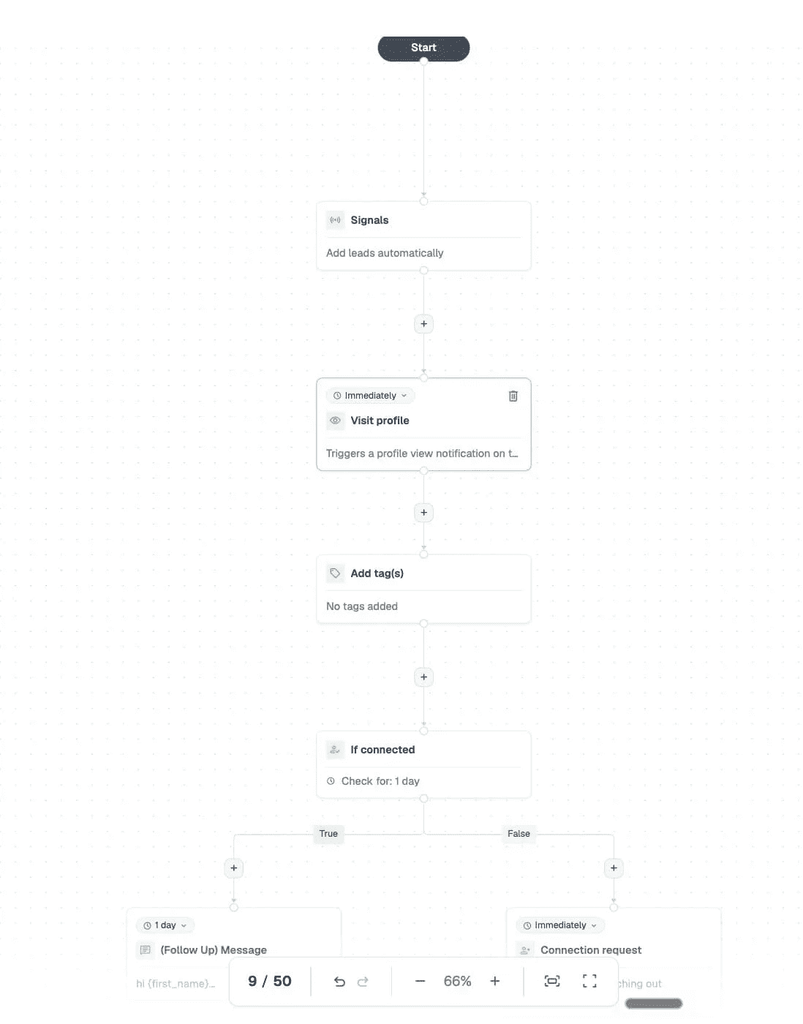
For the outreach layer of account-based selling, Expandi’s Builder campaigns run the same play at the account level: when a target account shows a signal, such as a profile visit or post engagement, the matching stakeholders enter a tailored LinkedIn sequence automatically.
4. Value-based selling
Value-based selling anchors the whole conversation on the outcome your product creates rather than what it does. The rep quantifies the buyer’s problem, then positions the product as the shortest path to the number the buyer cares about.
Real-world example of value-based selling
DoorDash needed a faster way to produce and scale its email marketing, which had been running on manual HTML forms and hand-maintained databases. HubSpot won the deal by selling the outcome, automated workflows and reliable data, rather than a feature list, and DoorDash’s results made the value case concrete.
Result
DoorDash cut 3 days off its email campaign production process and automated 80% of its marketing emails with workflows.
Free B2B sales strategy template
Use this B2B sales strategy template to turn everything above into one working document. Copy the seven sections into a doc, answer the prompts, and you have a strategy your team can execute and audit:
- Revenue goal and pipeline math. The number the strategy must produce, worked backward into opportunities, meetings, and touches per month.
- Ideal customer profile and buying committee. The account definition, plus the roles you must win and what each one needs to see.
- Positioning and value proposition. The outcome you sell, the proof behind it, and why a buyer switches from the status quo.
- Channel mix. Which of inbound, outbound, and social selling you run, and what share of pipeline each must carry.
- Outreach sequence. The touch-by-touch cadence across LinkedIn, email, and phone, including timing and fallback steps. Our H2 2026 data puts the sweet spot at three messages (9.8% reply rate), and five or more drops below a single message.
- Tool stack. Prospecting, enrichment, engagement, and CRM, with an owner for each.
- Metrics and review cadence. The numbers you track weekly and the quarterly checkpoint where the strategy itself gets revised.
Treat the template as a living document. Prospect behavior shifts and channels saturate, and the quarterly review is what keeps the strategy from quietly going stale.
What to avoid when building a B2B sales strategy?
The fastest way to strengthen a B2B sales strategy is to remove the failure modes. These four sink more pipelines than any missing tactic:
1. Generic messaging over personalization
One message blasted to CEOs, sales leaders, and RevOps managers alike reads as spam to all three.
Segment your list by role and situation, then tailor the pain point and proof to each segment. Relevance is the price of a reply.
2. Chasing quantity over quality
A pipeline stuffed with poor-fit leads looks productive and closes nothing. Focus the team on accounts that match the ICP and show real intent, even if the raw numbers shrink. Ten committed conversations beat a thousand ignored touches.
3. Ignoring data-driven insights
Running outreach without data means targeting by guesswork and following up blind. Keep customer and campaign data in your CRM, review it on a fixed cadence, and let it decide who gets contacted next.
Outreach automation tools like Expandi feed the loop automatically by writing campaign results back to your CRM through native integrations.
4. Overpromising and underdelivering
Deals won on inflated claims churn within a year and take referrals with them.
Be straight about what your product and team deliver, scope the edge cases honestly, and let the buyer be surprised in the right direction after the contract is signed.
Turning your B2B sales strategy into pipeline
A winning B2B sales strategy is a system you run, review, and revise:
- pick your frameworks
- work the 12 steps
- hold the results against your benchmarks every quarter.
Teams like IBM, Scientifica, and DoorDash won by executing a documented plan consistently, and that part is fully within your control.
Ready to put your outbound on autopilot?
Expandi is a LinkedIn automation tool that grabs your ideal buyers from LinkedIn, triggers sequences off real buying signals, and personalizes every touch at scale. Start your 7-day free trial today.
Frequently asked questions
A winning B2B sales strategy is a documented plan for how a company identifies, engages, and converts other businesses into customers. It defines the ideal customer profile, the value proposition, the channel mix, and the metrics that prove the plan works.
The strategies that win share one habit: they get reviewed and revised on a fixed cadence.
A B2B sales strategy framework is a repeatable model that structures how reps run deals from first conversation to close. The four with the strongest track records are:
• Strategic selling
• SPIN selling
• Account-based selling
• Value-based selling
Pick one as the team’s default so every rep runs deals the same way and results stay comparable.
Each example below started with a clear target outcome and a framework matched to it:
• IBM centralized roughly 30,000 sellers onto one cloud CRM platform, cutting administrative work and increasing selling time.
• Scientifica applied SPIN selling and lifted its won-versus-lost conversion rate from 10% to 23%.
• DoorDash adopted an automation-first workflow that cut email campaign production time by 3 days.
Start from seven sections, filled in order since each depends on the one before it:
1. Revenue goal
2. Ideal customer profile
3. Positioning
4. Channel mix
5. Outreach sequence
6. Tool stack
7. Metrics
Then treat the document as living: review it quarterly and revise whatever the numbers contradict.
A B2B sales strategy sets direction: who you target, why they buy from you, and which channels you run.
A B2B sales plan turns that direction into dated, owned actions such as quotas, territories, and activity targets.
Write the strategy first because a plan built without one just schedules random activity.
A B2B marketing strategy framework structures how you create demand: audience definition, messaging, and the channels that build awareness.
A sales strategy framework structures how you convert that demand into revenue through direct conversations.
The two share one ICP and one positioning, and the strongest GTM teams build them together.
The four highest-cost mistakes:
• Generic messaging sent to every persona
• Chasing lead volume over lead fit
• Running outreach without data
• Overpromising to win deals that later churn
All four trace back to skipping the foundations: a tight ICP, honest positioning, and a measurement cadence.


You’ve made it all the way down here, take the final step