Contemplating Fashion.

“What poet would dare, in the depiction of the pleasure caused by the apparition of a beauty, separate the woman from the dress?” — Charles Baudelaire

Fashion is an active metaphor.
A distilled silhouette of modernity, it’s the shadow of our culture tied weightless under our feet. It delineates behind us, trends ahead of us; its pretension sometimes beneath us, but it is never too far away from us. Fashion keeps record of our world through infatuated eyes. It draws out a reality, not how it is, instead how we propose it to be. It grooms us with the desire to be more than what we are. Which is to say that Fashion is in the business of selling us a certain kind of potential; It promises the notion that we can make tangible the expression of something we do not naturally possess. It leverages the very vanity of being, feeds off the unfathomable urge of aspiration, and commodifies it to become the very product of aspiration itself. Though the glamour of Fashion is not without its brutality. Fashion cannibalizes. It dispenses a certain mode of high-toned presentation until it deems itself unworthy of its own judgement. Fashion then, kills itself off until a new decade resurrects it in its own image. It is the destiny of fashion to become unfashionable. This contradictory interplay of birth and resurrection introduced a culture of aesthetic commodification, which allowed Fashion to become an industry with a growing tendency for futile innovations. Endorsing the need to consume to satisfy the need for consumption — fashion for the sake of Fashion— desire for the sake of itself. But before it was an industry, fashion was simply a word — it was an idea.
Fashion begins as a noun. It is a word denoting when something is “in style”. It comes from the Old French façon meaning “appearance, face, manner; beauty.” From the Latin factionem, “a making or doing”. But fashion is also a verb, and when it moves, fashion “gives form”; it “gives shape to”. It’s even attested in the Bible, God not only created the Earth, he fashioned it [Isaiah 45:18]. He designed it so wonderfully in the ultimate style and likeness of Himself.
The Fashion system, is a concept almost impossible to define, yet the economist Paul Nystrom offered to describe it (rather successfully) as, “Nothing more and nothing less than the prevailing style at any given time”. Fashion, in many ways, archives this thing we call Time. It preserves the impermanence of the present, which inevitably succumbs to the past the very moment we observe it, through the poetics of style and silhouette. Fashion allows us to celebrate the chronology of a moment through the indulgence of material beauty; because what is the pursuit of beauty but not an instrument of self-preservation? Plato writes in his Symposium, about a woman named Diotima who taught Socrates about the importance of beauty. She told him that the experience of beauty is intimately connected with the desire for reproduction and reproduction— a desire for the eternal. Is that not why we continue to reproduce that which we consider beautiful? Why we write poetry, photograph sunsets, and tell stories? Is that not why we choose to remember? In order to somehow relive the beautiful? Under the fascism of Time, all that exists dances on the verge of creation and catastrophe. Yet under the certainty of death, it is beauty that remains. Is that not why at the end of every civilization all that’s left, under rubble and forgotten history, is the art? Is the pursuit of beauty not the closest thing we can get to witnessing eternity? Does Fashion not attest to this as well? Is it possible we’ve invented Fashion for the purposes of achieving that end? To materialize the immortal quality of beauty in hopes that we can apply it to ourselves? I have to admit, we cannot expect Fashion itself to bear the weight of its immense philosophical aspirations, but there must be a truth in there that remains. That by dressing ourselves in clothes deemed “beautiful”, by adorning, perfuming, and assessing ourselves, we in turn consecrate our own image. We carve out our own space for it and dignify ourselves into something worth beholding. In the end, we all look towards beauty as a means to refuse the sureness of death. Perhaps the desire for fashion exists in order to make those longings tangible — to resist the inevitable and dwell in the affirmation of the present — or is that too much to ask of it?
Another thought seduces me:
Get Alison Prada’s stories in your inbox
Join Medium for free to get updates from this writer.
There must be something in our clothes, a semiotic material of some sort, that may allow us to see better. More than sight in a practical sense, what if observing the banality of dress could expand the perception of who we are as people? Aldous Huxley, during his infamous mescaline trip in 1953, remembers an epiphany he had while flipping through the pages of a book on Botticelli:
“I turned the pages. “The Birth of Venus”-never one of my favorites. “Mars and Venus,” that loveliness so passionately denounced by poor Ruskin at the height of his long-drawn sexual tragedy. The marvelously rich and intricate “Calumny of Apelles.” And then a somewhat less familiar and not very good picture, “Judith.” My attention was arrested and I gazed in fascination, not at the pale neurotic heroine or her attendant, not at the victim’s hairy head or the vernal landscape in the background, but at the purplish silk of Judith’s pleated bodice and long wind-blown skirts. This was something I had seen before-seen that very morning, between the flowers and the furniture, when I looked down by chance, and went on passionately staring by choice, at my own crossed legs. Those folds in the trousers–what a labyrinth of endlessly significant complexity! And the texture of the gray flannel–how rich, how deeply, mysteriously sumptuous! And here they were again, in Botticelli’s picture.”

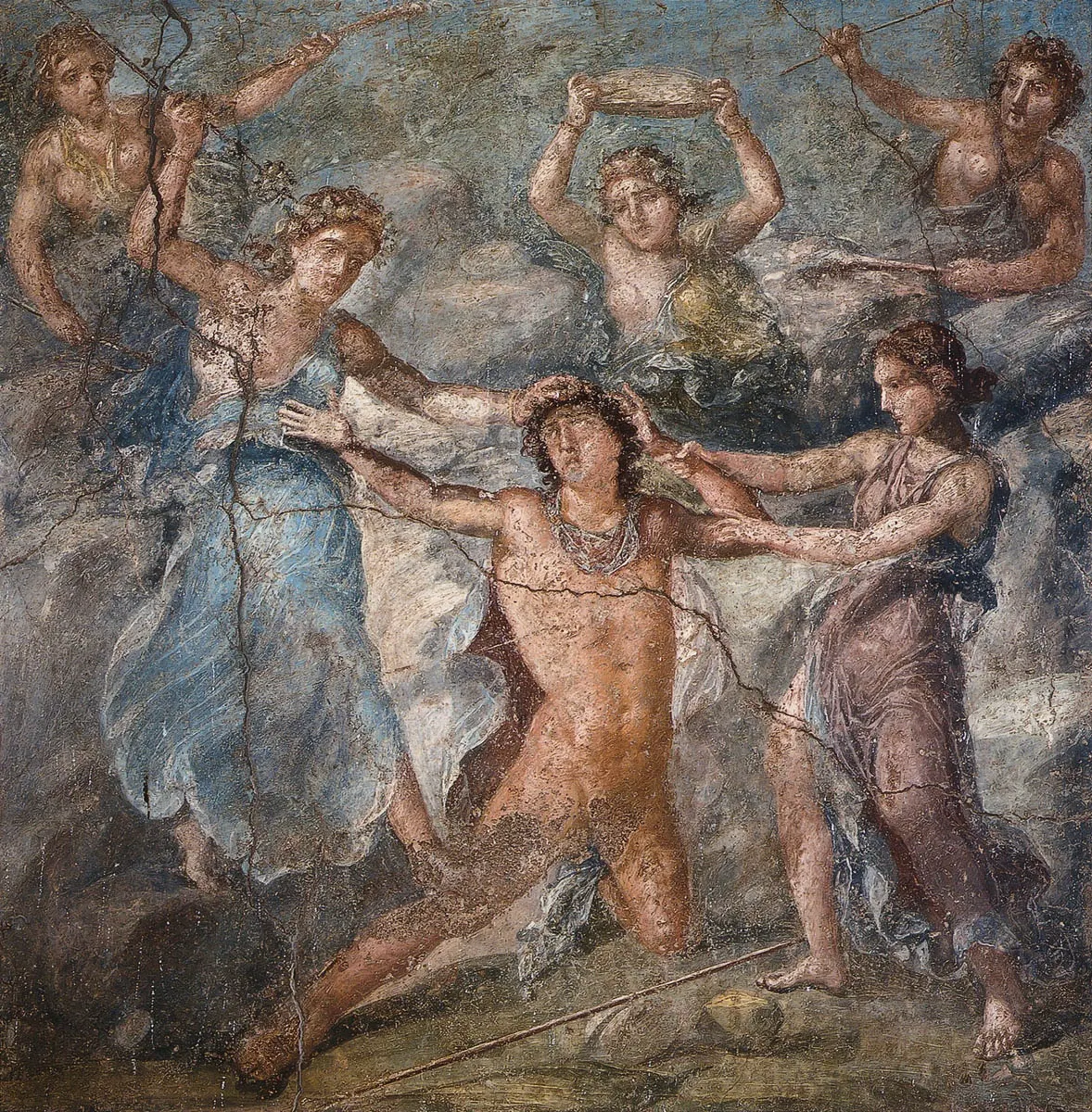
What Huxley saw in these portraits, and subsequently in himself, was a peculiar revelation: From the moment we conceived civilized consciousness, there existed an impulsive need to rid ourselves of our own nakedness — a need to dress ourselves. It may be because of the self-staging nature of our species that developed the moment we decided to remove ourselves from the constraints of nature, and evolve into a civilization made in the image of artifice — who knows? But Aldous Huxley, while looking at Botticelli’s portraits under the influence of mescaline, realized that the representation of a civilized man is woven in the clothes that he wears. He noted:
“Civilized human beings wear clothes, therefore, there can be no portraiture, no mythological or historical storytelling without the representation of folded textiles.” In other words, at the foundation of our civilization — at the foundation of our awareness as people, exists the Textile; a carefully crafted garment embroidered with intricate threads of being.
It’s generally understood that the truth, the real truth, is naked. It may be an idea that stems from the Platonic school of thought, or it may also allude to the ancient Egyptian story in which Truth and Falsehood go bathing. Falsehood, who covetted his brother Truth, dressed himself as him. While Truth, refusing to take on someone else’s clothes, goes into the waters naked. Since then we’ve learned that the Truth bears nothing but itself. With no concealments or embellishments, the truth is naked. It’s probably that very belief that leads most philosophers to disregard any serious inquiry regarding Fashion for it simply deals with the material appearances of the self, while philosophy aspires to reveal the true self underneath the raiments of conduct. But there was something about taking mind altering psychedelics and admiring the folds in Botticelli’s portraits, that allowed Huxley to see things with a new sense of intellect and curiosity. He wondered if perhaps there may be an element of our true self that, rather than being naked, is completely clothed? Huxley wrote, “Draperies are living hieroglyphs that stand in some peculiarly expressive way for the unfathomable mystery of pure being.” This mystery within the folds of these garments were charged with what Huxley called, is-ness; a completely undefinable fabric of being. “Perhaps, because the forms of folded drapery are so strange and dramatic that they catch the eye and in this way force the miraculous fact of sheer existence upon the attention? Who knows?” He wrote, “What is important is less the reason for the experience than the experience itself.” All of infinity was revealed to Huxley within the banality of ordinary things. “This is how one ought to see”, he kept repeating to himself, “This is how one ought to see.” The truth may be naked, but what we call Truth is also a kind of mythology. And for us to fully incarnate that mythology, one must take on the mantle of this so-called truth, drape it around ourselves completely, and give it form.

In the 1997 short film titled, “Trans”, a man named Henry contemplates the constrictive definitions of gender and sexual politics, while culminating his extols and frustrations about his own gender identity, through the exhilarating act of wearing a suit. Seated in a grand wingback chair wearing a brown wool jacket and khaki trousers, he confesses that he does not always dress that way, but when he does, it is in order to navigate more comfortably in a world made hostile for people like him. One doesn’t know the power of a suit until they’ve put it on. Because to be dressed in a suit — with its structure and ease — was to draw out the most authentic version of himself. With the constriction of a starched collared shirt buttoned up to his clavicle, and a silk tie coiled firmly around his neck — a suit is, by design, an architecture of restriction. But for Henry, it offered him a euphoric mode of liberation. For the wearing of a suit denotes an intriguing affair for a man. Akin to a rite of passage, it marks the becoming of a boy into a self-realized man. The heightened shoulders and canvased interior imposes a new shape onto the male form, suggesting a new posture, a new way of navigating through space. It restricts the flow of certain movements and allows the rhythm of new ones. For a western man, the pinnacle of a dignified masculine sensibility lies within the wearing of a fine tailored suit. For it designates the memory of his virility cut and sewn into every panel of cloth. To wear a suit is to take part in a long tradition of the masculine ideal. Which for Henry and countless men like and unlike him, provides an unspeakable sense of belonging. The truth is, the design of a suit encourages a certain kind of uniformity. The structure of its banility and sophisticated homogeneity, lends men, specifically transgender men, the opportunity for euphoric normalcy— to melt into the sea of unvarying masculinity and to become just another man; Completely and utterly like the rest.
There’s a slight gesture of self realization in the act of dressing. To phrase Descartes: “We think, therefore we are”. Therefore (I add) we dress ourselves accordingly. The truth is we were born human, shackled in skin, cursed to endure our nakedness. But our species is also one of imagination, and with creativity as our salvation, we learned to design our way out of the wilderness. It was through the invention of the textile that we ceased to be animals, and somehow became human. our clothes dress the stage of our lives and allows us to play the part of ourselves we cannot be without. It must be true that the ways in which we adorn our body inform the very consciousness that allows us to exist. Wasn’t it the fig leaf that remedied the shame that led us out of Eden and into the knowledge of our mortality? Whether it’s for better or for worse, a clothed body is a body made aware of itself. It’s a body made aware of its place in this world— aware of its nakedness, its lack, its shame— but even more, its potential for beauty. Could it be that the pursuit of Fashion is in quest of the humanity we seek in ourselves? It may be that the wearing of clothes, the concealment, the embellishment, and veneration of the body, work in order to give value to the sheer act of existence. I also wonder if the desire to make something beautiful out of ourselves exists in order to give history a picture to remember us by? Aldous Huxley noted that in most historical or religious portraits, what is strictly human accounts for around ten percent of the whole; the rest is rendered in visceral images of textiles. Throughout time we’ve consistently asked of our fashions to immortalize us in the image of our ideals. Using dress as articles of moral and material splendor, they bear the task of materializing the immaterial. Our fashions are mediators between the world of picturesque beauty and what is merely human. But it might also be that Fashion, at its best, is merely a representation; an inanimate hieroglyph that our bodies then, fashion into moving metaphors that run like language and draw out the purest, otherwise indescribable, expression of our being.