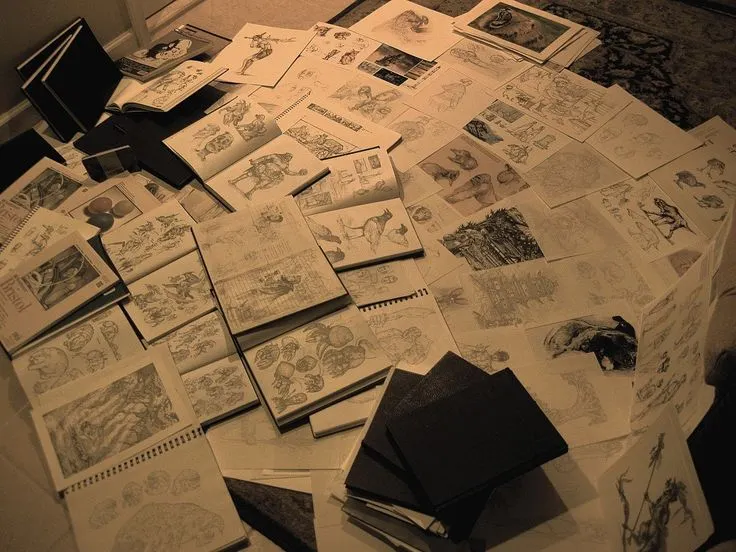
7 Benefits of Starting a Daily Sketching Habit
The sketchbook effect in your life

Many people view sketching as a skill reserved exclusively for “artists” that born with a rare, natural talent for capturing reality on paper. However, this narrow perspective overlooks the most valuable part of the creative practice. Sketching is not merely about the final image that lies in your sketchbook; it is about the deep impact the process has on your brain, your mood, and your overall perspective on the world.
Whether you are an aspiring professional or someone who has not picked up a pencil since grade school, the act of drawing offers plentiful of psychological and physical rewards. Here are seven life-changing benefits of making sketching a daily habit.
1. Achieving “Flow” and Mental Clarity
In our modern, high-speed digital world, our brains are constantly bombarded with notifications, emails, and competing distractions. Sketching requires a specific type of deep focus that that psychologist often refers to as “flow.” This is a state where you become so immersed in a task that time seems to disappear.
When you are deeply engaged in analyzing the curves of a leaf or the complex proportions of a city building, the buzz of your daily to-do list begins to fade away. This state of flow acts as a powerful form of active meditation. Unlike passive relaxation, such as watching television, sketching provides a sense of calm and mental clarity that actively refreshes the mind and reduces cortisol levels.
2. Sharpening Your Powers of Observation
Most of us navigate our daily lives on autopilot, seeing only enough of our surroundings to get from one point to another safely. When you commit to drawing, you are forced to actually look. You begin to notice things you previously overlooked: the way light hits a glass of water, the intricate patterns in old brickwork, or how a person’s posture changes when they are tired.
A daily habit transforms you into a professional observer. You start to see the world in high definition. This improved awareness makes the world feel much more vivid and interesting, turning even a mundane commute into an opportunity for visual discovery.
3. Strengthening Fine Motor Skills
Sketching is a physical discipline as much as a creative one. The delicate coordination required to transition from a bold, dark line to a faint, wispy shadow builds significant manual dexterity. Over time, this strengthens the neurological connection between your brain and your hand.
Get Art of C’s stories in your inbox
Join Medium for free to get updates from this writer.
Beyond just "hand-eye coordination," engaging in new creative tasks promotes neuroplasticity, the brain's ability to form new neural connections. For adults, this is a vital way to keep the mind sharp. The precision you gain in your sketchbook often spills over into other areas of life, improving your control and focus in various manual crafts or technical tasks.
4. Creating a Personalized Visual Diary
While a smartphone photo captures a split second with the press of a button, a sketch captures an entire experience. When you sit for fifteen minutes to draw a park bench, a cafe interior, or a sleeping pet, you are soaking in the sounds, smells, and atmosphere of that specific moment.
The time spent observing and processing a subject ties that memory into your mind with incredible intensity. Years later, looking back at a sketch will trigger a much deeper and more emotional memory of that day than a digital photo ever could. Your sketchbook becomes a museum of your life's observations.
5. Building Resilience Through Low-Stakes Failure
Every artist, no matter how experienced, has bad drawing days. Sometimes the proportions are skewed, the perspective is warped, or the shading looks muddy and overworked. In the private pages of a sketchbook, these mistakes are not disasters; they are valuable data.
Learning to turn the page and start a new drawing after a perceived failure builds an essential growth mindset. It teaches you that mistakes are a necessary, non-negotiable part of progress. This resilience which is the ability to face a challenge, fail, and try again is a life lesson that applies to your career and personal relationships just as much as your art.
6. Enhancing Creative Problem-Solving
Drawing is essentially a series of visual puzzles that require constant internal dialogue. You must ask yourself: How do I represent a three-dimensional object on a flat piece of paper? How do I show that one object is further away than another without using color? By constantly calculating angles, light logic, and composition, you are exercising your brain’s spatial reasoning and analytical skills. This type of creative problem-solving helps keep your mind flexible. It trains you to look at problems from multiple angles and find effective solutions, a skill that is highly adaptable to any professional field.
7. Developing Lasting Creative Confidence
There is a unique and deeper sense of empowerment that comes from seeing a blank white page transform into something structured and meaningful through your own effort. As your messy initial sketches slowly start to resemble your subjects, your confidence begins to grow.
This creative courage is contagious. Once you realize that you can learn a difficult skill like drawing through persistence, you begin to wonder what else you are capable of. This often gives people the boldness to tackle new hobbies, languages, or professional projects with a renewed "can-do" attitude.
You do not need an hour of uninterrupted free time or a professional-grade studio to reap these rewards. The magic of a daily sketching habit lies in its consistency rather than its length. Even ten minutes of doodling during a lunch break or sketching your morning coffee cup can shift your mindset for the rest of the day.
Grab a pencil, find a blank page, and give yourself permission to draw poorly. The goal isn’t a masterpiece; the goal is a better version of yourself. The benefits are waiting for you, one line at a time.