Cadillac Restoration: Things to Consider

Written by: Hank Miller
Cadillac. America’s premier luxury automobile, and although it was their own marketing slogan, it was truly the Standard of the World, and for many, a sign that you’ve made it.

Glamorized by celebrities and immortalized in film and music, the brand not only made an indelible mark on automotive history but popular culture as well.
I love you for your pink Cadillac
Crushed velvet seats
Riding in the back
Cruising down the street
Waving to the girls
Feeling out of sight
Spending all my money
On a Saturday night
- Pink Cadillac, by Bruce Springsteen
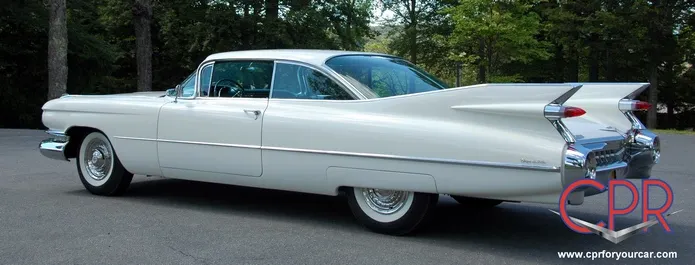
It’s that allure that drives the popularity of classic Cadillacs. You won’t see many at car shows but when one is present, particularly the big tail fin models, they inevitably draw a crowd.
For those who desire to take that admiration to the next level and want to purchase a decades-old Cadillac (or any classic for that matter), there are many considerations. We cannot discuss all but most important is the understanding and acceptance that Cadillac restoration is not for the faint of heart and depending upon condition, a forty, fifty or eighty year-old car can require a significant investment beyond the purchase price.
Whether you’re seeking something fun to cruise around town in, or a show car that will compete at the highest levels, there are some important items to consider.
Those desiring a ready-to-roll example would be advised to seek out either a -well maintained, unrestored car or one that has already undergone a properly-performed restoration. Generally speaking, coupes and convertibles are most desirable and command a higher price than sedans, which were typically produced in higher numbers.
The sheer size of a Cadillac alone can add many labor hours and expensive materials to body and paint work and the low-production numbers of more collectible models (of which only a fraction remain today) will make some parts much more difficult and costly to obtain.
Whether original or restored, descriptions of condition are subjective and should not be trusted. Paramount of importance is to perform a detailed inspection (on a lift) and lengthy road test. If you do not possess the expertise to do so yourself, it would be wise to engage the services of someone who does.
A valuable resource would be your local chapter of the Cadillac & LaSalle Club (CLC). Each will have knowledgeable members willing to share their expertise. You can also engage the services of an expert in classic Cadillac restoration whose direct experience will be well worth the initial investment.
Get Cadillac Restoration’s stories in your inbox
Join Medium for free to get updates from this writer.
The odometer of a 1955 Cadillac may have been turned over numerous times and that “cherry, original 62,000 mile car” may actually have 162,000 miles on it. Rust is another issue. Some surface rust is not a major issue that doesn’t need to be addressed immediately unless desired but various years and models have known trouble spots that may require extensive and expensive fabrication and body work. While it is difficult to spot every possible/potential issue, an experienced eye can help to identify them before you buy.

Previous body work, engine and transmission performance, mechanical operation, interior and authenticity are all critical areas to understand in order to make an informed purchase decision.
For those seeking a weekend “driver” and who do not possess the required skills, a mechanic experienced with old cars is very important in order to avoid frustration due to likely mechanical issues. Common issues like rear main engine seals can be notoriously tricky to repair on some models and in today’s era of fuel injection it can be difficult to find a competent carburetor re-builder.
With some research and a comprehensive assessment you can eliminate a lot of headaches and rest assured that your “turn key” new purchase will be worth its price.
Those looking to buy a classic Cadillac to restore to show condition face a more extensive list of considerations that mostly involve the expense of restoration work. If you have the Cadillac-specific knowledge, skill, time and space you’re already ahead of the game and some of the above-mentioned items are of less importance. However, most people don’t and will require the services of restorer experienced with the brand.
Extensive restoration, particularly for a show car, is a lengthy process that can take a year, or longer, depending upon the condition of the car as it arrived at the restorer. As for cost, expect to spend into the six-figures and the price can vary depending, of course, upon condition.
Hundreds of hours can be spent on body and paint work alone with expensive, high-end materials adding to those costs. Correct interior work (upholstery, dash, trim, etc.) may cost upwards of $20,000. The horn ring of the iconic 1959 Cadillac is notorious for cracking and the cost just for this part alone will set you back a thousand dollars or more.
Other difficult-to-find parts will only escalate the cost which makes it wise to purchase a car as complete and authentic as possible. A rear quarter-panel trim molding for a 1960 Coupe de Ville is a good example. A new-old-stock (NOS) example is virtually impossible to find and many hours can be spent on the search alone. That part, in used condition, can also cost upwards of one thousand dollars and you can expect to spend that same amount to have it restored to show condition.
There are many other rare and expensive parts that we can discuss but, by now, readers should have a clearer understanding of how rarity drives up the cost of restoration.
Restoration horror stories abound in the classic car community. Far too many vehicle owners have wasted thousands of dollars by sending their car to a disreputable shop where no to little or sub-standard work was performed only to send it to a well-regarded shop to start from scratch and re-do previous shoddy work already paid for.
Hopefully, it’s pretty well understood that research is the most important task for anyone considering diving into the deep-end of the pool that is classic car restoration. Taking the time to understand value, condition, process and market as well as seeking the right restorer, known for quality and authenticity, will not only assist in better budgeting but also a more enjoyable process.
Cadillac Parts & Restoration (CPR) is a world-renowned restorer whose team has specialized in classic Cadillacs since 1984. Their completed projects are among the world’s finest examples of restored Cadillacs and many have earned award-recognition at prestigious CLC, AACA and concours-level events. Regular customers include those up and down the East Coast who send their prized classics only to CPR for maintenance and repair.
Located in Poughkeepsie, NY, their restoration facility is easily reached by road or rail and convenient to those from New England (and points north) as well as those from the New York City area (and points south).
CPR can be reached by phone at (845) 462–5959 and interested parties can view their website at www.cprforyourcar.com.