Trust Used to Be a Process. The Sandbox Made It a Property

The deepest change mini-app containers bring isn’t technical. It’s that trust between software parties stops being negotiated and starts being enforced.
For most of software’s history, letting someone else’s code run inside your system was an act of faith, managed the way humans have always managed faith: with process. You reviewed the vendor. You audited the code, or paid someone to. You negotiated a contract with liability clauses. You checked references, monitored behaviour, and retained the right to terminate. Trust was built through diligence, documented in agreements, and enforced — when it failed — through lawyers.
This machinery worked, more or less, when integrations were few and slow. An enterprise adopting a payment SDK could afford a three-month security review, because it adopted perhaps five SDKs a year. But the machinery has a structural ceiling: it scales with human attention. Every new party requires new diligence. Every version update potentially re-opens the review. The trust process is serial, expensive, and — as the last decade demonstrated — porous. SolarWinds passed every procurement review of the 18,000 organisations it compromised. Log4j sat inside millions of applications whose owners had never consciously trusted it at all, because it arrived as a dependency of a dependency. Process-based trust failed not because the processes were lazy, but because the volume and depth of third-party code exceeded what any process built on human review could cover.
The significance of the sandbox — and the reason it sits at the core of the mini-app container rather than at its periphery — is that it replaces this entire machinery with something categorically different. Trust stops being a process the organisation performs and becomes a property the architecture possesses.

What “property” means here, concretely
The distinction sounds philosophical; it is intensely practical. Consider what a mini-app container actually enforces, and at what layer.
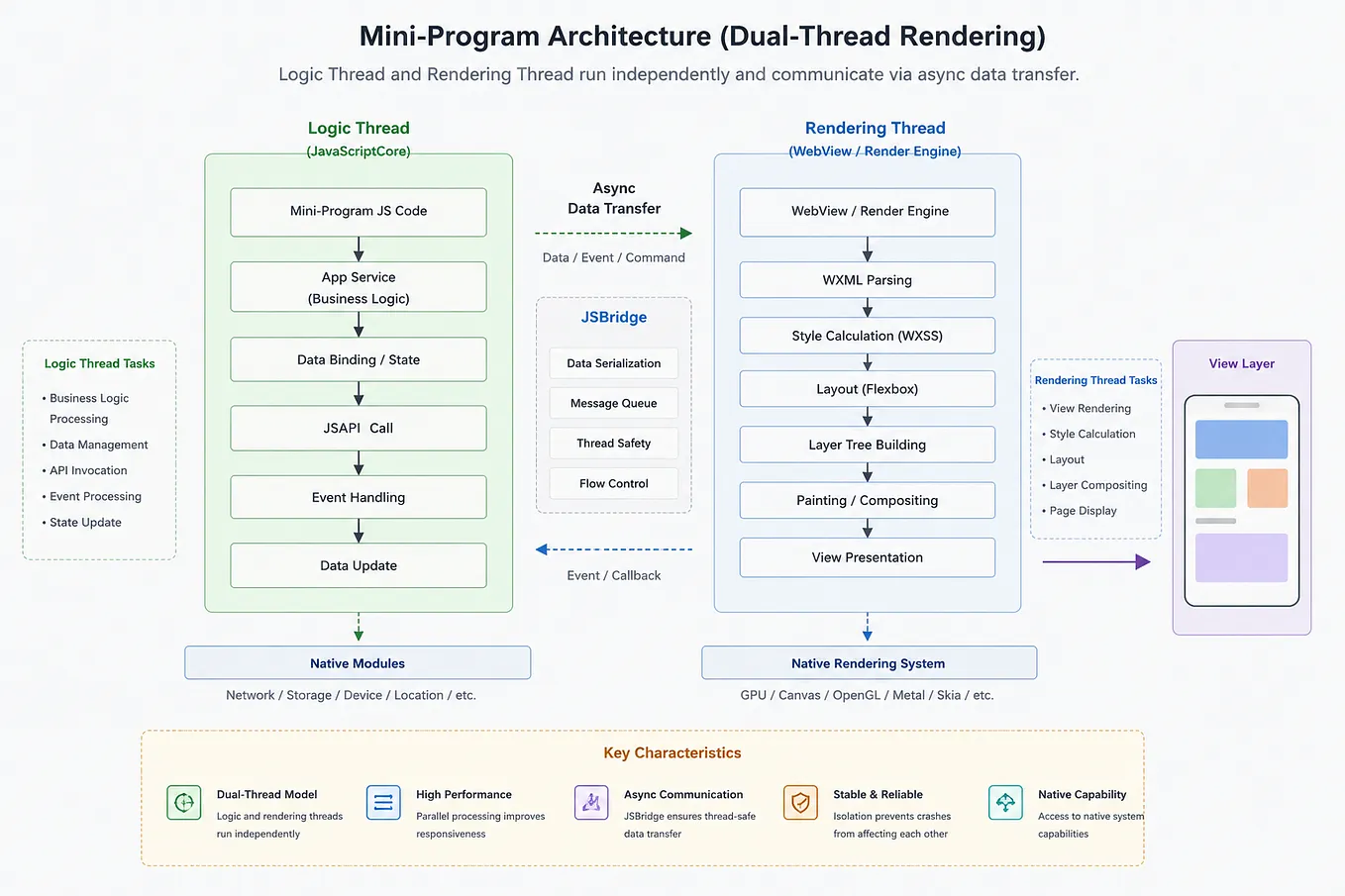
Each mini-app executes inside its own JavaScript engine instance — process-level isolation, not a shared runtime with rules. The architecture is dual-threaded by design: a rendering layer that can paint the interface but cannot touch the file system, call native APIs, or reach arbitrary memory; a logic layer that can compute but cannot touch the DOM. Between the mini-app and anything that matters — user data, device capabilities, network destinations, payment rails — stands a capability gateway that grants access by explicit whitelist, per app, per role, default-deny. Storage is namespaced and encrypted per mini-app, with no cross-app visibility. Packages are signature-verified and statically analysed before a single instruction executes. Runtime behaviour is monitored, anomalies flagged, violating processes terminated automatically. And everything a mini-app ever touched can be wiped in one action, without residue.
Now re-ask the trust question against this architecture. Can this partner’s code read our customer data? Under process-based trust, the answer is an assessment: “we reviewed their practices and believe not.” Under the sandbox, the answer is a fact: “there is no code path by which it could.” What happens if their next update misbehaves? Process answer: “our contract provides remedies.” Architecture answer: “it can damage only itself, and we can terminate and erase it in seconds.” The questions stop being about the counterparty’s character and start being about the system’s construction — and construction, unlike character, can be inspected, tested, and certified once for all parties.
Get FinClip’s stories in your inbox
Join Medium for free to get updates from this writer.
This is the shift worth naming precisely: the sandbox converts trust from an O(n) problem — diligence per partner, forever — into an O(1) problem: harden the architecture once, and every subsequent party inherits the same enforced boundaries at zero marginal diligence cost.
Why the ecosystem is downstream of this conversion
Every business capability that makes mini-app platforms attractive is, on inspection, an application of this conversion.
An open ecosystem — dozens, then hundreds of internal teams and external partners publishing into one app — is economically impossible under process-based trust; the diligence alone would consume the value. It becomes routine under architectural trust, because onboarding a partner no longer means learning to trust them; it means configuring their capability grants. Release velocity — shipping weekly without whole-app regression — is not courage; it is the rational consequence of a blast radius capped at one module. Cross-surface deployment onto kiosks and shared terminals is tolerable only because per-app encrypted namespaces and instant cleanup make a public device defensible. Even the hot-update mechanism, the feature businesses cite first, is safe precisely because whatever arrives over the wire lands inside the same verified, gated, monitored cell as everything else.
Remove the sandbox and each of these reverts to a negotiation. Keep it, and they are simply settings.
Why finance is the credential, not just a customer
There is a reason mature container platforms describe their sandboxing as financial-grade, and it is worth taking literally rather than as positioning. Banking and securities are where process-based trust was always most expensive — regulators demand demonstrable isolation, auditable permissions, encrypted storage, data-sovereignty options, and the ability to reconstruct any action after the fact. These are, precisely, demands that trust be a property rather than a promise. A sandbox architecture that has cleared security review at dozens of financial institutions — as FinClip’s has across more than forty securities firms and banks, with per-app engine isolation, API whitelists configurable down to developer role, RBAC-governed operations, full audit export, and private deployment for jurisdictions that require it — has effectively been certified by the most sceptical process-based trust apparatus in the economy. Every other industry that adopts it inherits that certification. Finance, having paid the highest diligence costs under the old model, ends up subsidising the trust architecture of the new one.
The general pattern
Step back far enough and the sandbox story is an instance of a recurring pattern in computing: expensive human processes get absorbed into architecture, and whole categories of activity become feasible that the process era couldn’t afford. Memory safety moved from code-review discipline into language design. Transaction integrity moved from operator carefulness into database engines. Access control moved from policy binders into identity systems. In each case, the volume of activity the old human process could support was dwarfed by what the architectural version enabled — not because humans got better, but because the property didn’t need them per-instance.
Third-party code is undergoing the same absorption now, under pressure from a supply-chain threat environment that has made the old faith untenable. The mini-app sandbox is what that absorption looks like at the application layer: trust, once a quarterly review and a signature page, compiled down into engine instances, capability gates, and encrypted namespaces — verified continuously, for every module, at a marginal cost of approximately nothing.
That is why the sandbox is the core of the container and not a feature of it. The container’s product, in the end, is not runtime or tooling. It is trust at ecosystem scale — and the sandbox is the machine that manufactures it.
We write about super app architecture, container security, and the trust infrastructure behind open ecosystems — at https://super-apps.ai/