Lumera and the Hidden Problem Nobody Wants to Fix

Every system looks fair — until you look at who actually takes the risk.
In Web3, we talk a lot about decentralization, transparency, and trustless systems. But there’s one uncomfortable truth most people ignore:
Not everyone is equally accountable.
And that’s where Lumera becomes interesting.
⚠️ The Invisible Flaw in Collaboration
Let’s start with something simple.
Imagine this:
- A developer ships code
- A reviewer approves it
- The system goes live
- Something breaks
Who pays the price?
Almost always — the builder.
The reviewer? Moves on.
The system? Keeps running.
The damage? Already done.
This is what we call an asymmetric incentive structure.
And it’s everywhere:
- Open-source projects
- DAOs
- Content platforms
- Even AI moderation systems
Lumera’s Different Approach
Lumera doesn’t try to “fix culture.”
It fixes incentives.
Instead of asking people to be more responsible, it designs a system where:
Being responsible is the most profitable move.
That’s a big difference.
A System Where Everyone Has Skin in the Game
In Lumera:
- Contributors don’t just submit work
- Reviewers don’t just approve
- Validators don’t just signal
Everyone participates with risk.
This changes behavior instantly.
Because now:
- Approving bad work costs you
- Ignoring details costs you
- Rushing decisions costs you
And suddenly, quality isn’t optional anymore.
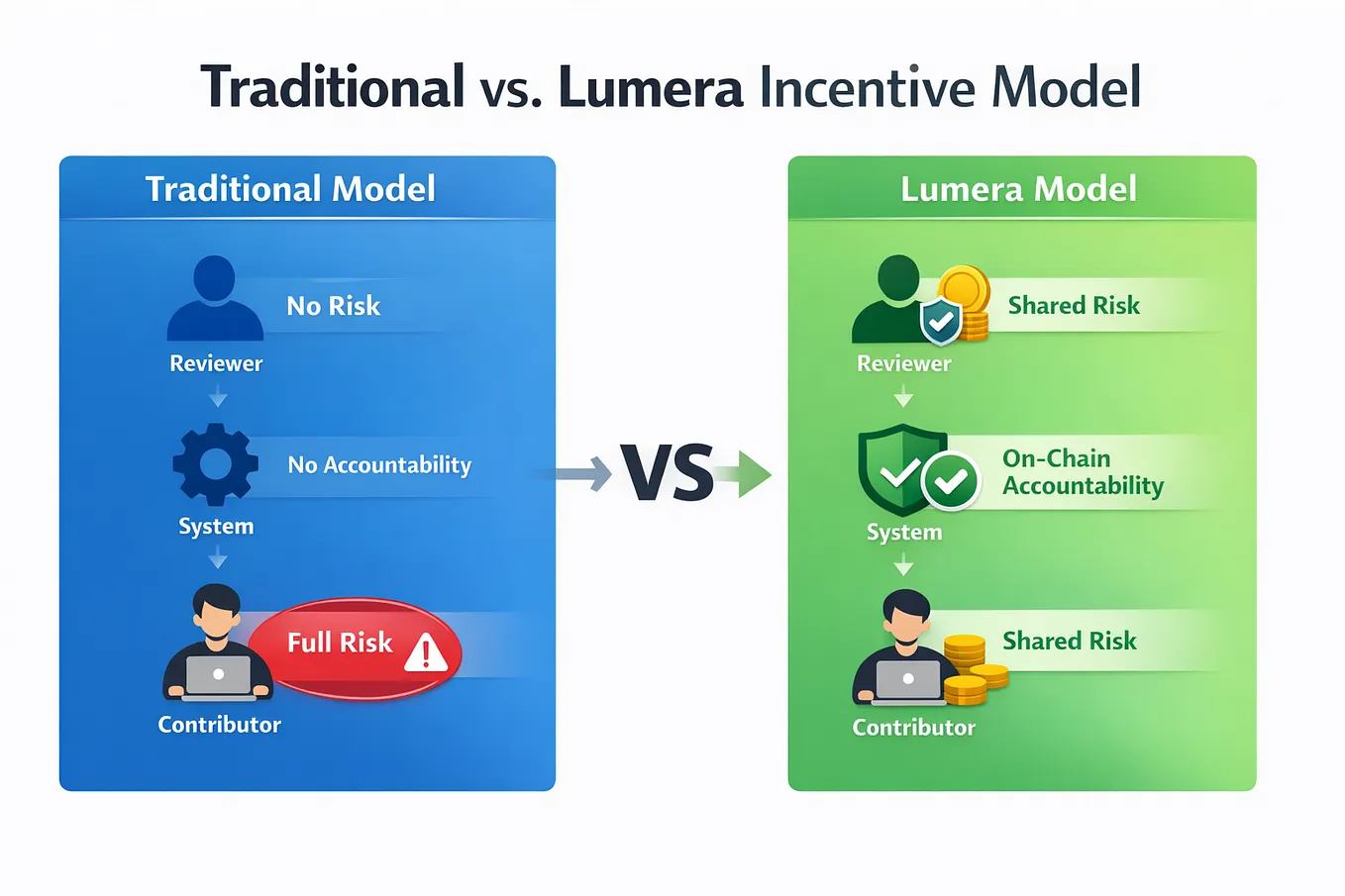
“Before vs After Lumera”
Before:
- Contributor → Risk
- Reviewer → No risk
After:
- Contributor → Shared risk
- Reviewer → Shared risk
- System → Balanced outcome
From Trust-Based to Incentive-Based Systems
Most platforms today run on assumptions:
- “People will review carefully”
- “Validators will act honestly”
- “Users will behave rationally”
Reality? Not really.
Lumera removes the need for assumptions.
Get Gomadt’s stories in your inbox
Join Medium for free to get updates from this writer.
Instead, it builds a system where:
- Good decisions are rewarded
- Bad decisions are penalized
- Neutral behavior doesn’t survive
This creates a natural filter for high-quality participants.
⚙️ How Lumera Actually Works (Simplified)
Think of it like this:
- Someone submits work
- Others review it (with stake)
- Outcome is measured
- Rewards or penalties are distributed
That’s it.
Simple structure.
Powerful effect.
“Lumera Workflow”
Submission → Review (Stake) → Validation → Outcome → Reward/Penalty
Why This Matters More Than You Think
We’re entering a new phase of the internet:
- AI generates content faster than humans
- DAOs make decisions without hierarchy
- Remote collaboration becomes default
But here’s the problem:
Speed is increasing. Accountability isn’t.
That gap is dangerous.
Without proper incentives:
- Low-quality output scales faster
- Bad decisions compound
- Trust erodes quietly
Lumera directly targets this gap.
Incentives Are the Real Infrastructure
People often think:
“Blockchain is the foundation of Web3.”
Not quite.
Blockchain is just a tool.
Incentives are the real foundation.
Because at the end of the day:
- Systems don’t fail because of code
- They fail because of human behavior
Lumera understands this deeply.
“Incentive vs Outcome Curve”
X-axis: Incentive alignment
Y-axis: System quality
Show upward curve → better incentives = better outcomes
Trust, But Engineered
What makes Lumera powerful is this:
It doesn’t rely on trust.
It engineers trust through consequences.
That’s a subtle but important shift.
Because now:
- You don’t need to “hope” reviewers care
- You don’t need to “trust” validators
The system ensures they do.
Where This Could Go
If Lumera executes well, it won’t just be another Web3 project.
It could become:
- A layer for DAO governance
- A standard for open-source validation
- A framework for AI-human collaboration
And maybe even:
- A backbone for future digital economies
✨ Final Thought
Most systems try to fix people.
Lumera fixes the rules people play by.
And when the rules are right, behavior follows naturally.
That’s the real innovation.
🏁 Closing
If you’re paying attention to where Web3 is heading, don’t just look at new chains or faster transactions.
Look at how incentives are evolving.
Because the future won’t be built by the smartest people alone —
It will be built by systems that make smart behavior inevitable.