Ordered Disorder and Peripheral Pressure Transfer

Why China Cannot Afford to Ignore the Geopolitical Stabilizing Role of Iran

The strategic landscape of the twenty-first century is increasingly shaped not by direct great-power confrontation, but by indirect pressure mechanisms operating across peripheral regions, economic corridors, technological ecosystems, and maritime chokepoints. Unlike the Cold War era — where confrontation between superpowers often followed rigid ideological and military lines — contemporary geopolitical competition relies on gradual strategic exhaustion through distributed instability, economic fragmentation, hybrid pressure, and selective containment.
Within this framework, a new strategic logic appears to be emerging in American grand strategy: a doctrine that may be described as “Ordered Disorder.” This concept does not necessarily imply uncontrolled chaos, nor does it require overt military confrontation. Rather, it reflects the calibrated management of instability across strategically sensitive regions in ways that preserve American primacy while slowing the consolidation of rival Eurasian powers.
In this evolving geopolitical environment, China has become the principal long-term competitor to the United States. However, unlike the Soviet Union, China cannot be contained through purely military means. Beijing’s industrial capacity, technological integration, financial influence, and role within global supply chains make direct confrontation extraordinarily risky for all sides. As a result, strategic competition has gradually shifted toward indirect methods: technological decoupling, maritime encirclement, sanctions architectures, alliance restructuring, cyber competition, and pressure on strategic corridors surrounding China’s geopolitical periphery.
The 2022 U.S. National Security Strategy identifies China as “the only competitor with both the intent to reshape the international order and, increasingly, the economic, diplomatic, military, and technological power to do it.” Simultaneously, the emergence of strategic frameworks such as AUKUS, the Indo-Pacific Strategy, advanced semiconductor restrictions, and maritime balancing initiatives collectively suggest a long-term architecture of distributed containment rather than direct confrontation.
Yet one critical dimension of this emerging strategic environment remains underexamined: the transferability of geopolitical pressure.
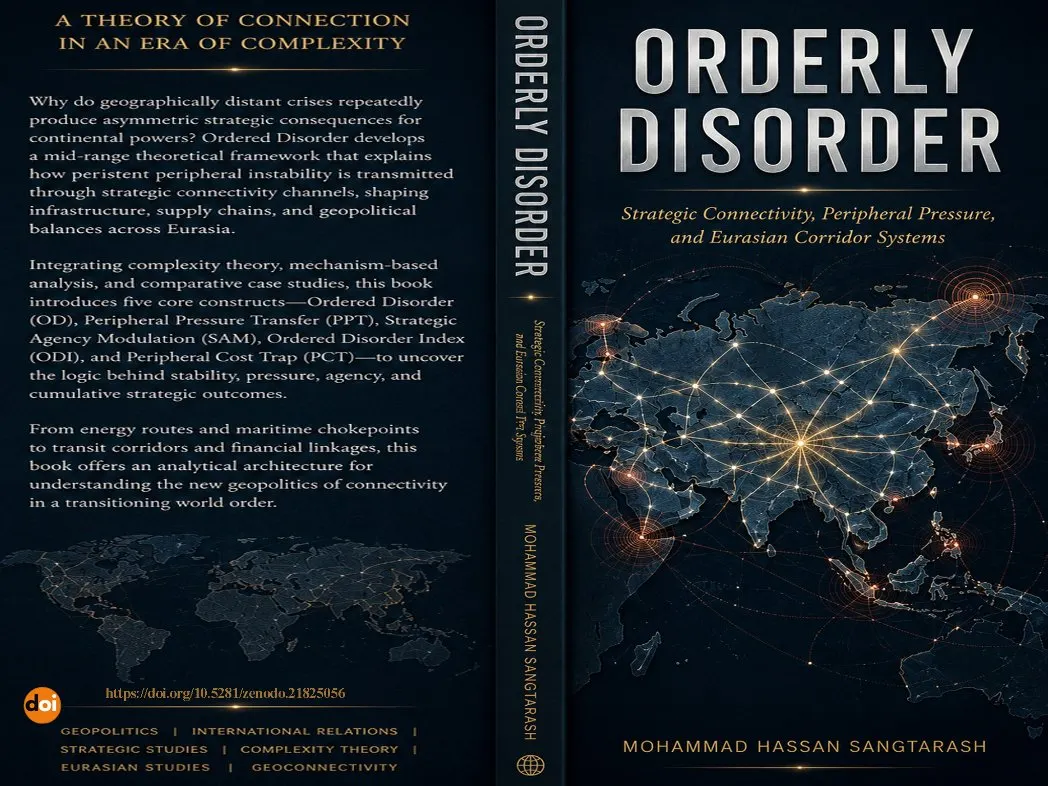
This paper argues that instability introduced and normalized in one strategic theater can gradually migrate toward adjacent geopolitical systems through a process that may be termed Peripheral Pressure Transfer (PPT). Under this logic, pressure initially concentrated in regions such as Eastern Europe or the Middle East does not remain geographically isolated. Instead, it progressively moves across trade corridors, energy routes, maritime chokepoints, technological networks, and political fault lines until it approaches the strategic core of rival powers.
This mechanism forms the operational foundation of what may be described as the Domino Logic of Managed Disorder.
The Domino Logic of Managed Disorder
Historically, major powers rarely collapse through sudden military defeat alone. Strategic exhaustion usually emerges incrementally through the accumulation of peripheral crises. The Soviet Union, for example, was not destroyed in a single confrontation; rather, it experienced prolonged erosion through Afghanistan, economic stagnation, technological competition, sanctions pressure, proxy conflicts, and internal fragmentation pressures that intensified over time.
A similar — though not identical — logic may now characterize long-term competition with China.
The current objective of American strategy does not appear to be immediate Chinese fragmentation. Such a scenario would generate catastrophic global economic consequences and remains highly improbable in the near term. Rather, the observable pattern suggests a slower strategy aimed at disrupting the structural conditions necessary for China’s uninterrupted rise.
This process can be conceptualized in five sequential layers:
- Peripheral instability creation in strategically sensitive regions;
- Disruption of energy and connectivity corridors;
- Technological and financial decoupling;
- Pressure on identity and governance fault lines;
- Gradual transfer of strategic pressure toward the geopolitical core.

Under this framework, Ukraine, the Eastern Mediterranean, the Persian Gulf, Taiwan, the South China Sea, and Central Asia should not necessarily be viewed as isolated crises. Rather, they increasingly resemble interconnected theaters within a larger architecture of competitive pressure distribution.
This interpretation does not require the assumption of a centralized conspiracy or a singular operational blueprint. Great-power systems often generate strategic patterns organically through institutional convergence, alliance behavior, and overlapping geopolitical incentives. Nevertheless, the cumulative effect can still resemble a coordinated pressure ecosystem.
Chokepoints and the Strategic Vulnerability of China
China’s greatest long-term vulnerability may not lie primarily in military inferiority, but in strategic dependence on vulnerable external systems.
Despite Beijing’s enormous industrial power, Chinese trade and energy flows remain highly exposed to maritime chokepoints — particularly the Strait of Malacca and broader Indo-Pacific sea lanes. A substantial portion of China’s imported energy passes through routes that could become vulnerable during periods of geopolitical escalation.
Get Mohammad Hassan Sangtarash’s stories in your inbox
Join Medium for free to get updates from this writer.
This reality explains why Beijing has invested heavily in continental connectivity projects under the Belt and Road Initiative (BRI), as well as diversified infrastructure corridors linking East Asia to Central Asia, the Middle East, and Europe.
Within this wider Eurasian geography, Iran occupies a uniquely important position.
Iran connects the Persian Gulf, the Caspian Basin, Central Asia, the Caucasus, and the Indian Ocean simultaneously. It also constitutes one of the few geopolitical corridors capable of partially reducing China’s overdependence on vulnerable maritime supply routes. In this sense, Iran functions not as a traditional military ally of China, but as a strategic redundancy corridor and geopolitical stabilizing buffer.
This distinction is essential. Beijing’s relationship with Tehran is driven less by ideology than by long-term geoeconomic logic. China historically avoids rigid alliance systems and generally prefers strategic flexibility. However, flexibility should not be confused with dispensability.
Peripheral Pressure Transfer and the Iranian Buffer
The central argument of this paper is that geopolitical pressure tolerated in Iran today may gradually reappear tomorrow along China’s own strategic periphery.
If instability becomes normalized across West Asia, the effects are unlikely to remain confined to the Middle East. Energy insecurity, corridor fragmentation, maritime militarization, sanctions escalation, cyber competition, and proxy conflicts possess strong transfer effects across Eurasian systems.
In practical terms, destabilization pressure can migrate:
- From the Persian Gulf toward the Indian Ocean;
- From maritime insecurity toward supply-chain fragmentation;
- From sanctions regimes toward technological isolation;
- And from peripheral conflicts toward domestic economic stress inside major powers.
This is the essence of Peripheral Pressure Transfer. Under such conditions, Iran effectively functions as a western geopolitical shock absorber for Eurasian stability. Strategic pressure absorbed in the Iranian theater may delay or reduce direct pressure migration toward China’s own vulnerable corridors.
The Scenario of Strategic Distancing: If China Abandons Iran
A critical policy scenario deserves serious examination: what would occur if China significantly reduced strategic engagement with Iran in exchange for temporary accommodation with Washington?
At first glance, such a move could appear rational. China seeks economic stability, export continuity, technological access, and avoidance of premature confrontation with the United States. Reducing exposure to Middle Eastern tensions may therefore seem tactically attractive. However, the long-term consequences could prove strategically damaging.
- Increased Vulnerability: Weakening Iran would likely increase the vulnerability of Eurasian land corridors central to long-term Chinese connectivity diversification.
- Deepened Dependence: Maritime dependence would deepen further, reinforcing American leverage across Indo-Pacific chokepoints.
- Pressure Migration: Pressure could gradually migrate northward toward Central Asia and western China through intensified competition surrounding infrastructure, identity politics, and regional security.
- Geopolitical Precedent: If strategic pressure successfully neutralizes one major Eurasian buffer, future pressure mechanisms may increasingly focus on China’s own peripheral zones.
In this sense, abandoning Iran would not eliminate instability from China’s strategic environment; it may merely relocate instability closer to China itself.
Conclusion
The emerging international order is increasingly shaped by distributed geopolitical competition rather than direct superpower war. The strategic challenge facing China is therefore not simply military containment, but the gradual management of interconnected pressure systems operating across Eurasia and the Indo-Pacific.
The central warning for Chinese policymakers is therefore not ideological, but geopolitical: Peripheral instability rarely remains peripheral forever.
When pressure systems become normalized in one region, they tend over time to migrate across corridors, chokepoints, and economic networks toward larger strategic centers. The history of great-power competition repeatedly demonstrates that crises ignored at the periphery can eventually reshape the geopolitical core itself.
To mitigate the long-term dynamics of Peripheral Pressure Transfer, Beijing may eventually need to transition from a posture of passive regional engagement toward one of selective strategic stabilization regarding Iran. This does not necessarily imply a formal military alliance, but rather the consolidation of resilient geoeconomic and security coordination mechanisms capable of preserving Eurasian corridor stability. Such measures could include accelerated Belt and Road infrastructure integration, expanded energy-security cooperation, and stronger diplomatic coordination designed to reduce corridor fragmentation across West Asia.
From this perspective, the preservation of Iranian strategic resilience is not merely a regional question for China, but part of a broader effort to prevent the gradual migration of geopolitical instability toward China’s own vulnerable peripheries. Strategic pressure normalized in one theater may gradually migrate toward the strategic core itself.