Why Label Durability Should Drive Your Thermal Printing Decision
A barcode label must remain readable for its entire service life — not just when it leaves the printer. Learn how to evaluate label durability, media compatibility, operating costs and sample performance before choosing direct thermal or thermal transfer printing.
Subtitle: A practical way to evaluate label lifespan, environmental exposure, barcode readability and operating risk before choosing thermal printing hardware.
Original Source: This article is a separately structured educational adaptation based on MINJCODE’s original guide, Direct Thermal vs Thermal Transfer: The Complete Comparison.
A Label That Prints Well Today May Not Work Tomorrow
A barcode label can look perfectly clear when it comes out of the printer and still become unreadable before its job is finished.
That creates a different kind of printing problem.
The printer may be functioning correctly. The barcode design may be acceptable. The initial print quality may look good.
But the label material may not be suitable for the conditions it encounters after printing.
Consider two applications.
An e-commerce shipping label may only need to remain readable through fulfillment, transportation and delivery.
An asset identification label may need to remain attached to equipment and readable for years.
Both can contain the same type of barcode. Yet their durability requirements are very different.
This is why choosing between direct thermal and thermal transfer printing should begin with the required service life of the label, not the printer specification sheet.
Think About the Entire Label Lifecycle
A useful way to evaluate a printing application is to follow the label from production to its final use.
Ask what happens at each stage.
1. Printing
Does the printer produce the required text and barcode clearly on the selected material?
2. Application
Will the label be applied to cardboard, plastic, metal or another surface? Does the adhesive suit that surface?
3. Handling
Will the label be rubbed, stacked, folded or frequently touched?
4. Storage
Will it be exposed to heat, sunlight, humidity or changing temperatures?
5. Scanning
At what point must the barcode still be readable?
6. End of service
How long must the information remain available before the label can be replaced or discarded?
These questions help define the printing requirement more precisely than simply asking whether a business needs a thermal label printer.
Match the Printing Method to the Required Service Life
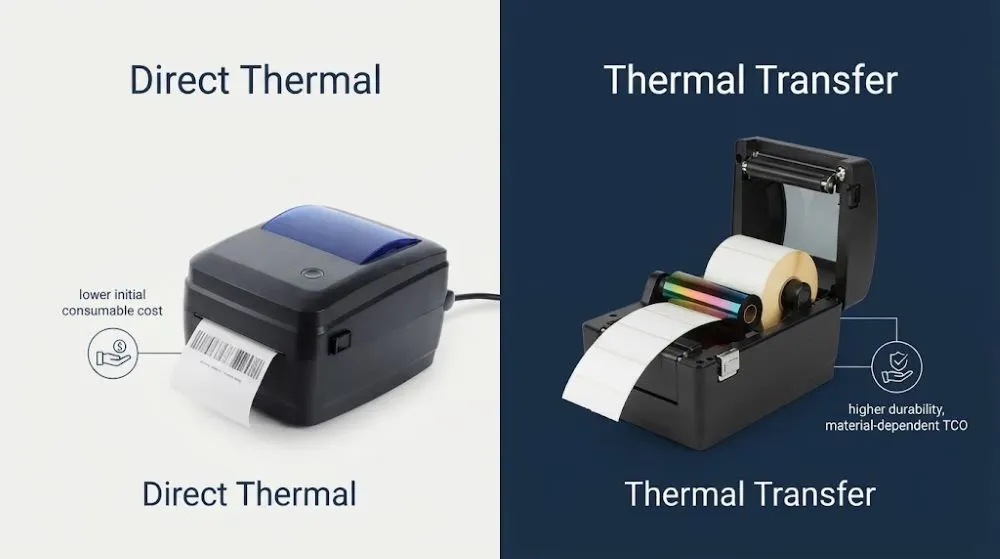
Direct thermal and thermal transfer printing can both produce barcodes and identification labels, but they use different materials to create the image.
Direct Thermal: A Practical Choice for Defined Short-Term Use
Direct thermal printing creates the image on heat-sensitive media without a ribbon.
It is commonly used for shipping labels, receipts, tickets and temporary identification.
For many short-term applications, its ribbon-free operation simplifies consumable handling.
However, the image depends on the properties of the thermal coating. Exposure to heat, light, certain chemicals and other environmental factors can affect readability.
The important question is not whether direct thermal printing is durable or fragile in general.
It is whether the specific media will remain readable for the required period under the actual conditions.
Thermal Transfer: More Material Options for Longer-Term Identification
Thermal transfer printing uses a ribbon to transfer the image onto compatible label media.
With an appropriate ribbon and substrate combination, it can support applications requiring greater resistance to abrasion, environmental exposure or long-term handling.
However, the printing method alone does not guarantee durability.
A resin ribbon, for example, is not automatically suitable for every synthetic label. The ribbon, label material and printer settings must be compatible.
For procurement teams, the correct decision is based on the complete label construction rather than a general technology preference.
The Hidden Cost of a Failed Label
When comparing printing technologies, buyers often calculate the cost of the printer, media and ribbon.
That is necessary, but it does not capture every operational cost.
Imagine a barcode label becomes unreadable before a shipment reaches its destination.
Someone may need to identify the item, generate another label, reprint it and apply it again.
If the failure occurs after the item leaves the original facility, the consequences may be more difficult to manage.
A practical cost assessment should consider:
- Consumable cost per label
- Failed scans and reprints
- Labor required to replace labels
- Interruptions to the normal workflow
- Equipment maintenance
- The cost of handling identification errors
This does not mean thermal transfer is always the lower-cost choice.
For a short-term shipping label, adding ribbon consumption may provide little benefit if the direct thermal label already meets the requirement.
For a long-life asset label, a more durable printing system may reduce the risk of repeated replacement.
The objective is to calculate the cost per usable label over its required service life.
Barcode Readability Is a Lifecycle Requirement
A barcode should not be judged only by its appearance immediately after printing.
Get Eliakim’s stories in your inbox
Join Medium for free to get updates from this writer.
Readability depends on several interacting factors:
- Barcode dimensions and quiet zones
- Print resolution and darkness settings
- Media surface and coating
- Printhead condition
- Ribbon compatibility, where applicable
- Handling and environmental exposure
- Scanner and verification requirements
For an important identification application, test the barcode at the beginning of its service life and after representative exposure conditions.
For example, if the label will experience repeated handling, evaluate abrasion resistance.
If the label will be stored in changing temperatures, test the intended material under representative conditions.
Where formal barcode verification is required, use an appropriate verification process rather than relying only on visual inspection.
The goal is to confirm that the information remains usable when the business needs it.
Why the Label Material Matters as Much as the Printer
Two labels with identical dimensions can perform differently.
Their surface coating, substrate, adhesive and liner may not be the same.
This is especially important when comparing paper labels with synthetic materials.
A suitable printer does not automatically make every label material suitable for the application.
The same principle applies to thermal transfer ribbons.
Wax, wax-resin and resin formulations are designed for different combinations of media and performance requirements.
Before approving a configuration, confirm that the proposed printer, ribbon and label stock work together.
For buyers managing several locations or repeated orders, it is also useful to document the approved media specification. Substituting a different label stock without testing can change the final result.
A Better Way to Evaluate Samples
A sample test should reproduce the actual use case as closely as possible.
Rather than printing a generic demonstration label, provide the supplier with the intended design and media requirements.
A practical evaluation may include:
Step 1 — Define the application
Record the required label life, dimensions, barcode type and operating environment.
Step 2 — Select the media
Confirm the substrate, coating, adhesive and ribbon requirements where applicable.
Step 3 — Print the actual label
Use the final artwork, barcode size and intended print settings.
Step 4 — Check compatibility
Verify media feeding, sensor calibration, interfaces and print-command support.
Step 5 — Evaluate the output
Check alignment, readability and consistency across representative print jobs.
Step 6 — Test relevant exposure
Evaluate the label under the handling, temperature, moisture or abrasion conditions that matter to the application.
Step 7 — Record the approved configuration
Document the printer model, media, ribbon, settings and test results.
This creates a repeatable reference for comparing suppliers and approving future orders.
What Distributors and Brand Owners Should Confirm
For commercial purchasing, technical suitability is only one part of the decision.
The approved configuration must also be practical to source, deploy and support.
Before placing a larger order, ask:
- Which printer models support the required printing method?
- What media specifications are supported?
- Which interfaces and printer commands are available?
- Can the proposed configuration be tested with the actual label?
- Are replacement parts and consumable specifications documented?
- Which OEM/ODM changes are available for the selected model?
- How will the approved configuration be maintained across repeat orders?
These questions help reduce uncertainty before the project moves from sampling to production.
Final Thoughts: Buy for the Label’s Job, Not Just Its First Print
Direct thermal and thermal transfer printing should be evaluated according to what the label needs to accomplish.
For short-term shipping, receipts and temporary identification, direct thermal may provide a practical solution.
For longer-lasting identification or applications involving greater environmental exposure, thermal transfer may deserve closer evaluation.
In either case, the final decision should be supported by testing the actual printer, media and barcode under representative conditions.
The most useful question is not simply “Which technology prints better?” It is “Will this label remain readable until its job is finished?”
Further Reading
For a detailed technical comparison of direct thermal and thermal transfer printing, including ribbon types, consumables, application differences and procurement considerations, read MINJCODE’s original article:
Direct Thermal vs Thermal Transfer: The Complete Comparison
Discuss Your Printing Requirements
MINJCODE manufactures thermal printing hardware for commercial applications. If you are evaluating a new printing project or an OEM/ODM configuration, prepare your label dimensions, material, required service life, print volume and interface requirements before contacting our team.
These details help determine which available hardware configurations are worth testing.