Dialectical Materialist Spirituality
How Dialectical Materialism & Spirituality Can Co-Exist


Do I actually believe that gods exist? I can answer honestly but struggle to answer truthfully. It would not be true to say that I do not believe they exist because I understand myself to do so. It would also not be true to say that I do because the only things that people can understand me to be saying with “yes” are not true. The source of this contradiction is that I lack the language to properly articulate a truthful “yes” and the first step on the journey to get there is the foundation I lay in this article.
I am, at least as far as my ex-Catholic habit of laxness will allow me, a spiritual person. I am also not just a communist but a hardcore dialectical materialist. Some people find this to be a contradiction and, for many religious or spiritual communists, there is a contradiction. My situation is a bit different in that I’ve put in literal years of work centered around making sure that my spirituality accords with what I believe to be true about the dialectical materialist nature of reality. I don’t find my spirituality and a dialectical materialist world outlook to be contradictory because I have forced the former to conform to the latter.
The problem I have is that explaining my conception of spirituality and spiritual matters is made significantly harder by a number of preconceptions that people growing up in culturally Christian societies are generally unaware of. I can justify to myself in terms that are clear to me why I can believe in deities but I want to be able to explain that to others in ways they will understand. That requires explaining what I mean when I talk about deities at all.
The first step on the road to being able to do that is establishing a clear dialectical materialist account of spirituality. This last task is the purpose of this article. But, before we get to that, I want to give a little more context for why I’ve found it so difficult to clearly explain things that I do understand very clearly. This, in turn, will inform the path toward understanding we will take and clarify why this path has significant political value well beyond being able to understand seemingly paradoxical beliefs like my own. The end of this introduction will explain how, by taking this journey of understanding with me, you will be able to see currently invisible causes of problems with how we understand a myriad of politically practical things like justice and why cis people have difficulty in understanding what it means for their trans comrades to be trans.
The Problem that Needs Solving
The work I’ve done has resulted in me having a perspective on spirituality that is unfamiliar, sometimes to the point of unrecognizability, to people who’ve grown up in a culturally Christian society. Even atheists growing up in this society who reject the Christian perspective on different elements of spirituality are entirely unaware that other perspectives exist, throwing the baby out with the bathwater. The classical example can be found in the realm of anthropology with the distinction between the concepts of “old animism” and “new animism.”
So-called old animism refers to anthropology’s original understanding of animist worldviews and practices. Christian anthropologists who were dualists (emphasizing the separation of the body and the self) saw similar practices that they labeled “animism.” According to these cultural Christians, these practices were characterized by a “primitive” belief that inanimate objects are also inhabited by the same spiritual force that inhabits animate objects. It is, in their view, a simple mistake where people are “confusing” non-living things for things that are actually “alive.” This worldview has largely been rejected by the anthropologists of today but largely remains the only way people are capable of understanding animism when they lack real-world exposure to it.
The concept of “new animism” rejects this old view and sees animism as a collection of diverse practices centered around a relational way of knowing the world, an understanding of how all interactions between things are always a two-way street, and respect for the “more-than-human world” around us. In the opening paragraph of his seminal work on this new conception animism, Graham Harvey defines animism as follows:
“Animists are people who recognise that the world is full of persons, only some of whom are human, and that life is always lived in relationship to others. Animism is lived out in various ways that are all about learning to act respectfully (carefully and constructively) towards and among other persons.”
This understanding of animism recognizes it as a practice that is deeply rooted within the material world and embraces the interconnected nature of all things. In other words, as a practice that points toward a dialectical materialist world outlook rather than one that is incompatible with it.
I have had some success as an animist in explaining this to people and opening up their perspective on the possibility that spirituality is necessarily in contradiction with a dialectical materialist world outlook. Part of the reason is that most people do not feel like they know much about animism. When it comes to “supernatural” entities like spirits or deities, people feel much more confident in their understandings that also fail to recognize the existence of non-Christian perspectives. The idea that spirits need not be conceptualized as supernatural is foreign to people. The notion of deities is the worst of all. I’ve struggled for years to explain how I could believe in deities as a materialist because the notion of “god” is so inseparable from Christian theology that people refuse to reject as the only possible truth of what the spiritual realm might look like.
The gap in worldviews between myself and an idealist or dualist Christian may be too wide to ever systematically bridge, making the juice potentially not worth the squeeze. However, I find it hard to accept that I cannot find a way to do this with dialectical materialism (diamat). I think it’s a sign that, though we may accept diamat in general, our particular understanding of spirituality doesn’t truly accord with the fundamental principles of diamat. After all, can we really say we are dialectical materialists on the question of spirituality if our understanding of the phenomenon is point blank unable to even engage dialectical materialist spirituality on an intellectual level as an object of analysis?
Developing a clearly articulable account of how I conceptualize deities has been a white whale of mine. Recently, I’ve realized that the best route might be to build that account from the ground up. That starts with articulating a dialectical materialist perspective on spirituality overall. So… here we are.
Our Way of Approach & Value of Taking It
The path we’re going to take will itself be dialectical. The heart and soul of dialectics is splitting a whole into contradictory aspects to develop an understanding of the whole by way of understanding the relationship between those aspects. Thus, we will apply two different divisions that will combine to allow us to develop a general understanding of diamat spirituality by abstracting the general from the analysis of concrete particulars.

The first division will be between the etic and the emic, a common division within social sciences like anthropology and linguistics. The etic perspective is the outsider’s perspective that attempts to provide an objective description of what is going on while the emic perspective is the insider’s explanation of what is going on with their own culture or behavior as they themselves understand it. The unity of these two is necessary as we cannot, as materialists, develop an proper etic understanding that does not begin from the lived reality of a phenomenon while a strictly emic perspective remains too narrow to develop a generalized understanding.
In our case, this means that the first half of the article will take an etic approach where we develop a dialectical materialist understanding of spirituality as a social phenomenon. This will not be an exhaustive account but will be enough to open the door wide enough for us to approach the subject without the unconscious influence of Christian theological perspectives we may have unknowingly adopted from the Christian culture around us but have not unlearned.
The second half will take an emic approach to describe a spirituality or spiritual perspective that is dialectical materialist as a spiritual perspective. This will give us a concrete particular to engage with. In other words, we will familiarize ourselves first with dialectical materialist sociological thinking about spirituality and then with spiritual thinking that is dialectical materialist. This division parallels the division between sociological religious studies on one hand and comparative theology on the other. But, as is often the case, there is a degree of interpretation such that we’ll find elements that “belong” to one half in the other.
The second division will be applied to further divide the etic or outsider’s “objective” perspective between learning and unlearning. First, we will crack open the doorway to a dialectical materialist understanding of spirituality by defining some basic terms from a diamat perspective. This basic foundation will allow us to contrast that approach with latent culturally Christian beliefs (which are mostly theological though we may not realize it!) in more concrete terms, thereby revealing the latter from its subconscious obscurity through that contrast. Next, we will widen the crack in that door by directly addressing misconceptions about spirituality that come from culturally Christian theological beliefs inappropriately injecting themselves into sociological analysis.
My primary purpose of this article, as I said, is to lay a foundation for articulating important aspects of my personal worldview to others. However, I also hope that, through my efforts to help people understand me that I can also help readers understand themselves. The process of fighting to be able to communicate truths about myself through the distortions of the mostly unaccounted for influence of Christianity on even the most “secular” Western thinking can only happen by way of helping people identify where they have unknowingly had these perspectives.
The impact of this goes way beyond the difficulty in accepting that I can be both spiritual and dialectical materialist without contradiction. These influences shape how we understand and practice notions like justice (heavily structured by a secularized version of Christian “sin”) or how we can make sense of people with radically different notions of the self like trans people (where the “born in the wrong body” narrative is more accepted by cis people than ourselves & heavily influenced by secularized versions of the Christian notion of the self).
Now, with all of this in mind, the rest of this article will be broken into three parts. The first section will introduce a diamat perspective on what spirituality is. The second will address common misconceptions about spirituality that stem from culturally Christian ideas most of us in the West have inherited which unknowingly influence how even many secular atheists think about spirituality. The third and final section will continue developing a diamat conception of spirituality by teaching a particular perspective on spirituality that is dialectical materialist. This last part allows you to develop a diamat understanding of spirituality as a phenomenon by engaging with this particular spirituality, a necessary step in the process of “abstracting the general from the particular.” This article is rather long so feel free to read it in portions with breaks in between.
Part I: Spirituality According to Dialectical Materialism
The best place to start is by trying to work out some basic definitions we can use. The most basic definition of “spirituality” is “that which concerns the spirit.” Developing a more useful definition requires us to first define what “spirit” even is in the first place.
What Might “Spirit” Be?
There are many different conceptions of “spirit” that follow from diverse perspectives about the nature of reality. We can, however, identify a common thread. Generally speaking, “spirit” is used to refer to hypothesized causes of animacy. We can follow this thread and say that spirit is the animating force and motion that characterizes reality.
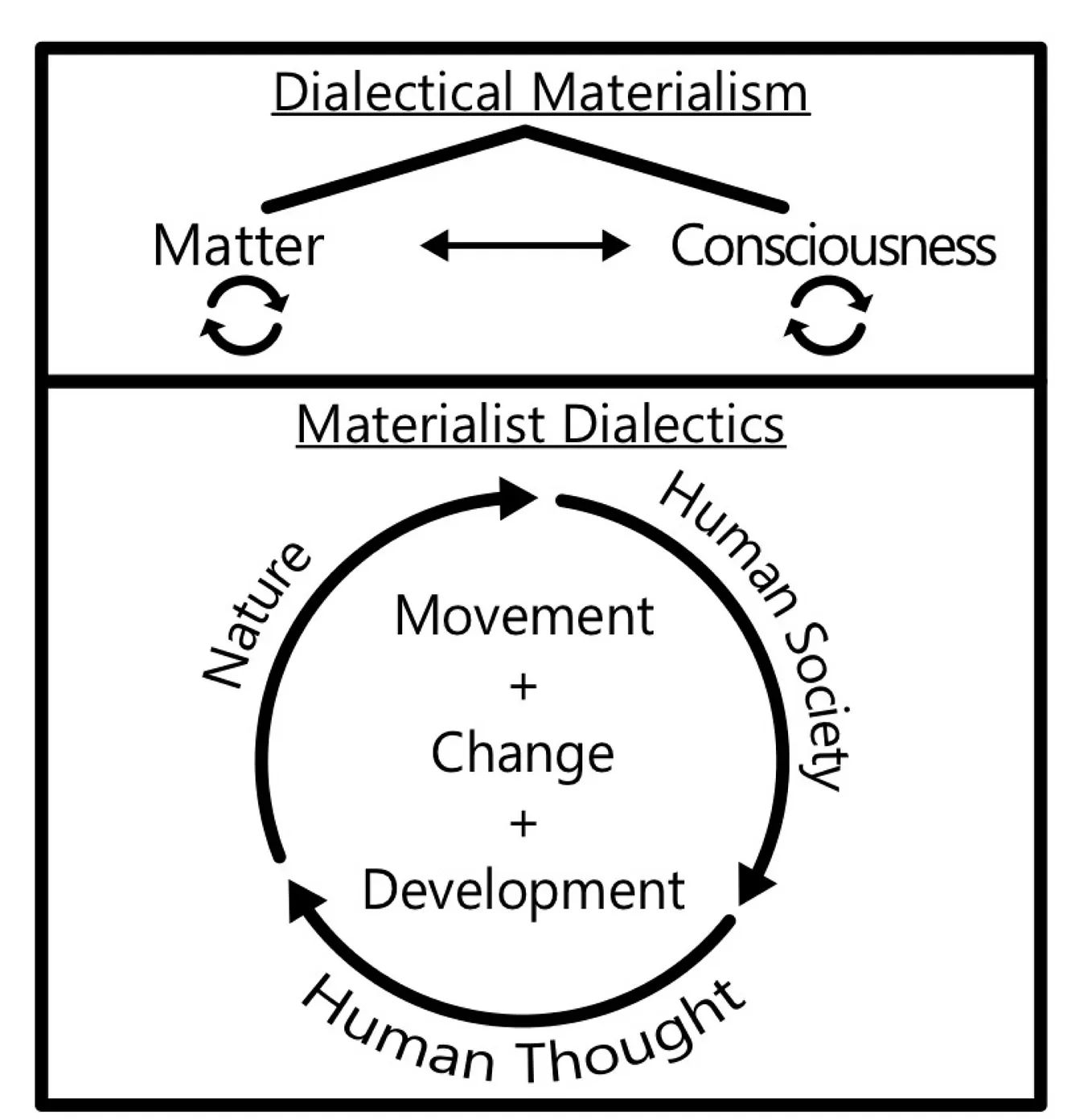
Astute dialectical materialists may read this and be reminded of the basic principle that “motion is the mode of matter’s existence.” This motion, change, and development that is the only way that matter can be is what “spirit” is. It is not something that exists like an ideal form hovering above material reality. It is embedded in material reality itself.
A common reaction I get to this sort of definition is to view this sort of definition as a cop-out where we are merely playing semantics to keep the label “spirit” in our worldview despite the fact that there’s nothing that we can “legitimately” call spirit. We’re just substituting a mere mystification, as far as this view is concerned, when it would be better to talk about material reality without reference to the supernatural.
Let’s ask ourselves why we might think this. Is it based on concrete observations that every conception of “spirit” references the supernatural? It couldn’t possibly be that because there are real world traditions we can point to that conceptualize spirits as things that are embedded within the natural world without ever causally transcending it the way that supernatural phenomena do (more on this natural vs supernatural distinction later). So, if there are real world traditions that conceptualize spirits in a similar way, on what basis are we saying this definition is not legitimate? It’s the same basis upon which “old animism” portrayed animist practices as a mistaken belief: cultural Christianity.

Objections to the validity of the definition of “spirit” I am presenting here are just detailed ways of saying “that’s not what a spirit actually is.” This is not a scientific claim. This is a Christian theological claim. Even when someone rejects the idea that spirit as Christians conceptualize actually exists, it does not make it any less of a Christian position to the claim that the only spirit that could possibly exist is the Christian kind. The reality, if you are willing to grapple with it, is that many people understand spirit and this motion to be synonymous and they are no less “correct” on account of contradicting Christian frameworks.
What is Spirituality?
We can now return to our original definition of spirituality and say that spirituality is “that which concerns the animating force of reality.” This definition is a little bit better but doesn’t quite capture spirituality as a phenomenon in any especially useful way. We can take things further specifying what kind of thing spirituality is or what broader category it belongs to. From there, we will break it down into two co-constitutive aspects that make up spirituality’s whole.
Spirituality belongs to the general category of life activity, which covers how we interact with and relate to the world in all dimensions of life, including behaviorally, cognitively, and affectively (i.e. emotionally). The general category of life activity can be broken down into countless types. Three especially important ones are the daily reproduction of life (e.g. eating, sleeping, etc.), scientific inquiry, and political struggle (including class struggle).
What specifically distinguishes spiritual life activity from other forms of life activity? Spirituality, like all other forms of life activity, has both objective and subjective aspects. The objective reality of what it is we are doing when we do a thing and the subjective experience of doing that thing form an inseparable whole characteristic of all life activity. It is the particular combination of objective and subjective that distinguishes any particular type of life activity from another.
The objective aspect of spirituality is, at this point, very simply to address. We can start by, again, saying that spiritual life activity is life activity characterized by interacting with the animating force of reality (spirit). However, this definition has a problem in that it is overbroad. Life activity that interacts with the animating force of reality defines all life activity as far as a dialectical materialist is concerned. It is actually not an issue that all life activity can be spiritual activity, a point we will address later, but it is pointless to define spirituality in a way that makes all life activity spirituality by default. I am technically engaging with the animating force that characterizes reality whenever I eat a clementine but I’m doing so only to the extent that I am doing a thing in the real world. We need a definition that would only cause my eating of a clementine to be spiritual only if there’s something significantly “spiritual” about my doing so.
We can get there by noting that spiritual practices are generally understood by practitioners to have a spiritual component to them. This awareness leads to a distinction between intentionally engaging with the animating force of reality recognized as spirit and engaging with the animating force of reality without thinking about that fundamental component of your activity. Eating a clementine can be a spiritual experience if, in doing so, I am doing so as a way to engage with “spirit” in some way shape or form. This leaves us at the objective aspect of spirituality being: life activity that intentionally engages with the animating force and motion of reality as such.
The subjective aspect of spirituality, as we said, encompasses the subjective experience of engaging in spiritual activity. This realm of subjectivity deals with aspects of consciousness such as relational attention and affective states.
In order to understand the evolution and development of religion before recorded history by investigating potential “religious” or “spiritual” behavior in non-human animals, scholar of religion James Harrod developed a trans-species definition of religion. Defining religion is a notoriously fraught endeavor where definitions are filled with innate biases and, so, he examined a number of definitions and worked to cut out elements that were centered on the written word or were intrinsically anthropocentric.
The definition that he developed was aimed at studying potential spiritual behavior among non-human animals like primates. However, in doing so by way of generalizing concrete particulars, he developed a definition of spirituality and spiritual experience that can be a basis of a general definition for our discussion on human spirituality.
Get MarxistHeathen’s stories in your inbox
Join Medium for free to get updates from this writer.
The definition we will use is based on his original definition, which can be found in his paper, but with three adjustments. First, I adjusted wording where I felt the original label may not accurately communicate the concept he detailed, Second, where his definition centers “religion” as a communal and ritualized activity, I have downplayed that element for a definition of “spirituality” that is not restricted to communal religious practice. Finally, I made a small adjustment to better account for an animist perspective. With those adjustments, we can say that the subjective aspect of spiritual life activity is characterized by the following:
- Empathetic Intimacy: The experience of empathetic intimacy with respect to the aliveness and animacy of the more-than-human world
- Reverence: Relational attitudes of reverence, devotion, deep respect, or intense love
- Careful or Solemn Observation: Focused attention and reflection, which may be individual (internal) and/or social (“may involve calling-out or announcement”)
- Sublime Affect: The aesthetic and emotional experience of confronting vastness, grandeur, magnitude, power, etc. that overwhelms our ability to comprehend in its entirety
The first feature is an absolute necessity that must be present for our definition. Additionally, it must be accompanied by at least one of the other three features. All of these features can vary greatly in their intensity. A sublime affect could center around a powerful but relatively subtle feeling of connection, experienced in the course of meditation, where the world you are connected to is so vast that you cannot feel all of that connectedness all at once. Alternatively, sublime affect can be an intense and emotionally overwhelming experience that some might call it religious ecstasy. However, our definition is only concerned with the presence of one of these features rather than these features being especially intense in their presence.
Thus, we can unite the objective and subjective aspects of spirituality to say that spiritual life activity is characterized by (a) life activity that intentionally engages with the animating force and motion of reality as such and (b) a subjective experience involving empathetic intimacy and one or more of the following: reverence, careful observation, and sublime affect.
Part II: Misconceptions About Spirituality
Before we continue, I am going to address a few more common misconceptions about what spirituality is or necessarily must be. I’ve mentioned an example of how the overly narrow worldview of culturally Christian on questions of spirituality can cause problems. However, I feel it is worth addressing several other points of over-narrowness to expand our understanding of human diversity when it comes to spiritual practices. This will make us more prepared to engage with my particular account of a dialectical materialist spirituality later.
Spirituality is fundamentally a question of belief
A common feature of culturally Christian thought, that you can see plenty of examples of in Western Marxist discourse, is the widespread favoring of orthodoxy (right belief) over orthopraxy (right action). This is ironically in contradiction with the basic principle of dialectical materialism that, between theory and practice, practice is primary. Both of these perspectives do prefer right belief and right action over wrong belief and wrong action. The difference lies in which concern is primary. An orthodoxy-centric approach inherited from Christian religious practice is overly concerned with whether or not people believe the “right things” regardless of whether this leads them to do the “right things.” Where orthodoxy is forgiving of wrong actions as long as the proper belief is maintained, orthopraxy is forgiving and less concerned with the belief that motivates a right action rather as long as that right action is taking place.
Unbeknownst to cultural Christians, this is a very common approach to religion that can be seen in practices ranging from Animism, Judaism, Chinese spiritual practices, to pre-Christian “paganisms” across the ancient Mediterranean. Analyzing a spirituality primarily in terms of whether its beliefs are the correct ones neglects any form of spirituality that falls outside Christian understanding. Orthodoxy cares only about what you believe while orthopraxy allows you to believe whatever you’d like as long as you get to the same practice.
This confusion causes people to reinterpret orthopraxic spiritual activity in inappropriately orthodoxic terms, casting Indigenous traditions of relating to and stewarding land as superstition because the terms in which people described their justifications fell outside the bounds of white colonizer rationality. Thus, the way gets paved for more enlightened “right beliefs” that have caused ecological devastation that threatens the existence of the human species.
Spirituality must relate to the supernatural
The misconception that spirituality must be spiritual is based on the misconception that any conception of spirits must be supernatural. This, in turn, is simply a blind spot for cultural Christians that is refuted by many naturalist conceptions of spirits from around the world across time. This is the case for many different forms of animism, including Shintoist animism where Kami are not entities set above the material world that are inhabiting inanimate objects but conceptions of things in the material world in terms of how they are manifestations of the animating force that defines reality.
This may be confusing for someone engaging with these sorts of perspectives for the first time but what ought to help is developing a clear understanding of what we’ve been talking about when I’ve been talking about “natural” and “supernatural.” The difference between naturalism and supernaturalism comes down to a concept known as causal closure.


A naturalist view holds that all things that exist do so within a closed network where all natural phenomena have natural causes. A supernaturalist view, on the other hand, holds that there are some phenomena that exist above this network, able to create natural effects from non-natural causes that exist outside the influence of the natural world. Naturalism rejects this. Thus, spirituality which conceptualizes spirit in terms of the material world’s inherent animacy is a naturalist view and does not make any reference to supernatural phenomena that influence the natural, material world without being of that world.
Spiritual life activity is in conflict with other forms of life activity like scientific life activity
There is a common belief that spirituality and science are separate from each other. This is a modern belief but stems from older Christian conceptions of religion as an area of life activity that is fundamentally separate from all others. We see this difference whenever we look at pre-Christian beliefs that Christianity overtook where these cultures frequently did not have a term for “religion” because spiritual activity was not conceptualized as separate from other forms of activity.
Life activity is spiritual when it concerns the spirit, the animating force and motion that characterizes all of reality. This makes it so that life activity that is “mundane” daily stuff aimed at the reproduction of life or is scientific can also be spiritual activity. There are, objectively, people for whom this is absolutely the case and whether or not supernatural beliefs are incompatible with science’s naturalistic approach does not make that any less true.
In fact, the position that these forms of life activity are in all cases incompatible leads us to reactionary positions rooted in colonial ideologies. To say that spiritual activity and scientific activity cannot ever be one and the same is to, at best, deny the legitimacy of Indigenous systems of knowledge production or, at worst, deny the very existence of Indigenous science and the Indigenous scientists working within that framework. I don’t think I need to elaborate on why these necessary implications of this “always incompatible” position are factually incorrect, contrary to consensus scientific perspectives, and (most of all) flat out racist.
Now that we have addressed and discarded these sneaky theological misconceptions many of us have inherited from Christianity, we are prepared to move forward. The notion of a spirituality that is orthopraxic, relational, naturalist, and entirely compatible with scientific inquiry should now be entirely thinkable to anyone who has reached this point. The rest of this article will finally focus on laying out a particular dialectical materialist spirituality.
Part III: A Dialectical Materialist Spirituality
On “The Spirit” and The Dao
When we say that spirit refers to the animating force and motion that characterizes reality, what is this motion? In dialectical materialism we just refer to it as “motion” and assert that it is the “mode” of matter’s existence. Still, we don’t really have a great word to refer to this motion, change, and development as a total phenomenon in itself. “Motion” seems too particular and “reality” doesn’t call to mind the active aspect of it all very well. It is technically just everything but “everything” as a word seems unable to capture its simultaneously singular and myriad nature.
Any time we try to put a name to this thing that is everything, the name always seems to fall short somehow. Laozi struggled to give a name to this nameless thing and, accepting that no name would suffice, simply referred to it as the Dao. It translates to “the way,” where the word dào had been in regular use to refer to any process through which a thing was done. The sense that he was trying to capture is something like “the way in which the process that is reality itself is carried out.” I’m potentially oversimplifying a bit but you can find more detail from a Daoist scholar here.
The Dao is material in that motion can only exist through matter while matter can only ever exist in motion. Thus, the Dao is all things. Everything that exists in the material world is a manifestation of the Dao or, generally speaking, a system of manifestations of the Dao.
The Dao, like all of its manifestations, is one that divides into two. Daoists call these yīn and yáng: interpenetrating opposites that exist in opposition to each other while also containing part of the other in themselves. Dialectical materialists call this contradiction, the universality of contradiction, and the interpenetration of opposites.

Emanations of the Dao are always in a state of motion but change does not come all at once. These two, when paired, create four combinations: yang and yang, yang over yin, yin over yang, and yin and yin. These are the four stages of change: one aspect has total dominance, then its dominance is contested, then it is contesting its subordination by its opposite, then is totally subordinated to its opposite. These first two stages and latter two stages represent basic change and the leap between the first two and the second is a shift in the nature of a process where the two halves switch places. Reaching the end of a process does not and cannot mean we arrive at a thing that no longer changes. This manifestation will also undergo change in an endless chain of one thing turning into another. Dialectical materialists call this quantitative change leading to qualitative change, the identity of opposites, and either “the negation of the negation” or “negation and affirmation.”
That those who sought to learn about the Dao came to similar conclusions as those revolutionaries who sought to change reality through understanding the fundamentals of change and development is no coincidence. We come to understand reality through social practice and it is through social practice that we, time and time again, come to find the Eternal Dao.
The best starting point to learn more about The Way is by engaging the Dao De Jing while working to keep a perspective of what its wisdom must mean for a dialectical materialist concerned with liberation. The truly vast overlap between Daoist cosmology (especially in Daoist thought predating the Qin Dynasty) and materialist dialectics is something I hope to address more in the future.
On Spirits
We’ve been using the word “spirit” a lot or “the spirit” in a way that evokes a singular unity but what about, like, spirits? Do they exist? What are they? Again, we must abandon any cultural Christian habits we may have of simply deciding that whether spirits exist is one and the same with asking whether spirits as Christians can only conceptualize them as existing. But the answer is yes.
A spirit is the way that we conceptualize any particular system of manifestations of the Dao. This leads to a basic animist principle of all things being spirits in some sense or are being animated by spirits that, within a relational epistemology, can be related to as one and the same with the “material” they are animating (putting “material” in quotations as, motion being the mode of matter’s existence, there is not actually such a thing as inert matter distinct from its motion we call spirit). We are spirits. Other animals are. Trees and plants are spirits. Rocks are spirits. Lands are spirits.
Now, as for that last one, the idea of a land’s spirit may seem a bit of a leap if you are used to seeing a world of truly discrete parts. Wouldn’t everything we encompass within “a land” just all be individual things or, in our case, spirits? My response would be to ask whether it’s not the case that each of the discrete spirits we might imagine aren’t also made of their own discrete parts? And those in turn made of more parts? Contradiction inheres in all things. It’s just parts of parts of parts all the way down. At what level of combination do we say, “this is where a particular spirit comes into being and no higher”?
The simplest answer is that we do not. All parts combine into higher level systems which are themselves subsystems of a greater system, so on and so forth. It’s systems all the way up. Spirit, the Dao, divides and its parts both divide and recombine to form all things or systems or processes or spirits that exist. All things are manifestations of the Dao and all manifestations are systems of manifestations.
It is through this differing complexity of spirits relative to our own complexity that animists develop distinct traditions of dividing the world into classes of being which we relate to in different ways though recognizing the division of beings into classes is not a necessary method of recognizing these differences. This is also not always a hierarchical endeavor as the differences do not need to be detailed in terms of deference. These can simply be ways of relating that are attuned to the complexity of different spirits. Relating to a being that hungers and thirsts in the same way as ourselves in one way and relating to beings that only exist within and as the complex balance of many “separate” elements that include ourselves (land and ecosystems) in another.
This seems odd or unfamiliar to us because we have grown up seeing animism as the result of a primitive mistake diverging from orthodoxy rather than an orthopraxic framework for relating to the world around us. However, we have an innate animist bias that our anti-animist society has not been able to stamp out. We talk about living on through our legacy, what the words we read on a screen or book are “saying” to us, and talk about more-than-human entities like “the proletariat” as living things.
This is not right or wrong but simply how we relate to the world. It can be a good thing where we relate to a river through “personhood” or a bad thing where we talk about a drawing like it’s a real thing with feelings hurt by trans women. However we conceptualize these entities, we are talking about entities that can be properly called spirits. Not a force inhabiting an inanimate object but the animating force that constitutes all objects (manifestations of the Dao).
Where do spirits like deities come into the picture? I am unable to provide a full account of what a deity is from a dialectical materialist spiritual perspective but I can point out that a fundamental mark of how we relate to deities is that we do so with attitudes of respect and, especially, reverence (though not necessarily deference or love in all traditions). A deity is, though neither exclusively nor exhaustively, a spirit that we relate to with reverence. More elaboration will come after more work on more fundamental and general questions.
On Revolution as a Spiritual Activity
Revolution has a political character but also, in practice, has had a spiritual character. The Haitian Revolution began with a Voodoo ritual presided over by houngan Dutty Boukman and mambo Cécile Fatiman Voodoo. The armed resistance of Nat Turner and Tecumseh was spiritual as well as political. The resistance to the Qing Dynasty & China’s colonizers by the Yellow Turban/, the White Lotus, and the Society of Righteous and Harmonious Fists (the Boxers) all had spirituality woven into politics. Spirituality pervades the Palestinian resistance to their genocide by engineered by the zionist entity and US Empire.
Marxists have made revolution into a scientific activity but, despite all of our efforts attacking superstition, we have been unable to rid elements that could be called spiritual from the very fervor that motivates revolution. Revolutionary Black materialist transfeminist thought presents some of the most scientifically advanced (by miles) historical materialist analysis theory of our current society.
N.Z. Suékama, a (if not “the”) developing strain of thought, gets there not by applying dialectical materialism as an afterthought she uses only as far as the analysis remains easily digestible. She does so by taking it seriously and ensuring that all elements of our models about the world conform to a diamat understanding, suffering no idealism or isolated phenomenon. Through this uncommonly rigorous practice, Suékama addresses issues like the precise mechanics of how capitalism’s superstructure is tied together with society’s substructure of base and how White Supremacy and Cishetero-Patriarchy come together as a single system of systems of social ordering which lies at the nexus between superstructure and substructure. Despite taking the “scientific” part of “scientific socialism” more seriously than many self-proclaimed “scientific socialists,” she gives serious importance to spirituality (and Black spirituality in particular) within revolutionary practice rather than denigrating it as incompatible with science.
The spiritual nature of revolution does make sense. After all, revolution tears apart the nexing-forms that tie together the substructure and superstructure in order grant us the opportunity to reshape the reality we live in. The root grasping activity of revolution cannot help but concern itself with the Dao and with getting the widest possible swathe of people to begin directly engaging with the change and development of reality. Through liberation we not only remake reality but remake ourselves. How could all of this not be, in at least some sense, spiritual activity?
In turn, counterrevolutionary activity direct at the colonized world by colonizers has always seen spirituality as a battleground and the spirituality of the colonized as a threat. This has been true regardless of whether the colonizers appear as conservative and Christian or as “progressive” and atheist. Colonizers have long recognized that indigenous spiritualities (1) have organized and motivated anti-colonial resistance & (2) make space for ways of being that are not compatible with the social order colonizers seek to impose.
This is why the colonial violence of subjugation is often directed at exterminating spiritual leaders and transfeminized people, often overlapping populations. As queer people in colonizing countries have fought for our existence and pried concessions from our oppressors through costly sacrifice, our common oppressors seek to turn our liberatory impulses into oppressive ones. They cast the queerphobic attitudes they themselves impose on colonized people as signs of backwardness rooted in spirituality which ultimately make “necessary” continued colonial activity to “civilize them.” The desire for queer existence turns into support for colonial violence that erases the material conditions for queer existence on the same side of the same spiritual battlefield upon which Columbus and Cortés fought.
To engage in revolution as a dialectical materialist is to directly engage with the Dao. To resolve antagonisms in favor of the natural impulse and power of the oppressed toward liberation is wu wei (doing without doing). It is to undertake an activity that, if engaged in seriously, will evoke feelings of humility in the face of forces greater than oneself, intimate connection with those who come before us through tradition, an agency-recognizing respect for the more-than-human world, and a striving toward being an ethical being. Revolutionists need not conceptualize their activity in spiritual terms and are better off not succumbing to supernaturalism but to deny that revolution has a character that others may engage with as spiritual is to find revolution in books rather than reality.