Pointing Out What Cannot Be Pointet Out


By Michael Erlewine
[Following on the previous blog, I am encouraged to say more of what I can about what are called the pointing-out instructions in learning Mahamudra, a non-meditation. This is going to be one of those mind-twisters, for which I apologize. I don’t know a clearer way to say this. I’m working on it.]
A perennial problem in dharma instruction is trying to put into words that which cannot be put into words, yet over the centuries endless reams of words have been expended trying to do this. It’s not like the great dharma teachers don’t know better than to attempt to describe what cannot be described, but rather they hope something rubs off on the reader, some inkling or even a whiff.
If these words (or actions, signs, and signals, etc.) are shared by a Mahasiddha or great dharma teacher to a student, they are often called the “Pointing Out Instructions”, pointing out the actual nature of the mind. As with all of us, this can be hard for students to grasp.
For example, in Mahamudra meditation, when we are not just learning and practicing it, but are actually doing Mahamudra, and this is a form of non-meditation. We don’t do anything other than just rest.
What this means, is that when we are doing Mahamudra properly, “We” are not actually doing anything but resting in nature of the mind and then perhaps alternately reflecting on that or reflecting that experience. Here I’m talking mostly about the combination of the Insight Meditation itself, ‘reflecting’ on that insight dualistically, and perhaps taking notes.
And by ‘reflecting’, this means we are aware that we are (or just have been) aware (through the insight), yet that awareness itself is not an awareness of any ‘thing’ or object. Mahamudra is non-dual. It has no object and no subject seeing an object. Resting in Mahamudra is, as mentioned, non-dual, meaning we are fully immersive for however long we can sustain it, most often momentarily, followed perhaps by some awareness or reflection that we have been aware or were immersed.
And while the duration of actual resting, immersed in the true nature of the mind can be short, but a moment, it can be done successively, repeatedly, as often as we like, with each momentary immersion followed by the reflection (duality) of the immersion, whatever that may be. And this string of immersion/reflection can be strung together in a seamless chain of light — a rosary or mala of insight and reflection.
And after the insight, we may have a reflection not of any ‘thing’, since in Mahamudra there is no object or subject, however, in the world we live in (Samsara), we very much have both subject and object and by reflection some light from Insight Meditation may be reflected and known. I have done this for years.
My point is that alternating between immersion (non-duality) and duality (subject and object) in rapid succession does not in itself create an object. The clarity and lucidity that is intrinsic to full immersion in Insight Meditation can be pointed (like a flashlight) at whatever thought or activity we are actively involved in and it’s like the immersion with that thought or idea in mind sheds light on the thought upon withdrawal from immersion. Insight Meditation is like a flashlight that illuminates whatever it is directed at. And we can get some crumbs from the event, if we are aware.
In dharma training, duality (subject and object) is called Relative and non-duality (full immersion) is called Absolute. And there are caveats.
The main caveat here is that our idea of resting in the nature of the mind has to start somewhere, and by that, I mean using our normal idea of resting, as in ‘give it a rest’ is where we have to begin as that is all we know. We have to learn to let go and just rest.
And we can do that by stopping what we are doing and just resting in that moment as best we can. Relax. This can be awkward at first, yet in time, if we do this as often as we can think to do it, over time we can actually rest and stop just trying or making an effort to rest. We relax and let go.
Get Michael Erlewine -- Archivist Popular Culture’s stories in your inbox
Join Medium for free to get updates from this writer.
Obviously, trying to rest and actually resting are two different things. And there is one step more I have to share than just resting, and it is complicated and this cannot be put into words except very poorly. It can’t be said, not because it is secret, but because it is ineffable, beyond description or words. The closest analogy I have found is presented in this short video on polymers, which I find illuminating, very much worth seeing.
“Stretching Polymers”
https://www.youtube.com/watch?v=Z5RR_mVJf3s
In this video, I found it helpful to view what is called “Necking,” when a polyethylene polymer plastic is stretched. See the above demonstration. When a polymer plastic is stretched, the polymer chains in the original plastic are not aligned, but when carefully stretched the polymers align and create a plastic that is very much stronger than it was, and also crystal clear. This is the principle that makes Kevlar armor so strong.
The above is just an analogy, yet one I find instructive if we consider the kind of resting required for Insight Meditation. It is not just that resting is clarifying, but rather that the particular ‘clarity’ achieved is another order of magnitude more clear and lucid than we have ever known. Insight Meditation is stark or vividly clear AND it occurs without any sense of duality (subject and object). We are all in.
This event in dharma terms in its first instance is called “Recognition,” and it refers to our recognizing the true or actual nature of the mind for the first time.
I can’t tell you when this will happen or exactly what causes this or how, but this in dharma training is invoked by the ‘Pointing-Out Instructions’, where the result (what is pointed out) is non-dual (no subject or object), a fully immersive insight or experience.
That recognition experience, so to speak, is actually a form of mini realization. An insight in Insight Meditation is a vivid and non-dual experience that is realized. We are aware, but not aware of any ‘thing’; just vividly aware.
And the point in explaining this is that this experience of vivid ‘insight’, is like a spiritual flashlight that can be pointed in any direction we wish, and the insight itself is not a thing, but rather something like a light or torch, that when directed at an object, can’t help but illuminate or light up any subject or ‘thing’ in some manner. In that illumination, when we reflect dualistically on it, share some of that clarity with us and we can remember that.
That’s about as clear as I can make something that cannot be described in words. Insight Meditation shines the light of truth wherever it is invoked. Or it is like a star in the sky of the mind, that lights up anything in its vicinity.
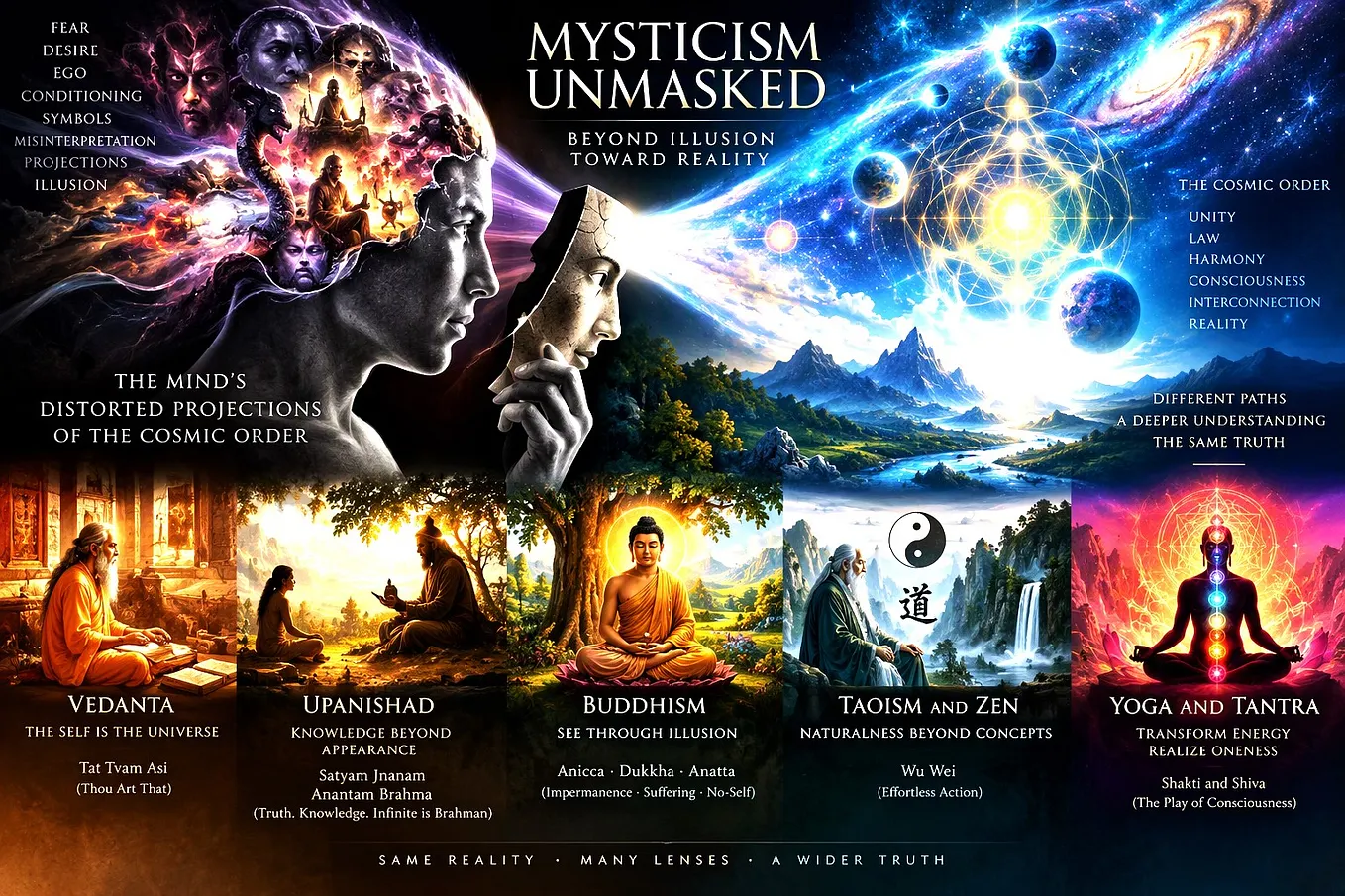
[Midjourney graphic prompted by me.]
EMAIL Michael@Erlewine.net Note: If you would like to have access to other free books, articles, and videos on these topics, here are the links: SpiritGrooves.net.
As Bodhicitta is so precious,
May those without it now create it,
May those who have it not destroy it,
And may it ever grow and flourish.