Women Commercial Astronauts
Contests, Social Media, and Billionaire Benefactors Are Employing Commercial Space to Change the Face of Space

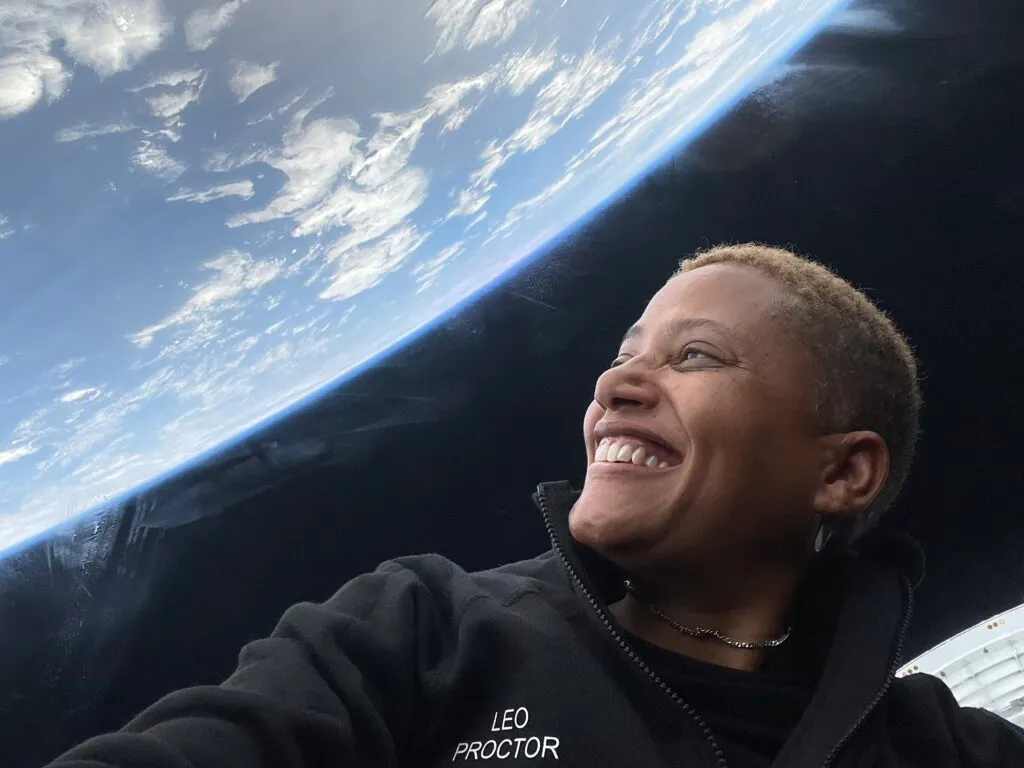
When Dr. Sian Proctor launched into orbit aboard SpaceX’s Inspiration4 mission in 2021, she became the first woman commercial astronaut to pilot a spacecraft. But more than that, she became a living symbol of a future where space belongs to all of us. As an artist, geoscientist, poet, and commercial astronaut, Dr. Proctor didn’t just break barriers — she painted new possibilities into the sky.

On her inaugural flight to space as a commercial astronaut, Dr. Proctor also notably became:
- the first artist selected to be an astronaut
- the first Black woman to pilot a spacecraft
- the first Black woman to paint in space
Each of these firsts redefined what it means to be an astronaut and a woman in the commercial space age.
No longer reserved solely for test pilots or engineers in government-funded programs, space is now being shaped by storytellers, scientists, and citizens — women whose diverse identities expand our collective understanding of where we belong in the cosmos, traveling to orbit aboard commercial launch providers.
Pioneering Women Commercial Astronauts
Long before commercial spaceflight became a media spectacle, a select few women broke barriers by purchasing — or having purchased on their behalf — their own tickets to space. While Dr. Proctor’s flight marked a turning point, she stands on the shoulders of other pioneering women who helped usher in the commercial space era.
Helen Sharman: UK’s Commercial-Sponsored First
In 1991, long before private spaceflights became headline news, Helen Sharman became the first British astronaut and the first woman to visit the Mir space station. Her selection came not from a government space agency, but through a commercial partnership. Project Juno, a privately funded venture supported by a consortium of British companies — including the likes of British Aerospace and ITV — launched Sharman’s historic journey aboard a Soviet Soyuz spacecraft. Though the UK government ultimately declined to fund the mission, corporate sponsors stepped in to make it happen, making Sharman the first woman in space whose seat was arranged and supported commercially.

Her mission predates the “space tourist” label entirely, yet her path mirrors today’s commercial astronaut paradigm: talent, training, sponsorship, and purpose — outside the traditional boundaries of national space agencies.
Anousheh Ansari: The First Woman to Self-Fund Her Flight to Space
In September 2006, Anousheh Ansari became the first woman — and the first person of Iranian descent — to travel to space as a privately funded astronaut. Launched aboard a Russian Soyuz TMA-9 spacecraft, she spent nearly ten days aboard the International Space Station, where she conducted scientific experiments on behalf of the European Space Agency and engaged in public outreach with students and the global public.

Ansari’s mission was more than a technical accomplishment — it was a cultural moment. She launched wearing patches representing both the American and Iranian flags, a quiet act of diplomacy and unity during a time of heightened international tension. Her presence in orbit sparked profound inspiration, particularly among women and girls in the Middle East and across the globe, who saw in her a symbol of what was possible beyond barriers of gender, nationality, or politics.
Wally Funk: The Long Arc of Justice
In the early 1960s, a privately funded program known as the “Women in Space Program” — later dubbed the Mercury 13 — set out to test whether women could meet NASA’s astronaut selection criteria. Thirteen highly qualified woman pilots passed many of the same tests administered to the Mercury 7 men. Among them was a 21-year-old aviator named Wally Funk, who became the youngest to complete the program. Though these women were never allowed to fly, their accomplishments revealed what the system would not yet acknowledge: women were ready.
It would take sixty years for that readiness to be honored in flight. In 2021, Wally Funk finally launched aboard Blue Origin’s New Shepard, becoming the oldest person to fly to space and taking her place as a commercial astronaut. Her journey bridged two eras — one of exclusion, and one of commercial inclusion — and gave long-overdue flight to the legacy of the Mercury 13.

At 82 years old, Funk became the oldest person to travel to space at the time, and her flight marked the first-ever crewed mission of the New Shepard rocket.
More than half a century from when she began to train for space, Funk launched at last — not as a state-sponsored astronaut, but as a commercial spaceflight pioneer. Her presence aboard that first New Shepard mission wasn’t just symbolic; it was revolutionary. In that brief suborbital arc, she helped close one chapter of exclusion and open another defined by access, equity, and joy.
The New Wave of Women Commercial Astronauts
The women who first entered commercial spaceflight — through contests, partnerships, or personal funding — laid the foundation for a future they could envision but never fully inhabit. Today, that future is arriving. The path carved by pioneers like Helen Sharman, Anousheh Ansari, and Wally Funk has widened into a broad avenue of opportunity — one traveled by engineers, doctors, teachers, artists, and even entire families.
This new generation of women commercial astronauts is more globally representative, professionally diverse, and culturally expressive than ever before. Their flights aren’t just historic — they’re deeply personal, purpose-driven, and often profoundly symbolic. Whether testing next-generation spacecraft, carrying national pride, expanding access through outreach, or simply proving what’s possible, these women are not only passengers — they’re participants in designing humanity’s future in space.
Fueling these opportunities are contests, social media campaigns, and billionaire benefactors. Programs like Space for Humanity, Inspiration4, and sweepstakes from Virgin Galactic have created unprecedented access to space for women from around the world. These initiatives reflect a powerful shift: access to space is no longer only about agency selection — it’s increasingly about visibility, community engagement, and storytelling. By linking public enthusiasm with private capital, these pathways are transforming who gets to dream — and who gets to go.
Beth Moses: Redefining the Role of the Commercial Space Professional
If Anousheh Ansari and Wally Funk helped prove that commercial spaceflight could be deeply personal, Beth Moses showed that it could also be deeply professional.
In February 2019, Moses flew aboard VSS Unity as part of Virgin Galactic’s testing campaign — becoming the first woman to fly to space on a commercial spacecraft as a crew member. Serving as the company’s Chief Astronaut Instructor, her mission wasn’t a passenger ride. She was there to evaluate the customer cabin environment and to refine the experience for future space tourists. It was a test flight — with Moses acting as both astronaut and subject.

Her flight demonstrated a vital truth: commercial astronauts wouldn’t just be space tourists or private citizens. They’d be instructors, engineers, operators, and leaders, helping to build the infrastructure for routine access to space.
Beth Moses has since flown multiple times with Virgin Galactic, cementing her role as a foundational figure in the training, safety, and design of human-centered commercial spaceflight. In many ways, she is a template for future commercial astronaut roles — where the line between explorer and engineer dissolves into something entirely new.
Dr. Sian Proctor: Space Poet, Space Artist and Renaissance Woman
While this story begins with Dr. Sian Proctor, her role deserves more than an introduction — it deserves its place among the great breakthroughs in the history of space exploration. As the first woman commercial astronaut to pilot a spacecraft, Dr. Proctor redefined leadership in orbit. But her contribution extends beyond her seat in the cockpit.
Dr. Proctor’s astronaut journey began long before she stepped inside a SpaceX Crew Dragon. She was a finalist in NASA’s 2009 astronaut selection process, nearly making the cut to become a traditional government astronaut. Though not selected, that experience launched her into the world of analog space missions, including NASA-funded HI-SEAS simulations, where she served as education outreach officer. Through these immersive leadership experiences, she became one of the most respected analog astronauts in the world.

When the Inspiration4 mission opened a contest slot to the public, Proctor entered with a poem and video that captured her personal philosophy and vision for a more inclusive space future. Her winning entry earned her the pilot seat — making her not only the first Black woman to pilot a spacecraft, but the first artist selected to go to space.
As an artist, poet, scientist, and communicator, Proctor brought a full spectrum of human expression into space. Her work painted a picture of possibility — not just of who can go to space, but of what space can be. With her Afro-futurist artwork and spoken word performances, she became the first Black woman to paint in space and a powerful voice for equitable access to space.
Dr. Proctor coined the term “JEDI space” — an acronym for Just, Equitable, Diverse, and Inclusive space — and has continued to embody those principles in her public advocacy and educational efforts. Among her most lasting contributions is her articulation of the importance of a phenomenon known as Earthlight — the gentle glow of sunlight reflected off the Earth that illuminates the Moon. During her time in orbit, Proctor recognized Earthlight not only as a natural marvel but as a symbolic beacon: a reminder that the light of our world reaches far beyond its surface, touching even the most distant places. She has since championed Earthlight as a metaphor for connection, unity, and the vital awareness that everything we do on Earth radiates outward.
Her mission was more than historic; it was visionary. She showed the world that space is not just a destination, but a canvas, a classroom, and a calling.
Hayley Arceneaux: Survivor, Healer, and Astronaut of Hope
When Inspiration4 launched in 2021 as the first all-civilian orbital spaceflight, Hayley Arceneaux stood out — not just for her age, but for the journey that led her to the stars. At just 29, she became the youngest American in orbit, the first pediatric cancer survivor in space, and the first astronaut to fly with a prosthetic.

Diagnosed with osteosarcoma at age 10, Arceneaux underwent extensive treatment at St. Jude Children’s Research Hospital, including surgery that left her with a titanium rod in her left femur. She later returned to St. Jude — not as a patient, but as a physician assistant — dedicated to caring for the very children whose stories once mirrored her own.
Selected to represent the mission’s “Hope” pillar, Arceneaux served as Medical Officer on the Inspiration4 crew alongside Dr. Sian Proctor. Together, they embodied a transformative narrative: one of inclusion, perseverance, and personal meaning. Arceneaux’s flight proved that space was not just for the physically elite — it was for those with stories to tell and futures to share.
During the three-day mission, she spoke live with patients at St. Jude, radiating a sense of joy and possibility that reached far beyond orbit. Her presence aboard Inspiration4 demonstrated that the boundaries once imposed by illness or disability no longer define the frontier of human potential in space.
Arceneaux’s legacy is one of healing, representation, and triumph. She reminds us that the future of spaceflight isn’t about perfection — it’s about participation. And in that participation, we find hope not just for who goes to space, but for who we are becoming as a species.
Sara Sabry: A New Kind of Space Ambassador
In 2022, Sara Sabry became the first Egyptian woman and the first Arab woman to travel to space, flying aboard Blue Origin’s New Shepard as part of a program supported by Space for Humanity. But her mission was never just about being first — it was about opening the door wider.
Get PR HORSE’s stories in your inbox
Join Medium for free to get updates from this writer.
An engineer and biomedical researcher, Sabry has used her visibility to champion space as a platform for unity, equity, and scientific collaboration. Her presence aboard New Shepard marked the arrival of a new archetype: the commercial astronaut as ambassador. Not just flying for personal discovery, but for social purpose.

Since her flight, Sabry has continued to advocate for representation in STEM fields and greater inclusion in global space discourse — reminding us that commercial space isn’t just about commerce; it’s about culture.
Katya Echazarreta: Making Space More Human
That same year, Katya Echazarreta, born in Guadalajara, Mexico, made history as the first Mexican-born woman to fly to space. Selected by Space for Humanity from over 7,000 applicants, Echazarreta launched aboard New Shepard with a mission grounded in service: to represent women, immigrants, and the next generation of explorers.

A former NASA engineer and science communicator, Echazarreta’s background connected the technical with the personal. Her flight was both a scientific milestone and a symbolic moment for communities historically underrepresented in aerospace.
Since returning, she’s spoken passionately about space as a human right, calling for increased access and education around the world. In her, we see the rise of the citizen communicator — a commercial astronaut who translates the wonder of space into inspiration on Earth.
Keisha Schahaff and Anastatia Mayers: Historic Mother-Daughter Voyage
In August 2023, Keisha Schahaff, a 46-year-old health and wellness coach, and her 18-year-old daughter, Anastatia Mayers, embarked on a groundbreaking journey aboard Virgin Galactic’s Galactic 02 mission. Their flight marked several significant milestones: they became the first astronauts from Antigua and Barbuda, the first mother-daughter duo to travel to space together, and Mayers became the youngest woman to journey into space.

Their path to space began with a stroke of serendipity. Schahaff entered a sweepstakes organized by Virgin Galactic and Space for Humanity, aiming to democratize access to space. Her unexpected win not only realized her lifelong dream but also allowed her to share this transformative experience with her daughter.
Mayers, a university student studying philosophy and physics at the University of Aberdeen, embraced the opportunity with enthusiasm. Reflecting on the experience, she emphasized the importance of stepping out of one’s comfort zone and believing in oneself.
Their voyage aboard VSS Unity was more than a personal achievement; it symbolized the expanding inclusivity of space travel. As pioneers from the Caribbean, Schahaff and Mayers have inspired countless individuals worldwide, demonstrating that the final frontier is becoming accessible to all, regardless of nationality or background.
Karsen Kitchen: A New Generation Reaching for the Stars
In August 2024, Karsen Kitchen, a 21-year-old senior at the University of North Carolina at Chapel Hill, became the youngest woman to cross the Kármán line, the internationally recognized boundary of space, during Blue Origin’s NS-26 mission. Her flight underscores the growing accessibility of space travel and the emergence of a new generation eager to explore the cosmos.

Her journey to space was also a family affair; her father, Jim Kitchen, a professor at UNC Kenan-Flagler Business School, had flown on a Blue Origin mission in 2022. This shared experience not only highlights the personal nature of space exploration but also serves as an inspiration for familial and generational involvement in the aerospace sector.
Kitchen’s historic flight is more than a personal milestone; it represents the breaking of new ground for young women in aerospace, illustrating that age and gender are no longer barriers to reaching the stars. Her story encourages aspiring explorers to pursue their dreams relentlessly and showcases the expanding inclusivity within the commercial space industry.
Sarah Gillis: Engineer, Musician, and Astronaut
In September 2024, Sarah Gillis launched into orbit as a Mission Specialist on Polaris Dawn, a private spaceflight mission operated by SpaceX. At just 30 years old, she became the youngest person to perform a spacewalk, stepping into the vacuum of space alongside mission commander Jared Isaacman during the first-ever commercial extravehicular activity (EVA).
Gillis’s path to space was paved through dedication and a passion for aerospace engineering. A graduate of the University of Colorado Boulder, she earned her Bachelor of Science in aerospace engineering in 2017. She interned at SpaceX and quickly rose to Lead Space Operations Engineer, developing and running astronaut training programs for both NASA and private crews — including Inspiration4.

Beyond her engineering work, Gillis is a classically trained violinist. While aboard Polaris Dawn, she performed Rey’s Theme from Star Wars: The Force Awakens, part of a collaboration with youth musicians to raise funds for global music education. Her flight united science and art, underscoring the richness of human expression in space.
The Horizon Ahead: FRAM2 and NS-31
Two upcoming missions — each groundbreaking in its own right — signal the next wave in the story of women in commercial spaceflight.
FRAM2

The FRAM2 mission, launching in March 2025, will be the first privately funded human spaceflight to enter polar orbit, designed to conduct pioneering research in space medicine and biology. The crew includes pilot Rabea Rogge and vehicle commander Jannicke Mikkelsen, two women whose leadership and expertise are advancing commercial science-forward missions. Rogge brings flight testing experience and a background in aerospace engineering, while Mikkelsen, a filmmaker and analog astronaut, has become a prominent voice for women in space exploration.
NS-31
Blue Origin’s NS-31 mission marks a significant milestone in space exploration, featuring an all-female crew set to launch on April 14, 2025, from Launch Site One in West Texas.


Astoundingly, this mission will be the first all-woman spaceflight since Valentina Tereshkova’s solo journey on Vostok 6 in 1963.
NS-31 Crew Members:
- Aisha Bowe: A former NASA rocket scientist, entrepreneur, and global STEM advocate. She is the CEO of STEMBoard, an engineering firm recognized twice on the Inc. 5000 list of America’s fastest-growing private companies, and the founder of LINGO, an edtech company on a mission to equip one million students with essential tech skills. Of Bahamian heritage, Aisha hopes her journey from community college to space will inspire young people in the Bahamas and around the world to pursue their dreams.
- Amanda Nguyen: A civil rights activist and founder of Rise, a nonprofit organization dedicated to protecting the rights of sexual assault survivors. She wrote the Sexual Assault Survivors’ Rights Act, which was signed into law in 2016. Amanda will become the first Vietnamese woman to travel to space.

- Gayle King: Co-host of “CBS Mornings” and editor-at-large for O, The Oprah Magazine. An accomplished journalist, Gayle has been a prominent figure in broadcasting for decades, known for her insightful interviews and reporting.
- Katy Perry: A global pop superstar renowned for hits like “Firework” and “Roar.” Beyond her musical achievements, Katy is an advocate for various charitable causes and aims to inspire young women to pursue their dreams through this spaceflight.
- Kerianne Flynn: A film producer known for her work in the entertainment industry. She brings a passion for storytelling and aims to document and share the profound experiences of space travel with the world.
- Lauren Sánchez: A licensed helicopter pilot, journalist, and philanthropist. Lauren has been instrumental in organizing this mission, aiming to challenge perspectives of Earth, empower storytelling, and inspire future generations. She is also known for her engagement to Amazon founder and Blue Origin founder Jeff Bezos.
The NS-31 mission represents Blue Origin’s 31st New Shepard flight and its 11th human spaceflight. The crew will experience a suborbital journey, crossing the Kármán line — the internationally recognized boundary of space — allowing them a few minutes of weightlessness before returning to Earth.
Humanity Looking Upward, Together
From the first commercial astronaut seats bought with quiet determination to the sweepstakes and missions now broadcast across social media, the ascent of women into commercial space is more than a shift — it’s a transformation.
These women aren’t just astronauts; they are artists, engineers, caregivers, communicators, scientists, survivors, and students. They bring with them not just skills, but stories — and those stories are reshaping how we see ourselves among the stars.
This wave of progress has been made possible by the growing ecosystem of support surrounding commercial space: philanthropists funding access, corporations building the vehicles, contests that open doors once closed, and social media communities amplifying voices previously unheard.
From citizen science to citizen astronauts, the entire model of spaceflight has been reinvented — and women are among its greatest beneficiaries and boldest architects.
The result is a more equitable, more imaginative, and more inclusive era of space exploration — one where who you are matters just as much as what you do.
The democratization of spaceflight is not only good for women; it’s good for everyone. Because a future that includes more perspectives, more participation, and more pathways to the stars is a future worth building.
Commercial spaceflight has not only expanded who gets to go to space — it has expanded why we go. No longer only about conquest or competition, space is now a place for healing, hope, expression, and shared humanity.
And women are at the center of that change.
As more launch providers take flight, as more missions are crewed, and as more stories are told, the face of space will continue to evolve — more inclusive, more representative, more human.
Because when space belongs to everyone, it belongs to the future.
On Monday, April 14, Blue Origin NS-31 successfully became the first all-woman space mission since Valentina Tereshkova’s 1963 solo trip to orbit.
Space poet Dr. Sian Proctor commemorated the occassion with a new poem, “For All Womenkind”: