Vasyl Lomachenko vs Guillermo Rigondeaux Breakdown — Part 2

On December 9th, two of the most accomplished amateur boxers in the sports history will face off in the ring. With four Olympic gold medals, world titles in three weight classes and an unbelievable combined record of 885–14 across the amateur and professional ranks, for once promoters’ hyperbole seems justified as the winner of this fight will have a genuine claim to being the best boxer in the world. But beneath the clumsy labels of “master boxer” or “defensive genius” which so often follow these two fighters around, what principles and techniques allow them to look so much better than the competition?
“El Chacal”
As with Lomachenko, the first place to start when considering Rigondeaux’s boxing technique is his footwork, the foundation on which his entire game is built. Having said this, Rigo’s footwork is an almost polar opposite to the Ukrainian’s. Lomachenko’s feet are always close together to provide the agility that carries him rapidly into punching range and around his opponents line of sight, Rigo on the other hand uses a deep, wide stance:


This gives Rigo a much lower centre of gravity than most other fighters, his legs ready to spring in any direction in the event of an opponent getting too close. He is more than happy to allow opponents to come into range only to crouch down, avoid their blows and retreat smoothly should they gain an advantageous position.


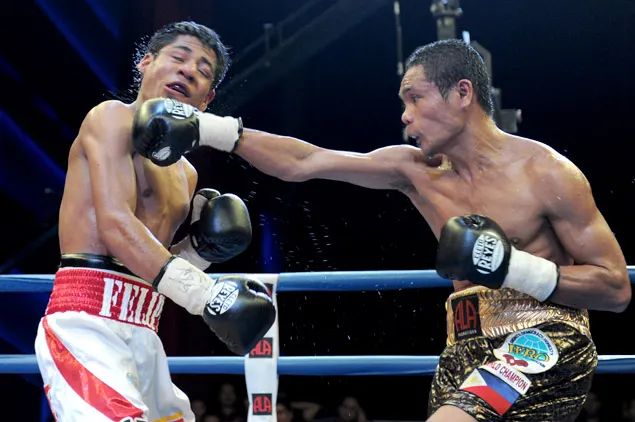
The stance’s manoeuvrability combined with insane reflexes and a slick shoulder roll are probably the most flashy element of his defence but they do carry considerable risk. even a fighter of Rigo’s calibre can get caught off balance. Considering that fighters like Nonito Donaire and Hisashi Amagansa whose feet do not move with half the surety or speed of Lomachenko were able to catch Rigo as he exited exchanges raises the question of how the Cuban will deal with an opponent who can effectively pressure him as he retreats.

When considering how Rigo will cope with Lomachenko’s offence however it is important to keep in mind that footwork is only the first layer of his multifaceted defence. The next is his lead hand, Rigo uses this hand for a variety of purposes, both to land hard counter hooks and to block his opponents’ punches.


His jab meanwhile would seem to be a neglected area of his game as he usually lands only a small percentage of those he throws. Rather than any lack of skill however, this reflects the fact that he often throws it as a range finder for his true money punch, his left hand.
Get Hector Ribeiro’s stories in your inbox
Join Medium for free to get updates from this writer.
For all the impressive knockouts he has scored with his notoriously powerful left straight, it is worth noting that he will almost certainly face difficulties in landing it consistently in this fight given that his fellow southpaw Lomachenko’s lead hand will be directly in its path. Rigo might be better served by his excellent counter-left to the body, a seemingly laser-guided punch that he is adept at timing underneath his opponents’ arms.


The threat of being countered may make Lomachenko think twice about invading the Cuban’s personal space, after all, Orlando Salido’s sustained body assault certainly succeeded in making the usually ultra-confident Lomachenko look downright timid at times. Should he succeed in dictating the distance of the fight and turn it into a slow chess match on the outside, the fight is his to lose.
What to expect
Lomachenko’s pressure and output will likely put Rigo on the back foot, as such it is hard counter-shots such as these which will probably comprise the majority of his landed punches on Saturday night. Fortunately for him, he carries seemingly far greater power behind his blows than Lomachenko does in any of his and it will be imperative for him to punish the Ukrainian’s aggression.
Expect the first few rounds to be a chess match as both boxers trying to impose their footwork, establish a rhythm and throw feints galore. Both fighters are extremely difficult to hit, just 16.8% of all punches thrown at Lomachenko have landed whilst for Rigo the figure is an even more impressive 16.4% (to put things in perspective, the same figure for Floyd Mayweather Jr is 19%) as such a back and forth war seems unlikely. Regardless, even if the fight ends in the first round you will see more techniques on display than you would in the average twelve round fight, that in and of itself is what makes this the best fight in recent boxing history and well worth the price of admission.
Whichever amateur standout emerges victorious, there will be an article released after the fight breaking down the techniques and strategies that carried them to victory.