Taking a Risk
By Dana Pe’er

Dana Pe’er, Ph.D., Department of Biological Sciences, Columbia University, has received two grants from Stand Up To Cancer.
On a Friday afternoon in the middle of July, with most of New York skipping out of work and leaving town to get a head start on the weekend, I sat on a stage engaged in a panel discussion about cancer research, immunotherapy, and clinical trials. And I wouldn’t have wanted to be anywhere else.
I was participating in a “Priceless Conversation,” an event hosted by Mastercard featuring fellow cancer researcher Dr. Julian Adams, president of Research and Development, Infinity Pharmaceuticals, Inc.; Linda Kirkpatrick, Executive Vice President, Market Development, Mastercard; and Karen Taphorn, a cancer patient who achieved remission after participating in a clinical trial. The moderator of our panel was award-winning journalist and cancer advocate Katie Couric.
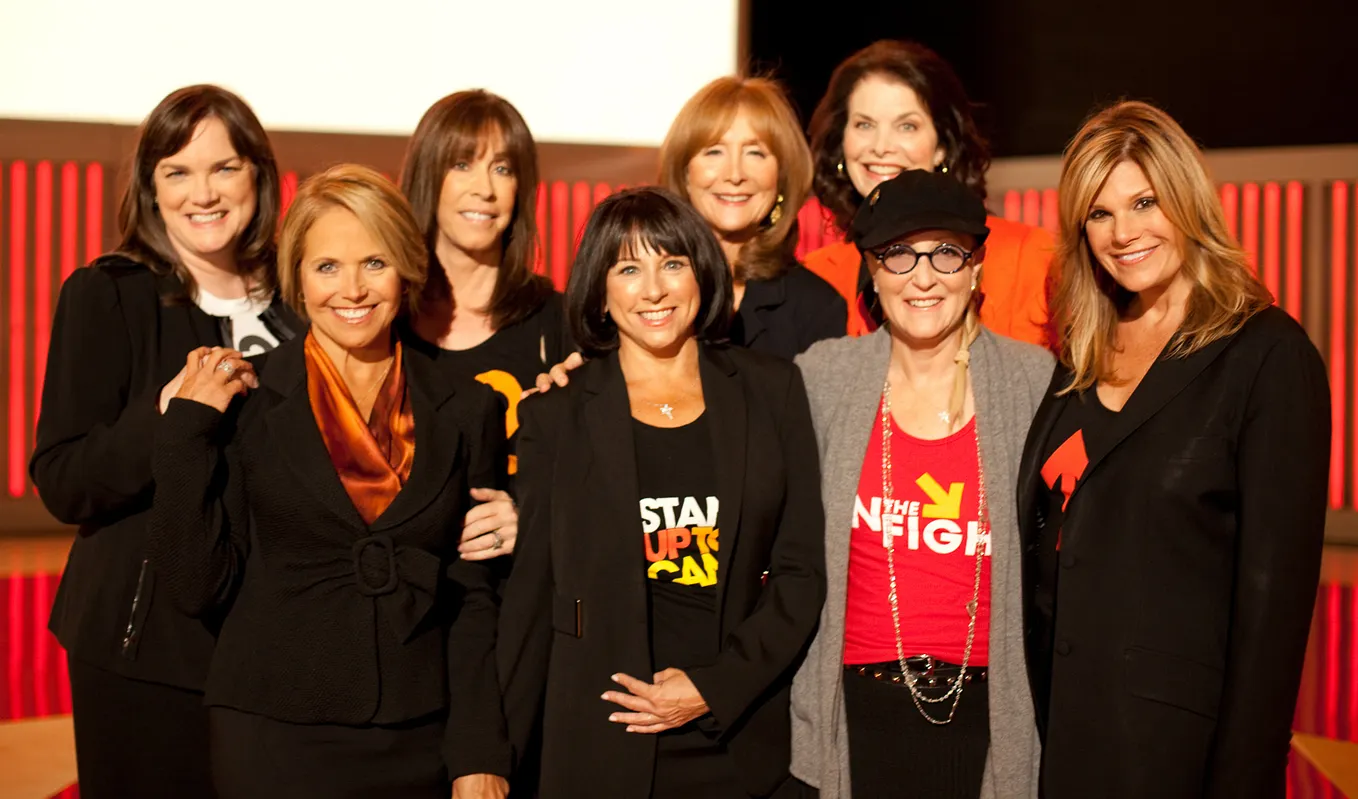
The common bond that brought all of us together on a hot Friday in Manhattan was Stand Up To Cancer (SU2C), an initiative that raises funds to accelerate the pace of research to get new therapies to patients quickly and save lives now. Katie Couric is a co-founder of SU2C. She is among a group of women from film and media who started this movement in 2008 because they were frustrated by the slow pace of research progress in many types of cancers. Dr. Adams serves on SU2C’s Scientific Advisory Committee. Linda is an executive at Mastercard, an SU2C supporter that has contributed more than $30 million[CR1] , thanks to its annual summer dine out campaign that invites cardholders to give back through the simple act of dining out. And Karen is literally living proof of the progress being made in the fight against the disease thanks to SU2C’s innovative collaborative model of research.
SU2C strives to break down the silos of cancer research and encourage collaboration to quickly get treatments to the patients who so desperately need them. Researchers who would historically have worked independently are now collaborating with scientists from different institutions and even different disciplines thanks to SU2C’s Dream Team approach. SU2C has created 19 of these Dream Teams since its inception eight years ago, with over 1,200 researchers representing 144 of the top institutions working together collaboratively.
But SU2C is more than just Dream Teams. SU2C has also awarded 36 Innovative Research Grants (IRG) to support early-career scientists with novel ideas that have a strong potential to improve patient care — projects that are high-risk, but could also be high-impact. And that’s my connection to Stand Up, because I am one of those 36.
I was trained as a mathematician, and as a computer scientist with an expertise in machine learning, so I can teach machines to look at data. I actually won a lot of awards and I was considered a good scientist in my field. But I really wanted to do something meaningful — I wanted to help fight cancer. While I had limited professional experience in cancer research, I had a lot of motivation. Cancer took both my mother and my best friend and I wanted to fight back.
Get Stand Up To Cancer’s stories in your inbox
Join Medium for free to get updates from this writer.
Cancer is complex. Our genome is complex. We have three-billion letters in our genome. They go wrong in cancer in many different ways, unique and individual to every patient. We have thousands of different cell types, tens of thousands of different genes, all creating differences inside our cancer that influence therapeutic response. This is too daunting for even the smartest and most brilliant human to decipher, but computers can run through data very, very quickly.
What we do is we teach computers to be able to look at data that comes directly from patients and see patterns. My computer crunches through 100-billion data-points and then finds a connection, perhaps a surprising connection, perhaps a pair of drugs that could work for a specific type of patient. Or, it finds a biomarker that can predict whether a patient might respond to a certain drug more effectively than to others. We humans can’t go through 100-billion data-points, but we can teach computers to do that. That is what we do in my lab.
In the three years before connecting with SU2C, I applied for grants from various funders. Time and again, I was turned down. The fact that I wasn’t trained in cancer science, and that my mentor assignment was not optimal to access cancer research or funding opportunities, appeared to be an insurmountable stumbling block. I couldn’t do cancer research because I didn’t have any prior experience in cancer research.
I was on the verge of burning out. I had no more funding. I was about to fail as an academic. I sent my application to Stand Up To Cancer as a Hail Mary. I didn’t actually think I would get the grant. But I was wrong. They believed in me, saying “You’re clearly serious about this and you have tools with big potential to help fight cancer.”
One of the obstacles researchers have early in their careers is called “proof of concept.” Basically, you have to complete some of the research to prove your approach has a good chance of working before you can get a grant. It’s a classic “Catch 22” that makes it hard to bring up a whole new idea. But Stand Up To Cancer is interested in new ideas and has no such requirement.
Stand Up gave me the funding that saved my career. Their backing meant I could take my entire lab and all of my intellect and figure out how to turn the computer into a life-saving tool for cancer patients.
Stand Up To Cancer gave me more than just money, though. It allowed me to join the community, to be directly mentored through a crash course in cancer research by greats in the field. The interactive immersion in SU2C scientific summits helped me better understand the most up-to-date in cancer research, so I could return to my lab and refocus our research efforts in the most promising avenues. Now I am about to take a major next step in my career, thanks to the chance I was given by Stand Up To Cancer, and the mentorship provided by other SU2C scientists.
I am so thankful to Stand Up to Cancer for taking a risk with me. I’m also incredibly grateful to donors like MasterCard who have made it possible for Stand Up to continue funding out-of-the-box research projects like those of my fellow Innovative Research Grantees. Making significant progress requires innovative thinking and really big ideas.
NOTE: This summer, when you spend $10 or more when paying for a meal with a Mastercard card, Mastercard will make a donation to Stand Up To Cancer (SU2C), one precious cent at a time up to $4 million. Ends 8/19/16 or when max is reached, whichever occurs first. See Terms at priceless.com/standup.
SU2C’s biennial telecast will air on over 50 broadcast and cable networks on Friday, Sept. 9.