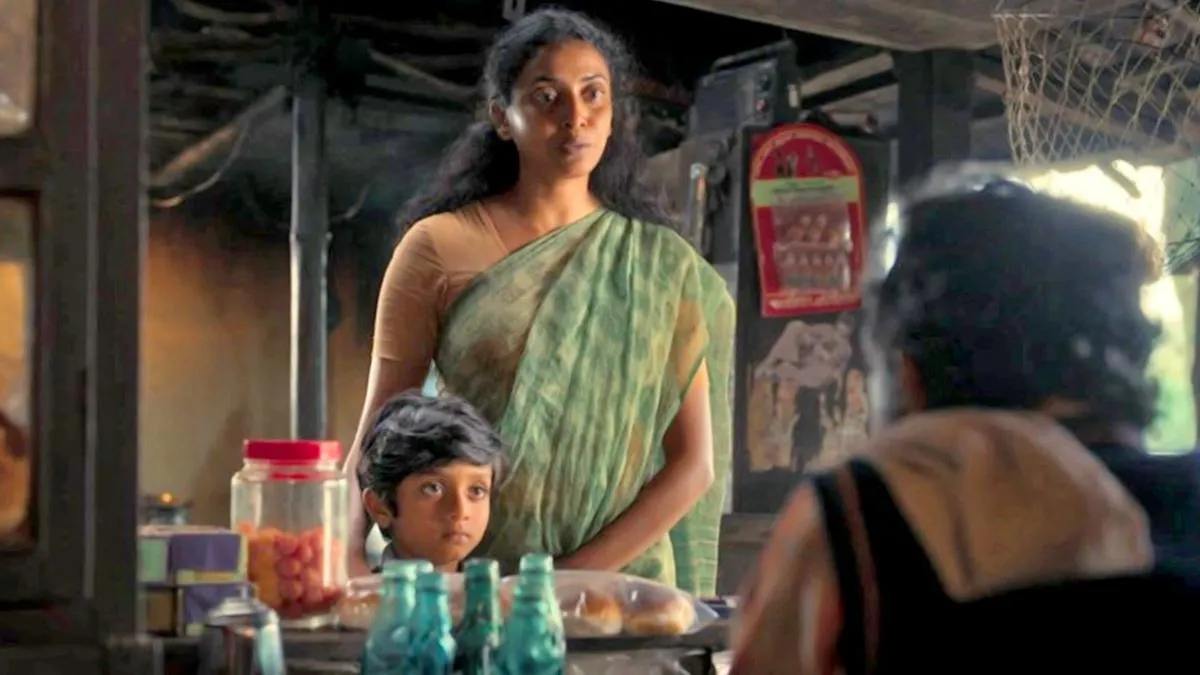
Idli Kadai Review

7.5/10

I was initially leaning toward a 6.5 to 7, but after finishing Idli Kadai, I realized it’s more than just a “feel good” entertainer — it’s a robust, fulfilling film. A movie that, while familiar in tone and beats, brings enough depth, craft, and sincerity to earn its place.
On Predictability:
Let me get something out of the way right at the start: predictability does not make a film bad. That mindset has become way too common among certain critics — especially those who dismiss films by saying things like “we’ve seen this before” or “it’s that type of film.” These same arguments were used against films like GOAT and Raayan. But here’s the thing: all films are predictable to a point. Every genre has conventions — it’s how the director executes those conventions that counts.
A film is a director’s medium. The story may be familiar, but what matters is how it’s told — the tone, the performances, the technical craft, the emotional weight, the world-building. Dhanush understands this, and that’s what makes Idli Kadai work. Just like with Raayan, he takes a potentially generic premise and infuses it with energy, texture, and personality.
In Raayan, Dhanush gave us a version of the Tamil gangster film that felt more alive than most of its kind. He built a world that didn’t just go through the motions — it had personality, layers, and soul. And in Idli Kadai, he does something similar, especially with the villain dynamics. Rather than leaning into the tired trope of evil-for-the-sake-of-evil, we get a more nuanced father-son opposition that breaks from the usual mold of Indian and Tamil cinema.
Direction, Execution & Writing:
Directors like Dhanush and Prithviraj often get praised for their “vision” or “making,” but I also want to highlight how much they resist the lazy route. That’s something not many people mention. Sure, they may not always deliver award-winning material, and yes, mistakes happen — but they rarely fall into the trap of taking the easy way out.
Idli Kadai is a perfect example of this. It’s not revolutionary, but it doesn’t need to be. It does what it sets out to do — and does it well. More than that, it does a little more than expected. And that “more” is what elevates it.
Visually, the film is very well shot — the color grading, framing, and especially the night cinematography, are all handled with style and care. The production design is also impressive — detailed, immersive, and tonally aligned with the story.

On the Writing:
Now, while the direction is strong, Dhanush’s writing still has its limits. One of his long-standing issues is how he falls back on overly familiar character types. For instance, while he directed Nithya Menen very well, her character still ends up being that same old “Nithya cliché.” You know exactly what kind of character she’ll be the moment she appears, but still done well.
Get The Rambler’s stories in your inbox
Join Medium for free to get updates from this writer.
But even with those weaknesses, I’d say this is Dhanush’s best film as a director. The story here is thicker and more layered than Raayan, even if both are on par in terms of direction.
Performances:
Arun Vijay does a solid job here, though he comes off a bit one-note. That said, his action choreography is fantastic — as always. I’ve long hoped he’d get more substantial roles like in Mafia Chapter 1 or Chekka Chivantha Vaanam, but sadly, he’s still underused. The first action scene with him felt a bit unnecessary, but after seeing it — and the way Dhanush frames him — it’s clear Dhanush sees something in him too and wanted audiences to witness what he can do.
SPOILERS AHEAD
One of the most effective subversions in Idli Kadai is the villain family dynamic. Instead of making Sathyaraj (the father) the typical rich enabler of his violent son, we get something more layered. He loves his son and doesn’t want him to ruin his life with vengeance. This goes directly against the usual formula, where the father usually supports or incites the revenge path. In contrast, Arun Vijay’s character wants retribution, while the father wants peace — a welcome inversion.
Unfortunately, while the setup is excellent, it doesn’t go deep enough. This could’ve been a powerful mirror to Dhanush’s own arc in the film. Both protagonists — Dhanush and Arun — have father-son dynamic at the heart of their stories. Dhanush resists inheriting the family legacy, only to return to it in a more human way, while Arun’s character is unable to let go of his personal vendetta and looseness. There was potential here for some truly robust thematic symmetry, but it remains underdeveloped.
I would’ve liked to see this go the Gladiator route — and let me explain why.
The Gladiator Parallel:
It should have been more like Gladiator, where Commodus isn’t just evil for the sake of it. His actions come from a deep desire for his father’s love and respect — something he never received due to Marcus Aurelius being emotionally distant and absent for most of his childhood. That lack of connection built over time until he finally snapped, not just because he wasn’t made emperor, but because his father chose someone else — Maximus, the man he saw as the son he wished he had.
Commodus even says, “I would butcher the whole world if you would only love me.” That’s Shakespearean-level character writing, which sums it up. He wasn’t simply a bad ruler for the pleasure of indulgence, like the historical Commodus, but because he wanted to destroy what his father loved most — Rome. It was his ultimate revenge, a final act of defiance: to burn down the legacy his father cherished, because that legacy had no room for him.
That kind of depth — a villain who’s tragic and desperate for validation, not just “bad” — is something I hoped Idli Kadai would go deeper into. It had shades of it, but it doesn’t commit. Arun Vijay’s character is too straightforward in his anger, and I wish he had a more emotionally layered reason for his actions.
But the fact that it does have shades of it is really different to the norm and was refreshing to see.
END OF SPOILERS

Music:
The score by G.V. Prakash Kumar was… fine. It worked. It fit the mood. But honestly, I still can’t put him on the level of ARR, Harris, or Anirudh. He just doesn’t have the same it factor or memorability. Outside of Theri, I struggle to recall any standout scores from him. I know a lot of people love him, and he’s frequently hired in Tamil and Telugu cinema, but I don’t quite understand the hype. He’s functional, not exceptional. Composers like Santhosh Narayanan, Anirudh, or Sushin just bring more texture and identity to their work.
Final Thoughts:
Idli Kadai is a very satisfying, well-made film. Like a good idli meal — simple, comforting, yet rich and fulfilling. While not without flaws — particularly in character depth and thematic reach — it more than delivers on its promise. Dhanush continues to evolve as a director and storyteller, and while he still leans on familiar territory, he executes with sincerity, skill, and a refusal to cut corners.
This isn’t an awards-season film, and it doesn’t need to be. It’s a film that knows what it wants to be and does it well — and in today’s landscape, that’s something to celebrate.