Why Building a Bigger Underwater Robot Changes More Than Its Size

It is easy to assume that a bigger underwater robot can simply carry more equipment. When looking at the implications of a larger vehicle, however, the relationships extend from the internal layout and manufacturing process, all the way to launch and preparation for the mission.
That is one reason large autonomous underwater vehicles present a distinct engineering challenge. The increased range and payload capacity they offer is only part of the equation.
The challenge becomes creating a system in which everything works together. A larger vehicle is not simply a matter of building a bigger hull to accommodate the added equipment. Instead, it becomes an exercise in creating a platform that takes into account the interrelated factors of structure, internal layout, and the entire process from manufacturing all the way to launch.

A Bigger Vehicle Poses Different Engineering Challenges
Beyond the obvious increase in interior space, size dictates a number of other considerations. These may seem like design decisions, but they are deeply intertwined with the engineering and manufacturing processes.
Batteries need space, sensors need stable mounting points, and navigation and control equipment must fit alongside the payload. All these components must work together without interfering with one another. The structure itself has to provide space and support based on the anticipated load and motion of the system under water. All these factors need to be taken into account when designing the platform, and changes to one will invariably impact the others.
A larger autonomous underwater vehicle (AUV) becomes an even greater challenge, as it has to include systems to accomplish the mission without the input of an onboard human crew. Its structure, power, navigation, control, and payloads have to be integrated in a way that allows the entire system to function as a cohesive whole.
More Space Inside Has to Be Considered in Relation to the Mission
Additional interior space lends itself to increased capabilities, but it is not always a given that more space directly correlates to more capacity. The purpose of the vehicle has to be factored into the engineering process, as a platform designed to carry a particular type of equipment will necessarily have different considerations than one designed for a completely different set of needs.
Power and data connections become just as important as physical space when it comes to the integration of various components. Systems will require the appropriate interface, and engineers will need to take into account how different technologies communicate as well as how they draw power from the vehicle’s energy source. The ability to physically access components will also become a consideration, when payloads or other equipment need to be accessed, replaced, or reconfigured.
These decisions are connected and must be considered together when designing a platform for a specific mission. In this regard, designing a larger vehicle is more valuable, as the necessary equipment can be integrated without having to consider entirely different layouts for each new addition.
It is also why the capacity of the platform should not be considered in a vacuum. The real value lies in how well the system can be adapted to use that capacity to best advantage over the course of the mission.
The Structure Has to Accommodate More Than a Simple Hull
The hull does more than enclose the vehicle. Its design affects weight, available space, structural performance, and how other systems are integrated.
The structure itself will inform the overall weight and volume capacity of the system, as well as the potential for integration and the production process. This is where the consideration of composite materials becomes relevant, as they can be engineered to suit a number of different applications. Carbon fiber composites, in particular, have found use in a variety of marine and subsea applications where strength, weight, and overall structural integrity is a concern.
The value of any particular material will be dictated by the needs of the application and the overall design of the structure. In all cases, however, material considerations will have to be made in relation to the intended purpose, the anticipated load of the system, and the overall needs of the mission.
The increased size of the vehicle also presents new considerations when it comes to the production process. The design has to be finalized in such a way that the structure can be produced consistently and at scale, while also retaining the ability to integrate the necessary components.
This is why manufacturing considerations cannot be an afterthought in the development of a new system. The production process has to take into account not only the final appearance and intended purpose of the vehicle, but also its ability to be manufactured consistently and integrated with the necessary equipment.
For large autonomous underwater vehicles, these considerations have to be made from the very beginning of the development process.
Large Underwater Vehicles Need a Practical Route From Factory to Water
Building the vehicle is only one part of the process. It must also be transported to the launch site, where its size and design can affect handling, preparation, and the facilities required.
This is yet another consideration that has to be factored into the overall design and production of the system, where the final platform has to be taken into account not only in terms of performance but also in terms of practicality of deployment.
A vehicle with excellent performance characteristics underwater could be rendered less useful if it is unduly complicated to transport and prepare for launch. By designing a system around the practicality of operations and transportation, the overall utility of the vehicle can be increased without necessarily having to change its fundamental design.
This is not to say that every large autonomous underwater vehicle (AUV) has to be designed in the same way. Some applications and missions are better served by different configurations, whether in terms of transport and launch or other considerations.
Get Undersea Frontier’s stories in your inbox
Join Medium for free to get updates from this writer.
The value of this approach lies in its application to the overall engineering and production process. The necessary elements have to be taken into consideration at every stage, rather than designing a system around a set of theoretical capabilities and then being forced to reconsider when it comes time to bring that theory into practice.
When it comes to the U.S. Navy’s work on large unmanned undersea vehicles, the long lead-up to the actual production of the first system is an especially telling sign of the kind of engineering that goes into these projects. In December 2023, Naval Sea Systems Command announced the delivery of the first Orca extra-large unmanned undersea vehicle test asset system. The program as a whole involved years of design and production, with the initial vehicle expected to serve as a prototype ahead of the production of additional units. Read the Navy announcement.
The same principles apply at every level of the production chain. The final product is only as good as the process that goes into its creation.
Manufacturing Becomes a Bigger Part of the Problem
A single large autonomous underwater vehicle is one thing. Being able to produce multiple units of the same design is quite another. The production process has to take into account the structural and integration considerations at every stage, from design and prototyping all the way through final production and quality control.
This is why the overall approach to production has to be considered as part of the larger engineering conversation. If the process of building each new unit requires significant changes and adjustments, then the ability to consistently produce new vehicles will become an issue.
This consideration becomes especially relevant in the case of large AUVs. Engineers and manufacturers need to take into account the overall approach to production as part of the larger conversation regarding structural design and component integration.
This does not mean that large vehicles have to be built using composite materials in order to facilitate easier production, but it does mean that the principles of manufacture have to be considered alongside the principles of engineering and design.
At this point, the value of this conversation becomes apparent within the context of the wider industry. As manufacturers attempt to create new and increasingly capable autonomous underwater vehicles, they have to consider not only the abilities of the final product but its ability to be consistently produced at scale.
Why Platform Design Matters for Future Undersea Missions
Large autonomous underwater vehicles are being created for a number of different applications, from oceanographic research to seabed monitoring and even defense-related missions. The requirements for each application are different, but the underlying principles remain the same. The vehicle has to be able to carry the necessary equipment and provide the required capabilities, within the limits of the practical considerations of manufacturing, launch, and other aspects of the mission.
A platform approach can be extremely valuable in this regard.
Rather than designing each new autonomous underwater vehicle as an entirely separate entity, engineers can instead work from the same basic design and make adjustments based on the needs of the mission, where practical.
This does not apply to every scenario, but it does provide a significant advantage when it comes to the creation of vehicles with widely varying requirements.
The true value of this approach, as mentioned previously, lies in its application across the entire production chain. Instead of designing one vehicle, building it, and then having to redesign it completely for the next mission, the engineer can work from the same basic set of plans and make only the changes to fulfill the new requirements.
This is why the true consideration is not one of size, but rather one of practicality. The larger vehicle has to be taken into account at every stage of the process, from design and production to launch and operation.
How Composite Energy Technologies Fits Into This Shift
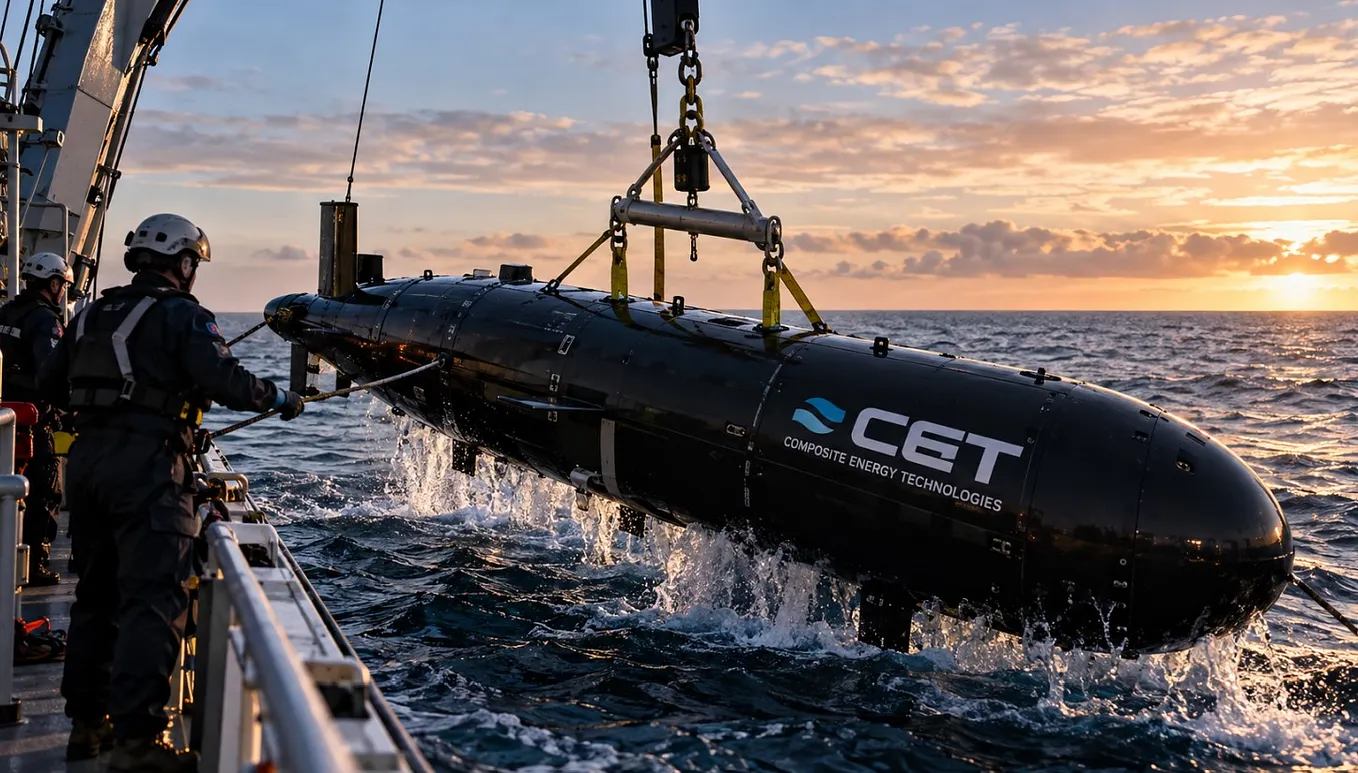
One company that is currently working on exactly these kinds of vehicles is Composite Energy Technologies, Inc. (CET), based out of Bristol, Rhode Island. As the name implies, CET works on composite materials and structures, and its HADALUS family of large autonomous underwater vehicles takes full advantage of the potential of composite construction and autonomous systems. Its various models are designed with a focus on payload capacity, range, construction material, and production scalability. CET’s HADALUS-XL flat-pack AUV announcement includes additional details on the company’s approach to transportation and production.
CET’s HADALUS-XL flat-pack AUV provides a practical example of how transport requirements can influence vehicle design, including the use of standard shipping containers. The company’s recent announcement of the HADALUS-XL flat-pack AUV provides additional insight into the overall approach, including its focus on transportation via standard shipping containers.
The principles continue to apply at the level of the individual manufacturer.
A larger autonomous underwater vehicle is more than a scaled-up version of a smaller one. Its structure, internal systems, manufacturing process, and deployment requirements all influence how useful it will be. As large AUVs develop, coordinating these elements will remain central to turning vehicle capability into practical mission performance.
Sources and further reading
1. U.S. Navy: Delivery of the first Orca XLUUV test asset system
2. Composite Energy Technologies: HADALUS-XL flat-pack AUV