Why Vibration Control Matters in Autonomous Underwater Vehicles


I grew up thinking that when a machine runs smoothly, it is doing its job. You turn it on, it works, and you rarely think about what is happening inside. But the more you learn about complex machines, the more you realize that even small movements and vibrations can affect how everything works.
That is especially true for autonomous underwater vehicles.
Inside an AUV, motors, propulsion equipment, rotating components, and other machinery are constantly generating some level of vibration. That is part of operating a machine. The real challenge is what happens next. Where does that vibration travel? Does it reach sensitive equipment? Can it affect sensors, navigation systems, or other components the vehicle relies on?
These are questions engineers have to consider when designing an underwater vehicle. Vibration control is not just about making a vehicle quieter or reducing mechanical movement. It is about making sure the different parts of the vehicle can operate together without one system interfering with another.
And that work starts long before the vehicle enters the water.
Sources of Vibration
There are many potential sources of vibration within an AUV.
One clear source of vibration is the propulsion. Motors, shafts, propellers, and other moving parts can all cause vibrations. How much and how frequently will depend on the equipment, speed, and mechanical design.
Other sources include:
Electric motors and drives
Rotating machinery
Propellers
Mounting points and joints
Pumps and ancillaries
Structural reactions
Depending on the equipment, engineers need to understand its characteristics and how movement can affect surrounding components.
How Vibrations Travel
Vibrations can travel from one component to another.
Vibrations can travel from the motor to the surrounding structure. It can then travel through mounting points, brackets, panels, and other connected components.
The material used and the vehicle’s design will affect how vibrations travel.
A rigid design may transmit vibrations differently to one with appropriate isolation. The position of the equipment will also be considered. Components mounted near the source of vibrations may have different conditions.
Engineers consider this when designing the whole mechanical system.
Sensor and Navigation Equipment
It is important to understand vibrations and how they will affect equipment used to study the underwater environment.
Acoustic sensors and navigation equipment require appropriate conditions to function well. Mechanical vibrations can cause additional noise or affect the readings. This depends on the equipment and frequency.
Acoustic equipment will need to distinguish useful signals from background noise. Vibrations from mechanical equipment can make this difficult.
Navigation and measurement equipment will also require appropriate mounting.
Engineers will need to consider where sensitive equipment is mounted, how it is supported, and if nearby machinery will affect its performance.
Mounting
Mounting equipment can be a practical solution for managing vibrations.
How the equipment is mounted will affect how it is connected to the structure and how much mechanical energy passes through.
Depending on the application, engineers may consider:
Get Undersea Frontier’s stories in your inbox
Join Medium for free to get updates from this writer.
Rigid mounting for equipment requiring a stable connection
Vibration isolation for sensitive equipment
Material and stiffness of the mounting
How the equipment is connected and supported by the structure
Position of the equipment
Accessibility for inspection and maintenance
Not all components will require isolation. Some equipment will require a strong connection to keep it in line or cope with the operational loads.
This depends on what the equipment is doing and the conditions it will be exposed to.
Propulsion and Structural Design
The propulsion system will need to integrate with the vehicle’s mechanical design. How it is mounted, aligned, and connected can affect how vibrations are transferred.
Stiffness, material and support components will all be considered.
This is particularly important in larger underwater vehicles, as the propulsion equipment, payload, and support systems will be spread out across the platform.
Engineers need to consider these factors when designing.
Testing and Measuring Vibrations
Assumptions made during design can be tested.
Measuring vibrations can help engineers understand which frequencies and levels of vibration are generated by the operational equipment. It can also provide information on how vibrations are traveling throughout the vehicle and whether any specific components are experiencing unwanted movement.
Depending on the design, engineers may measure:
Vibrations at mounting points
Vibrations from the propulsion
Structural reactions
Monitoring sensitive equipment during operation
Different speeds
If the isolations are working as intended
This will help engineers identify areas that may need to be altered before the vehicle goes into service.
Large Underwater Vehicles
Larger autonomous underwater vehicles will have more equipment, structural components and systems.
Composite structures, pressure vessels, batteries, propulsion equipment and modular payloads will all have different mechanical requirements. How they are positioned and connected will affect how the whole platform behaves.
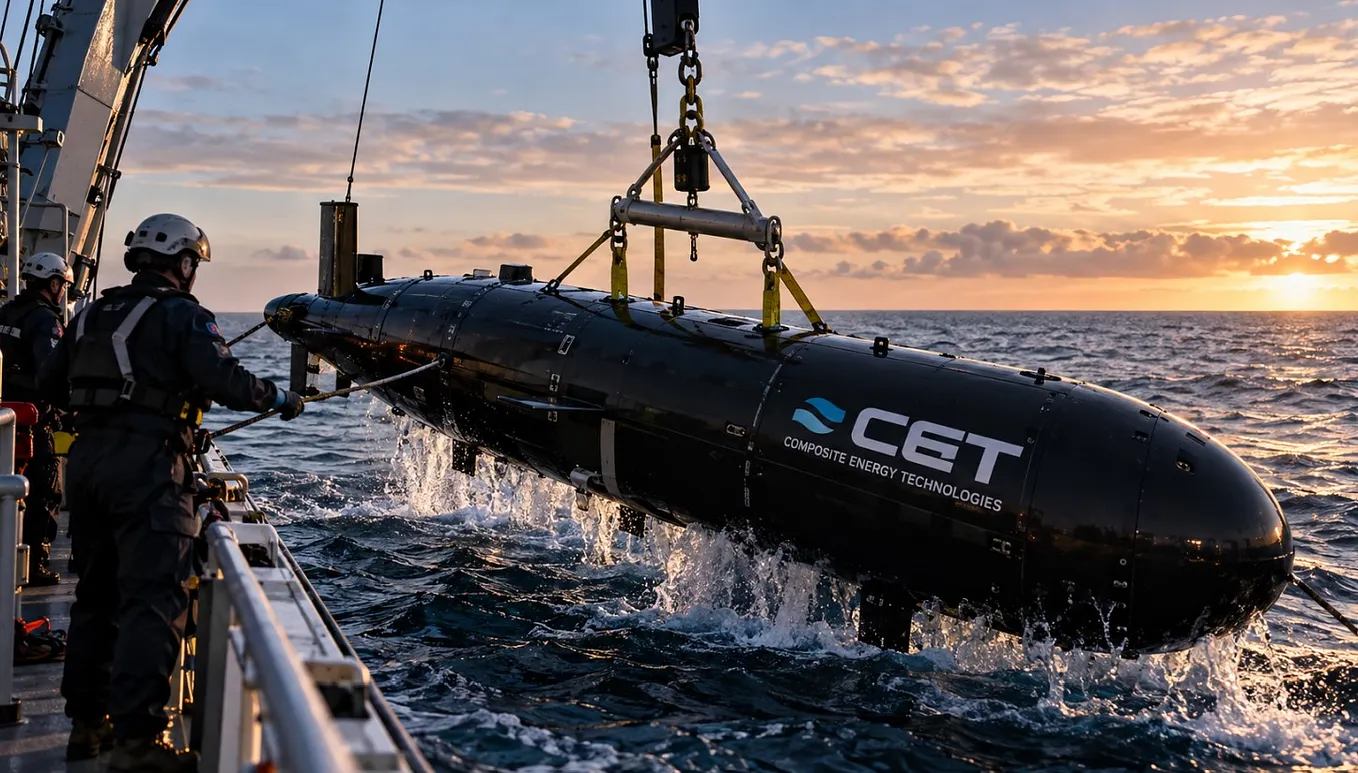
Composite Energy Technologies (CET), based in Bristol, Rhode Island, specializes in advanced composites manufacturing and autonomous underwater systems.
Their HADALUS range of large autonomous underwater vehicles employs composite and vehicle design, as well as integrated underwater systems. They have designed, manufactured, and demonstrated full-scale HADALUS vehicles, including a submerged launch demonstration during a U.S. Navy exercise with Raytheon (RTX business).
This shows the importance of considering structural design, mounting, and system integration. Vibration is one of the factors engineers will consider.
Designing the Whole Vehicle
Reducing vibrations to a minimum isn’t always the main concern. Understanding what vibrations are important, how they will affect surrounding equipment, and what the vehicle needs to operate correctly is key.
Propulsion, structural design, mounting and sensor performance are all linked.
By considering these factors during design and testing, engineers can create underwater vehicles that will work well together.