Production-Grade AI Agents: Moving Beyond Benchmarks to Enterprise Reliability


In last week, we explored how agentic AI is shifting from passive co-pilots to autonomous systems capable of executing complex business workflows. The feedback and discussions in the comments made one thing clear: leaders understand why agents matter, but the real challenge is how to take them from impressive local prototypes into resilient, production-ready cloud environments.
Building a demo that works 80% of the time in a notebook is easy. Building a system that operates with 99.9% reliability across enterprise data pipelines is where the real engineering begins.
Here are the key Architectural Pillars required to run production-grade agentic systems today.
1. Robust State Management over Stateless Prompts
Traditional LLM calls are stateless, but real-world business operations are multi-step, asynchronous, and long-running. An agent handling customer onboarding or automated procurement might need to wait on third-party API webhooks, human approval, or external database queries.
To prevent execution loops or lost context, production architectures require deterministic state graphs (using frameworks like LangGraph). By persisting state directly in scalable database backends — such as PostgreSQL with pgvector or enterprise cloud datastores — you ensure that if a worker node fails, the agent can resume execution mid-workflow without losing its memory or repeating actions.
2. Standardized Tool Interfaces via Open Standards
One of the largest bottlenecks in scaling enterprise agents has been the custom glue code required to connect models to internal microservices, databases, and third-party SaaS tools.
Get Abdul Basit’s stories in your inbox
Join Medium for free to get updates from this writer.
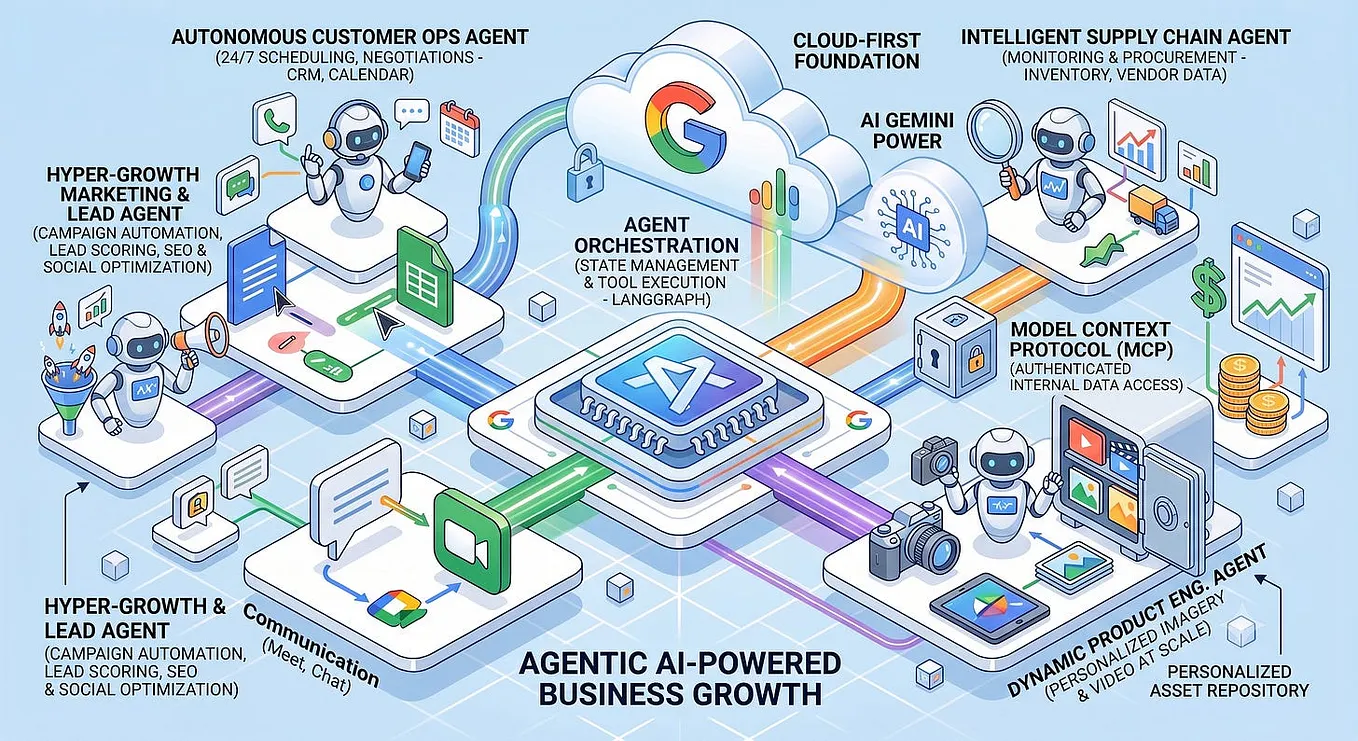
The industry is rapidly standardizing around protocols like the Model Context Protocol (MCP). By decoupling tool capabilities from the core model logic through standardized schemas, enterprise architectures become modular. You can swap underlying foundation models or add new tool capabilities — like Playwright web automation or CRM endpoints — without rewriting your core orchestration layer.
3. Local Prototyping to Secure Cloud Deployment
A scalable agent strategy balances developer velocity with enterprise security:
- Local Sandbox Environments: Utilizing tools like Ollama or local agent runtimes allows teams to rapidly iterate on agent logic, prompt instructions, and tool integration offline without incurring model API costs or exposing sensitive test data.
- Production Cloud Infrastructure: Once validated, deploying agent containers onto cloud platforms (such as GCP Vertex AI or Cloud Run) provides automated scaling, centralized secret management, and strict VPC perimeter security.
4. Deterministic Guardrails & Human-in-the-Loop Architecture
Autonomy without governance is a liability. High-performing agent systems don’t give AI free access to write to databases or execute transactions unchecked.
Instead, they enforce Human-in-the-Loop (HITL) checkpoints at critical state transitions. For example, an agent can autonomously analyze data, draft an action plan, and prepare API calls, but pause execution until an authorized human approves the transaction payload. Pair this with output validation libraries to ensure strict JSON schemas, and you eliminate uncontrolled hallucinations in production environments.
The Road Ahead
Moving from simple prompt engineering to full system orchestration requires treating AI agents not as novel software, but as distributed, event-driven microservices. The organizations winning with AI today aren’t waiting for perfect models; they are building robust cloud infrastructure around the models we already have.
Where is your organization currently experiencing the biggest bottleneck when moving AI projects from prototype to production? Drop your thoughts in the comments below — I’d love to hear your perspective.