The EU Wants to Read Your Messages. But Not Their Own.

A vote tomorrow in the European Parliament will decide whether mass surveillance of private communications continues — or finally ends. Here’s what’s really at stake, and why the answer can’t come from politics.

Tomorrow, the European Parliament votes on whether to extend “Chat Control 1.0” — a regulation that has quietly allowed Big Tech platforms to scan the private messages of hundreds of millions of Europeans since 2021. If extended, it continues until April 2026. If rejected, it expires April 3rd.
Most Europeans have never heard of it.
They should have.
What Chat Control Actually Is
The official name is the “ePrivacy Derogation.” The EU marketed it as a tool to fight child sexual abuse material (CSAM) online. The mechanism: allow platforms like Gmail, Facebook Messenger, Instagram, and Snapchat to scan every private message — automatically, without a warrant, without suspicion, without your knowledge.
Not just images. Text messages, too. Looking for “grooming patterns.”
The algorithm decides. There is no judge. There is no appeal before the scan happens.
Over 80% of respondents in the EU’s own public consultation opposed applying this to end-to-end encrypted communications. The Commission proposed it anyway.
The Part Nobody Talks About
In April 2024, a document was leaked to the French investigative outlet Contexte. It revealed what EU interior ministers were privately negotiating — the text they didn’t want debated publicly.
Inside: an exemption.
Police, military, intelligence agencies, and holders of “professional secrets” would be excluded from the scanning obligation. The people writing the law — the ministers, the commissioners, the generals — would not be subject to it.
The citizens would.
Patrick Breyer, then a Member of the European Parliament for the Pirate Party and the most outspoken opponent of Chat Control in the institution, put it plainly:
“The fact that the EU interior ministers want to exempt police officers, soldiers, intelligence officers, and even themselves from chat control scanning proves that they know exactly just how unreliable and dangerous the snooping algorithms are that they want to unleash on us citizens.”
They know it doesn’t work well. They just don’t want it used on them.
This Is Not New. The Pattern Always Looks Like This.
In 2013, Edward Snowden revealed that the NSA had been collecting the communications of hundreds of millions of people worldwide — under legal frameworks that said it was for national security.
In 2025, US lawmakers discovered that the UK government had secretly ordered Apple to build a backdoor into iCloud, allowing access to the encrypted data of users worldwide. The order was issued under a secret process. British courts prohibited Apple from even confirming it existed.
This week, a bipartisan group of US Congress members demanded a formal briefing from the UK government. The irony: the Americans — part of the Five Eyes surveillance alliance — are alarmed at a surveillance overreach.
In Russia, Pavel Durov was charged with “aiding terrorism” for refusing to hand Telegram’s encryption keys to the FSB. Telegram is expected to be blocked in April 2026. $500 million in assets frozen.
In the EU’s own corridors, Meta executives internally called WhatsApp’s end-to-end encryption “irresponsible” — while publicly advertising it as “privacy by design.” Revealed in court documents in 2026.
The pattern is identical every time: governments demand access, companies comply or resist, and users find out later. Trust is offered. Trust is broken.
Why Policy Alone Cannot Fix This
You might argue: elect better politicians. Pass better laws. Enforce GDPR properly.
These are not wrong responses. But they are insufficient ones.
Because every law has a jurisdiction. Every server has an owner. Every company has a CEO who can receive a secret order, a court injunction, or a threat of prosecution.
Durov had a company. He was arrested.
Apple had servers. They were ordered to build a backdoor.
WhatsApp had executives. They called privacy “irresponsible” in internal messages.
The EU ministers writing the surveillance law exempted themselves from it — because they understood, privately, that the infrastructure they were building was dangerous. They just didn’t extend that understanding to the 450 million people they represent.
This is not a failure of intent. It is a failure of architecture.
Get Paulo Aboim Pinto’s stories in your inbox
Join Medium for free to get updates from this writer.
When privacy depends on someone choosing not to look, it is not privacy. It is hope.
What “Architecturally Impossible” Means
The question is not: can we trust this company?
The question is: can this system be abused by anyone?
If the answer is yes, it will be. Not because people are evil. Because power over data is valuable, and valuable things attract pressure.
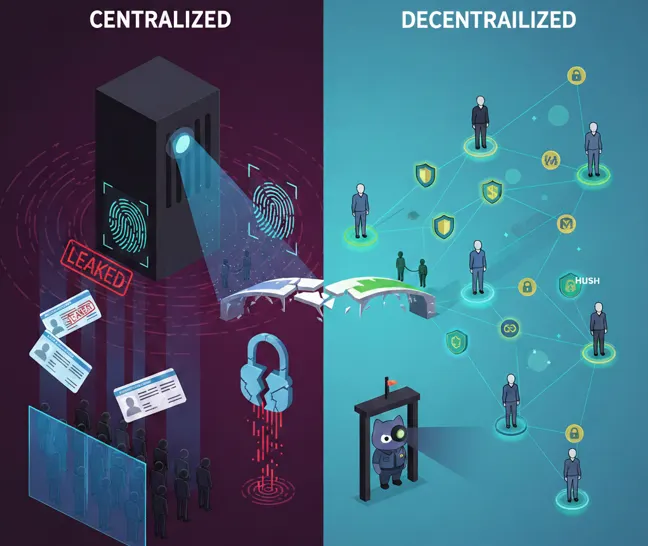
The only meaningful privacy guarantee is a system where the data cannot be accessed — not because no one wants to, but because the architecture makes it structurally impossible.
No central server means no server to seize.
No single company means no CEO to prosecute.
No master key means no key to hand over.
DAO governance means no single authority to receive a secret order.
This is not a theoretical framework. It is an engineering requirement.
The difference between “we won’t read your messages” and “we can’t read your messages” is not a matter of trust. It is a matter of design.
Every platform that has ever promised the first has eventually been forced — by law, by government pressure, by business incentive — to break that promise. Not because they wanted to. Because the architecture allowed it.
The only promise that holds is the one that doesn’t require anyone to keep it.
HushNetwork.social
HushNetwork is being built on exactly these principles.
Not as a reaction to Chat Control. As a response to the underlying problem, Chat Control reveals that centralized social networks — regardless of their intentions — are structurally incapable of guaranteeing privacy.
The architecture:
• No central server — data is distributed across the network. There is no single point to seize, subpoena, or shut down.
• End-to-end encryption by default — not as a feature you enable. As the foundation on which everything else is built.
• Zero-fee social actions — so the economic model cannot be captured, monetized, or weaponized against users.
• DAO governance — no single entity can change the rules, comply with secret orders, or sell the platform to someone who will.
• Blockchain-based identity — you own your account. No platform can deactivate it, shadow-ban it, or hand it over to a government.
When an EU minister issues a secret scanning order to HushNetwork, there is no one to receive it. No CEO to call. No server to access. No keys to demand.
That is not a privacy policy.
That is privacy by architecture.
The Vote Is Tomorrow. But You Don’t Have to Wait.
On February 26, 2026, the European Parliament votes on whether to continue Chat Control 1.0.
39 civil society organizations — led by European Digital Rights (EDRi) — have published an open letter urging MEPs to reject the extension.
Whether they succeed or not, one thing is clear: the fight over Chat Control will not end with one vote. Chat Control 2.0 is already in trilogue negotiations. The Cypriot presidency is driving the next iteration. The ministers who exempted themselves are still at the table.
The architectural question — who controls your communications infrastructure — will not be resolved by European Parliament votes alone.
But you can begin resolving it on your own. Today.
HushNetwork is currently in Alpha — not even Beta. This is the earliest possible stage: we are testing the concept, the architecture, the idea that a social network can be built where privacy is not a feature but a structural guarantee.
We are not promising a finished product. We are inviting you to help prove that this is possible.
If you believe privacy should be structural, not performative — if you think “we won’t read your messages” is not good enough and “we can’t” is the only honest answer — we want you at the table.
Join the Alpha at HushNetwork.social
The EU ministers exempted themselves because they understood the risk of living under a surveillance infrastructure they couldn’t control.
You deserve the same understanding. And the same protection.
Sources:
• Patrick Breyer MEP — Leak: EU interior ministers want to exempt themselves from Chat Control — patrick-breyer.de (http://patrick-breyer.de/)
• EDRi Open Letter — “We say no to Big Tech mass snooping on our messages” — edri.org (http://edri.org/) (Feb 25, 2026)
• Nextcloud — “How the EU Chat Control law threatens democracy” — nextcloud.com (http://nextcloud.com/)
• EFF — “Chat Control Is Back on the Menu in the EU” — eff.org (http://eff.org/)
• Center for Democracy and Technology — EU Tech Policy Brief January 2026 — cdt.org (http://cdt.org/)