Most First-Time Founders Are Chasing the Wrong Thing First


Step One: start a business. Step Three: profit. What happened to Step Two?
That question sits at the center of how most first-time entrepreneurs think about launching a company. They assume the missing piece between their idea and their success is money (one investor, one check, one yes). So they spend months writing a business plan, building a pitch deck, and rehearsing their ask, all before a single stranger has paid them a dollar.
It’s backward. The businesses that get funded are, almost without exception, the ones that have already proven something no amount of money can buy: that the market actually wants what they’re selling.
That proof is called validation, and most founders never do it. They collect encouragement instead, and mistake it for evidence.
Encouragement Is Not Validation
Friends saying “great idea” is not validation. Social media likes are not validation. Compliments from people who love you unconditionally are not validation. Your mother may think your idea is destined to explode. She is not the most objective market analyst you’ll ever meet.
Validation begins when real people commit time and attention: they join a waitlist, schedule a call, place a deposit, pre-order, or buy. The market rewards evidence, not enthusiasm.
This distinction matters because it changes what you should be doing in the earliest days of a business. Your job isn’t to build a perfectly optimized company. It’s to determine, as cheaply and quickly as possible, whether real prospects will exchange real money for what you’re offering.
That doesn’t mean you should sell below cost or ignore basic economics. It means early transactions teach you what no amount of planning can replicate: pricing sensitivity, perceived value, objections, and positioning. If your product costs $50 to make and people are willing to pay $100, that’s a strong signal the market sees real value in it, even if your margins are still rough around the edges. Efficiency, better supplier pricing, and improved fulfillment tend to arrive as volume grows. None of that matters if nobody wants to buy in the first place.
Even before you’ve built the full product, you can validate. When people join your waitlist, sign up for a beta, or leave feedback on a prototype, they’re signaling demand. A concept video, a landing page, a Kickstarter campaign- each is a “soft sale” that can later evolve into revenue. As the authors put it: sales begin the moment a prospect says “I’m interested” or “How soon can I get it?”, not the moment money changes hands.
Before You Build, Talk to People
Once you’re convinced your idea has merit, the next move isn’t to start building. It’s to develop an evidence-based understanding of the market — study the competitive landscape, identify existing alternatives, and surface your potential customers’ unmet needs and frustrations. Translate the idea into something tangible as early as possible: a prototype, a minimum viable offer, a testable version of the service.
AI tools and digital platforms have made this dramatically faster than it used to be. You can analyze markets, study customer sentiment in reviews and online communities, and pick apart competitors’ positioning in an afternoon. But information alone isn’t enough. Insight comes from interaction. Talk to prospects. Test your assumptions in real time. Watch how people actually respond to your offer, not how they say they’ll respond.
The goal isn’t to confirm your idea. It’s to challenge it until it proves itself.
This is also where proximity to competence pays off. Learn from people who’ve already succeeded in your field, through mentorship, collaboration, or simply studying their decisions closely. One of the book’s authors, Jay Abraham, spent his early career getting into the offices of accomplished entrepreneurs any way he could, including having oversized business cards made just to force a laugh and a conversation out of a receptionist. He’d walk in and ask thoughtful, sometimes provocative questions, then leave and ask himself: What just happened? What’s the principle here? What can I learn? Decades later, the tools have changed; LinkedIn messages and podcast outreach have replaced oversized business cards, but the mindset hasn’t. People still respond to sincerity, curiosity, and courage.
Get Dr Villy Abraham Author/Business Strategist’s stories in your inbox
Join Medium for free to get updates from this writer.
Pick One Idea and Kill Your Darlings
A recurring pattern among founders who never gain traction: three, four, five product ideas they want to develop simultaneously. The creativity is real. The execution collapses under divided attention.
For most undercapitalized, understaffed entrepreneurs, it’s nearly impossible to patent, trademark, fund, and launch multiple ventures at once. Even one can stretch resources to the limit. Over-diversification dilutes performance almost every time. The founders who win aren’t the ones with the most ideas — they’re the ones who know which single idea to focus on first.
Write the other ideas down in an inspiration log, then put it away. They’re fuel for later, not distractions for now.
The Spinning Towel Story
Picture this: you’re a spinning-class regular with an idea for a specialized towel that fits over a spin bike's handlebars. You spend $500 on materials, find someone to cut and sew them, and sell a batch to a few trainers. They come back and say, “This is fantastic, sell me ten more.” You sell them ten more.
You take the idea to trainers in another city. You sell twenty, then forty. At that point it’s worth protecting with a patent. You use whatever capital you have, even credit cards, to keep producing, because repurchase momentum is building. Eventually you’re at a trade show, walking the floor without a booth, talking to factories, buyers, and other vendors, learning the industry from the inside. Larger orders start coming in, not “nice work” but “you have to find a way to make more.” That’s the green light.
Notice what didn’t happen anywhere in that story: no pitch deck, no investor meeting, no seed round. Just a $500 bet, real customers, and a willingness to keep showing up. That’s what proof of concept looks like in practice, and it’s exactly the kind of story that makes an investor lean in later, because by the time you do walk into a pitch meeting, you’re not asking them to believe in a hypothesis. You’re asking them to help you scale something that’s already working.
Make a Sale — However Small
Peter Drucker put it best: “The purpose of business is to create a customer.” That’s the whole test. If you open the trunk of your car at a flea market and sell fifty units in two minutes, you have a business. No backers, no website required. If you have customers, you have a business. If you don’t, you don’t, regardless of how polished your deck is.
Many entrepreneurs spend months refining features, designing logos, and perfecting business plans without ever answering the one question that matters: will anyone actually buy this? Answer that question first. Everything else is downstream of it.
Your First Ten Moves
The book on which this article is based (see below) lays out a practical, iterative framework rather than a rigid sequence, get hands-on experience in your industry, focus on your single best idea, build a roadmap with real timeframes, inventory your tangible and intangible assets, identify a small test panel for honest feedback, find proof of concept through a simple landing page or pre-order test, sell wherever and however you can, show up where your audience already is, build a brand people remember, and never get too comfortable, because the market, your competition, and your customers will keep changing under your feet.
None of these steps require outside capital. That’s the point. Long before you’re ready to sit across from an investor, you need to have already done the unglamorous work of proving, in small and repeatable ways, that real people will pay for what you’re building.
Where This Leaves You
If you’ve validated demand, you’re not done; you’re just getting started. The next question is how to fund the growth that follows: whether to bootstrap on customer revenue alone, whether crowdfunding makes sense for your specific business, and eventually, how to walk into an investor pitch already speaking their language instead of yours.
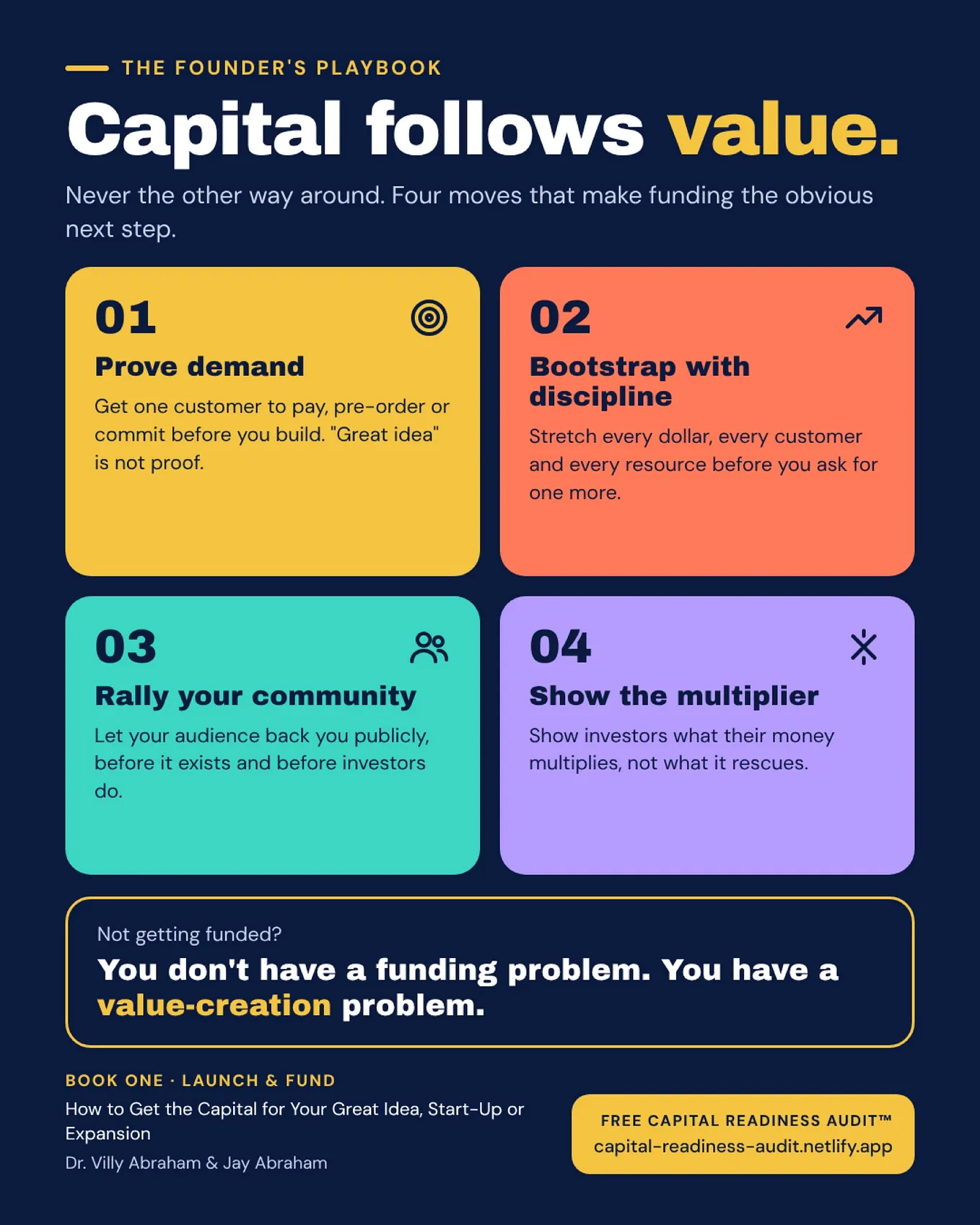
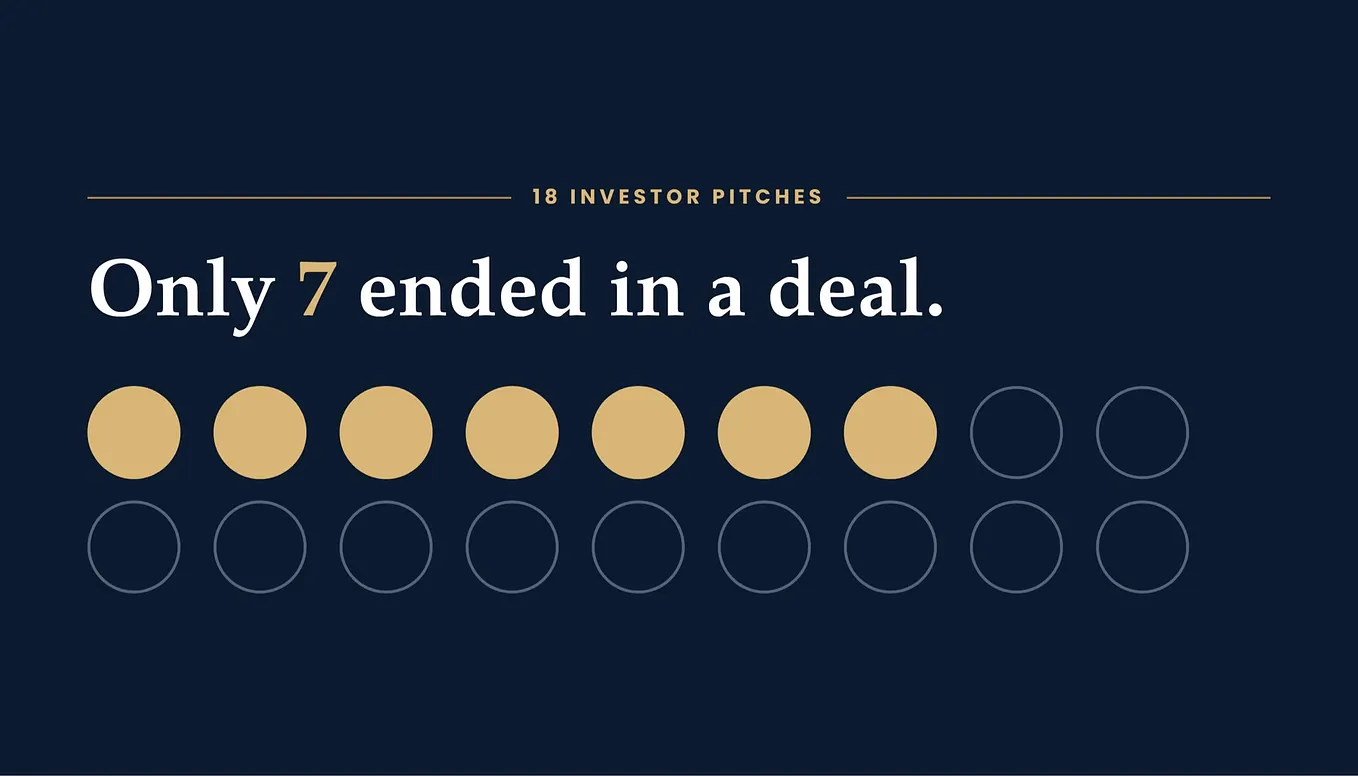
That’s the arc of Book One: Launch & Fund, validating demand before you chase capital, knowing when to bootstrap versus raise, using crowdfunding without underestimating its true cost, and understanding exactly what makes an investor lean in or walk away, illustrated through eighteen real, unfiltered pitch case studies.
If this resonated, How to Get the Capital for Your Great Idea, Start-Up or Expansion — Book One: Launch & Fund by Jay Abraham and Dr. Villy Abraham is available on Amazon, and picks up exactly where this article leaves off.