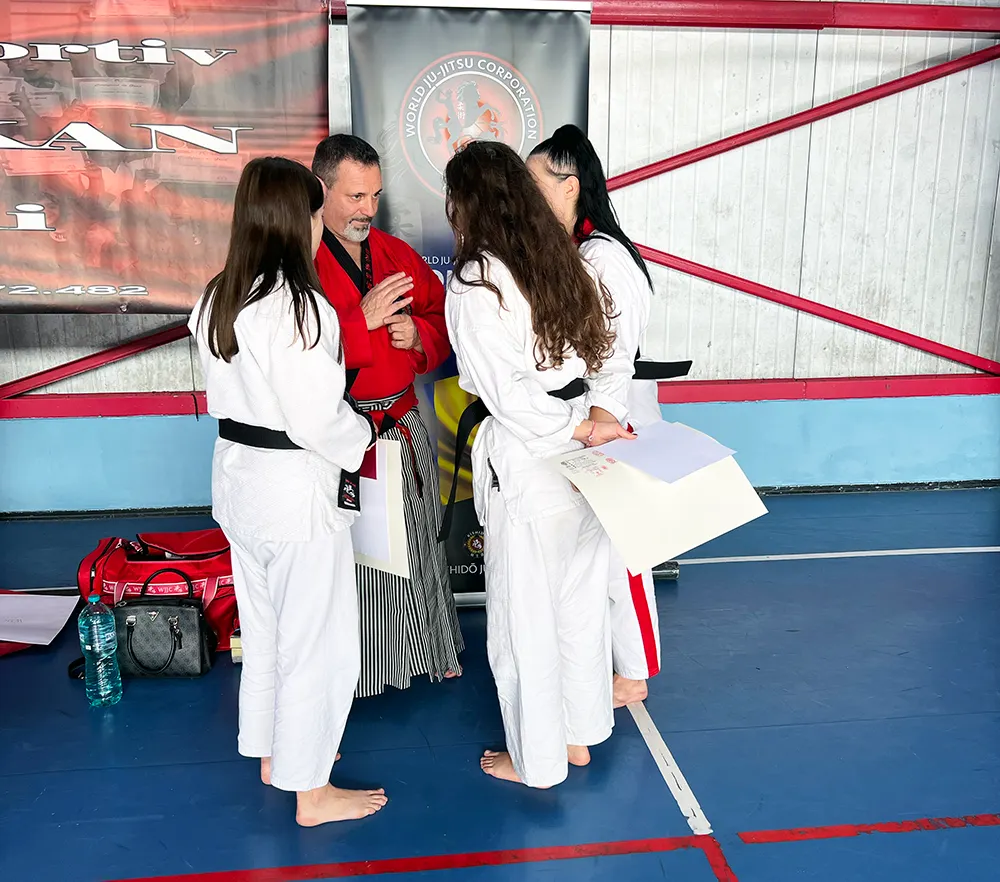
What Does It Really Mean to Represent a Martial Art Internationally?


International representation begins with responsibility and grows through shared technical knowledge.
Beyond national appointments and international recognition, the real responsibility lies in developing people, preserving technical identity and creating continuity.
By Soke Adriano Busà
Founder & International Technical Director
World Ju-Jitsu Corporation
International Representation Is a Responsibility, Not a Destination
In the world of martial arts, international representation is often presented as an achievement. A national appointment, an official designation or the opportunity to represent an organization can undoubtedly carry considerable significance.
However, the real value of such recognition does not lie in the appointment itself.
It lies in what follows.
Over many years dedicated to the development and teaching of Ju-Jitsu, I have come to consider international representation not as a destination, but as the beginning of a responsibility that must be demonstrated through continuous action.
A national representative is not simply someone authorized to use an organization’s name or display its emblem. That person becomes a point of reference for instructors, practitioners and schools, carrying the responsibility of communicating a martial art’s identity while encouraging its development.
An appointment may establish a role. Only consistent work can give that role substance.
A Flag on a Map Is Not the Same as a Martial Arts Community
The presence of a country within an international network can communicate geographical reach. Yet geography alone tells us very little about the actual development of a martial art.
What truly matters is what happens within that country.
Are students receiving regular instruction? Are instructors improving their technical knowledge? Are schools creating opportunities for new practitioners? Is there continuity between present activity and future development?
These questions reveal far more than the number of national flags displayed on a website.
An international organization should not measure its progress exclusively by the number of countries in which its name appears. Its strength depends on the quality and continuity of the work carried out by the people who represent it.
A small but active school, guided by a competent instructor who is committed to learning and developing others, may represent a more meaningful contribution than a prestigious appointment without any educational activity behind it.
In martial arts, credibility must ultimately be visible through practice.
Understanding the Art Before Representing It
Every martial art possesses an identity developed through its technical principles, educational approach, historical experiences and underlying values.
Representing that art internationally therefore requires more than general experience in martial arts.
It demands an understanding of the specific system being represented.
The World Ju-Jitsu Corporation promotes Kishidō Ju-Jitsu, a martial art founded on a defined technical direction and on principles that extend beyond the execution of individual techniques.
Energy, speed and precision are essential references within this approach. Their relationship must be studied, understood and progressively transmitted through training.
An instructor who approaches Kishidō with experience gained in another discipline may bring valuable knowledge and perspective. Such experience deserves respect, but it cannot automatically replace the study of the system itself.
International cooperation does not require instructors to disregard their previous experiences. It does, however, require clarity about the technical identity they have chosen to represent.
There is an important difference between respecting different martial traditions and treating every technical system as interchangeable.
Genuine development begins when this distinction is understood.
The Responsibility to Develop Future Instructors
One of the most important contributions a national representative can make is the development of new instructors.
A martial art cannot depend indefinitely on a single individual, regardless of that person’s experience or dedication.
If knowledge remains concentrated in one teacher, the future of the school or national organization becomes vulnerable. Illness, changes in personal circumstances or the simple passage of time may interrupt the work of many years.
This is why technical education must gradually create continuity beyond the person who initially introduced the system.
Students should have the opportunity to mature as practitioners. Experienced practitioners should be encouraged to acquire the understanding and responsibility required for teaching. New instructors should receive guidance rather than simply being given a title.
This process demands patience.
A teacher cannot be developed merely by issuing a certificate. Technical knowledge, educational ability and personal maturity must grow together.
For an international organization, the emergence of capable future instructors represents an essential measure of long-term development.
The objective is not to multiply qualifications. It is to ensure that knowledge can continue to be transmitted with competence and integrity.
International Cooperation Must Work in Both Directions
An international relationship cannot be sustained through formal recognition alone.
National representatives need opportunities to communicate, exchange experiences, discuss difficulties and maintain contact with the technical direction of the organization.
At the same time, an international headquarters needs an accurate understanding of the activities taking place within its network.
This requires openness and responsibility on both sides.
A country experiencing difficulties should be able to explain its situation without presenting an artificial image of success. A country making progress should be willing to share the experiences that contributed to its development.
Honest communication allows an organization to recognize problems, identify opportunities and make informed decisions.
It also establishes a fundamental distinction between belonging to an international network and genuinely participating in it.
Get Adriano Busa’s stories in your inbox
Join Medium for free to get updates from this writer.
Participation involves contribution, not merely association.
No international organization can guarantee success in every country. Local circumstances, available resources, cultural differences and personal commitments all influence development.
What can be expected, however, is seriousness, transparency and a genuine willingness to work towards agreed objectives.
Local Identity and International Technical Coherence
An international martial arts organization brings together people from different countries, languages and cultural traditions.
This diversity should be regarded as a strength.
The way a school communicates with its community in Europe may differ considerably from the approach adopted by a school in Asia or Africa. Educational environments, social expectations and practical resources are not identical.
These differences deserve understanding and appropriate adaptation.
However, cultural flexibility must not become technical confusion.
An organization can respect local circumstances while maintaining common principles, educational requirements and a recognizable technical identity.
Within the WJJC, the challenge is not to make every country identical. It is to preserve the coherence of Kishidō Ju-Jitsu while allowing dedicated instructors to develop meaningful activities within their own communities.
A shared technical direction gives international cooperation its purpose.
Without it, a network risks becoming a collection of unrelated groups connected only by a common name.
Leadership Is Demonstrated Through Example
The responsibility of national representation extends beyond administration and technical coordination.
The conduct of a representative influences how students, instructors and external organizations perceive the martial art.
Humility, respect, honesty, loyalty and a sense of duty must be expressed through decisions and behaviour, not merely repeated as abstract values.
An international appointment should therefore increase a person’s sense of responsibility rather than personal importance.
Leadership is not demonstrated by the constant use of titles or by demanding recognition from others.
It becomes visible through the willingness to learn, the ability to acknowledge difficulties, the consistency of personal conduct and the attention given to those who depend on the representative’s guidance.
The authority of a martial arts leader should be supported by knowledge, example and service to the development of the art.
Recognition without responsibility has little lasting value.
Measuring Development Through Continuity
International growth is frequently associated with expansion: more countries, more schools, more instructors and more practitioners.
These are meaningful indicators, but they should not be considered independently from one another.
The creation of a new school has value when that school can establish continuity. The appointment of a new instructor matters when the instructor possesses genuine competence. An increase in student numbers becomes significant when accompanied by sound teaching and the ability to retain and develop practitioners.
Growth without continuity may create impressive statistics but fragile foundations.
Sustainable development requires attention to the quality of what already exists, together with the ability to create new opportunities.
The work of a national representative should therefore be evaluated not only through what has been achieved, but also through what is being prepared for the future.
A successful year is not necessarily the one with the greatest number of announcements.
It may be the year in which a school improves its teaching, an instructor gains deeper technical understanding or a group of students develops the commitment necessary to become the next generation of practitioners.
Such achievements are less spectacular than public recognition, but they are essential to the future of any martial art.
Building an International Legacy
The World Ju-Jitsu Corporation was founded with a vision that extends beyond geographical borders.
Through Kishidō Ju-Jitsu, that vision seeks to connect people and cultures while maintaining a clear technical and educational identity.
International development is an important part of this responsibility, but it must remain connected to the daily work of teaching, learning and transmitting knowledge.
Every country presents different opportunities and difficulties. Every instructor follows a personal journey. Every school develops within its own circumstances.
What should unite these different realities is a common understanding of the principles and responsibilities that make international cooperation meaningful.
For this reason, I believe that the greatest contribution of a national representative is not the title held today, but the knowledge, opportunities and continuity that will remain tomorrow.
International recognition identifies a representative. Continuous commitment gives that representation meaning.
And ultimately, the future of a martial art does not depend on how many people claim to represent it.
It depends on how many are truly committed to preserving, practising and transmitting it.
WORLD JU-JITSU CORPORATION
Kishidō Ju-Jitsu — The Way of the Knight
ENERGY • SPEED • PRECISION
International development, technical education and cooperation between martial arts instructors and schools.
Official website: https://www.wjjc.biz
International affiliation information: https://www.wjjc.biz/affiliation.html