Enterprise Data for AI

For the last decade, enterprise data strategy has been shaped by a simple idea: consolidate. Pick a platform, migrate the data estate into it, enforce governance centrally, then build enterprise analytics and AI on top.
This logic is clean. In practice, at enterprise scale, it breaks.
AI changes the stakes. It does not just increase demand for better dashboards. It creates demand for enterprise-wide intelligence: an interface that can answer global questions, synthesize signals across the firm, and support decision-making in real time.
That is not achievable when the enterprise only has a partial view of itself.
The uncomfortable conclusion is straightforward: the largest enterprises will not build enterprise AI by consolidating their data into Snowflake or Databricks. They will build it by accepting fragmentation as permanent and designing around it.
This is where Starburst becomes strategically relevant.
Fragmentation is not a data problem. It is an organizational feature.
Consolidation programs fail less because of technology limitations and more because of the operating model.
Large enterprises are federations: collections of business units, geographies, acquisitions, and control functions with distinct incentives, security postures, and constraints. Data ownership is inherently distributed, and the political cost of unifying definitions across a global organization often exceeds the perceived benefit.
Regulatory limits, data residency requirements, sensitivity classifications, latency expectations, and M&A all reinforce the same outcome: even successful consolidation programs end up incomplete. The estate does not converge. It diversifies.
That reality was inconvenient for enterprise reporting. It is existential for enterprise AI.
Why Snowflake and Databricks do not solve enterprise AI
Snowflake and Databricks are highly capable platforms. The limitation is not scale or features. It is architectural.
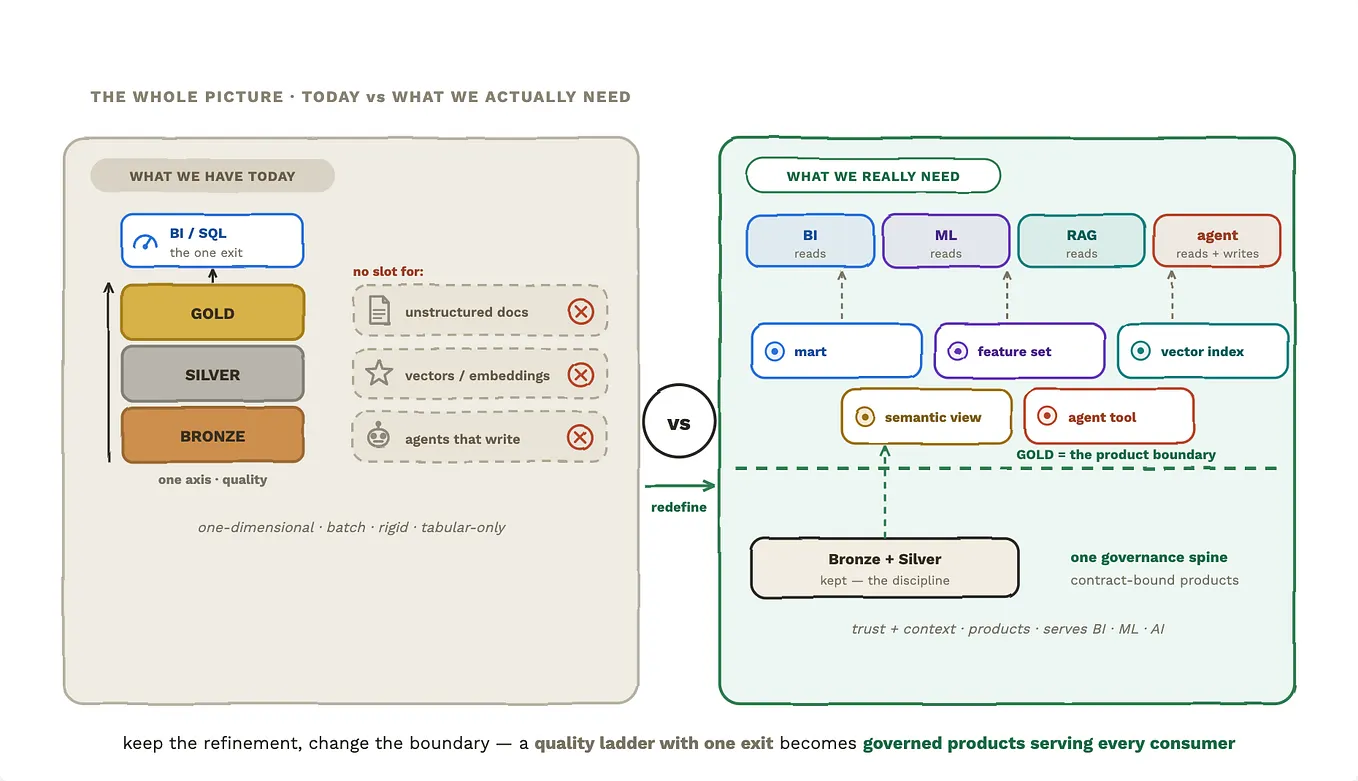
Both depend on a destination model: move the data in, standardize it, govern it centrally, then consume it.
At enterprise scale, this model systematically underperforms on what AI requires:
Breadth suffers because a meaningful portion of enterprise data never migrates. Freshness suffers because the most decision-relevant data sits in operational systems that cannot tolerate heavy replication cycles. Governance suffers because duplication proliferates and policy enforcement becomes inconsistent.
In other words, consolidation-first strategies are too slow, too incomplete, and too brittle to become the foundation of enterprise AI.
AI raises expectations from enterprise reporting to enterprise reasoning
Executives are not asking for dashboards. They are asking for global answers:
Get Jeff Smith’s stories in your inbox
Join Medium for free to get updates from this writer.
What is driving churn across every business line and region? How is fraud evolving across channels and what interventions work? If we tighten credit in one segment, what is the downstream impact on revenue, servicing cost, and retention? What is the real margin impact of supply variability, inventory choices, and labor constraints?
These are cross-enterprise questions. They require access to finance, customer, risk, operations, and compliance domains simultaneously. And much of that data will never live in one place.
That is the moment where destination platforms fail: not because they cannot compute, but because they cannot see.
Federation becomes strategic infrastructure
If fragmentation is permanent, the enterprise needs an architecture that produces enterprise-wide capability without waiting for enterprise-wide alignment.
That is federation.
Starburst is best understood as a modern enterprise data platform built around a different premise: query across data where it already lives. It provides a practical path to global analytics and AI without forcing replatforming, migration, or duplication as prerequisites.
This is not just a convenience. It is a structural advantage: it lowers time-to-value and avoids the failure modes of multi-year consolidation programs.
It is also a technical advantage. Starburst’s engine was designed to operate at internet-level scale: petabyte-class environments, interactive analytics on billions of rows, and multi-source query workloads that would otherwise require extensive pre-processing and movement.
In this framing, Starburst is not “another analytics tool.” It becomes connective tissue: an enterprise access layer capable of powering both traditional analytics and AI retrieval across the distributed estate.
Federation does not eliminate governance. It makes it achievable.
Federation does not magically solve semantics. Enterprises will still have competing definitions of revenue, inconsistent customer identity, and uneven quality.
But federation solves the gating constraint: access.
Without access, governance is theoretical. Enterprises cannot govern what they cannot see. They cannot standardize what they cannot interrogate. They cannot build enterprise AI on top of systems the model cannot reach.
Starburst makes governance a continuous program with near-term business value, rather than a prerequisite that delays value indefinitely.
The implication: the enterprise platform is becoming connective tissue, not a destination
Consolidation will continue where it is feasible and high ROI. Curated environments will remain important. Snowflake and Databricks will remain central parts of the stack.
But the winners in enterprise AI will not be the platforms that require the enterprise to converge. They will be the architectures that assume the enterprise will not.
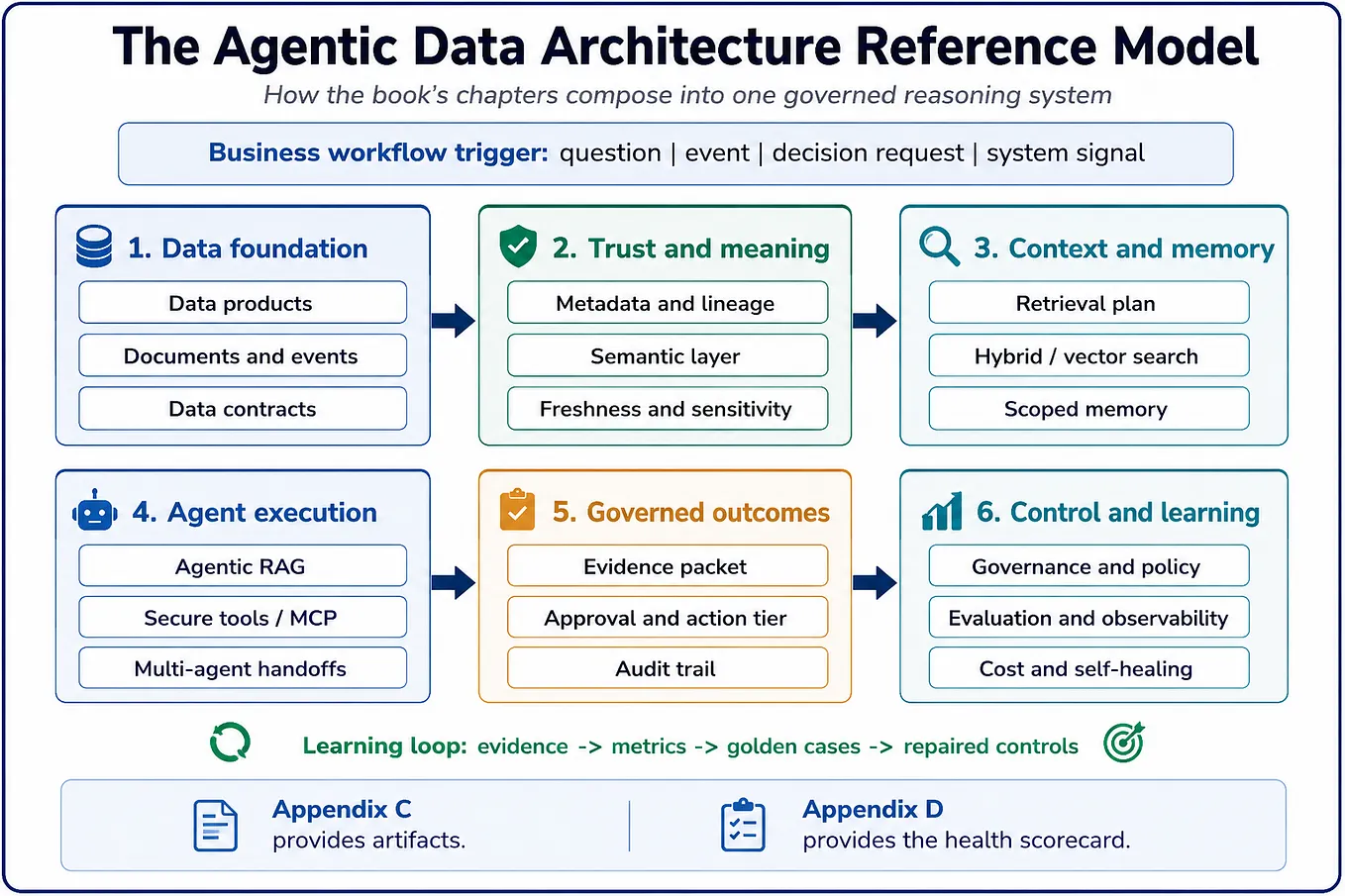
Enterprise AI will be built on a distributed estate connected by a modern access layer that can deliver governed, scalable, cross-domain retrieval.
In that architecture, Starburst is not simply a query engine. It is strategic infrastructure: a platform that makes the enterprise legible to itself, at the moment when AI demands that it finally be.