Pool is not a Matter of Life and Death.
It is much more important than that.

Note: I originally published this story here on 8/23/21 and deleted it roughly a year later. This story received a lot of positive feedback and I regret deleting it, because love it or hate it, this is part of my journey. Here is the story again in its original form.
“I don’t want you to survive, I want you to win,” he said.
In the pool and billiards community, one pocket is known as an old man’s game and as a 32 year old woman, I don’t fit that description. I had just been eliminated from a monthly tournament, frustrated that I didn’t place better. I lost two matches in a row and was out. My coach told me I’m not ready for the complexities of one pocket, and I must hone my pool skills in 8 ball and 9 ball first. “But I let you do it because I know you’re just going to do what you want.”
“I’m going back next month,” I told him.
“I know you are.”
I’ve gotten knocked down in pool a lot. I’ve been humbled by the more experienced and lost many matches that I should have won by getting in my own head. I’m still waiting for my greatness. Now that I have a coach, it’s starting to show up, but it’s still on the other side of the work.
At age 22 I started playing pool in bars. I always loved the game but didn’t have much access to it growing up. I started going out to play and I hated losing, so I chose to get better. I would often beat several bar patrons in a row. After a year or so, a couple people convinced me to sign up for a pool league.
It was spring 2014 and the American Pool Association (APA) bar league was starting its first season in Oakland, CA. I contacted the league operator who told me who the captain at my bar would be. I told the captain to look for the girl in the grey sweatshirt with the mohawk at the bar. He told me to look out for his blue flames shirt. He put me on the roster but was unsure if I would play the first night because the roster was full.
In APA league, two teams square off in 5 rounds of individual matchups, the number of games needed to win the match is determined by the two players’ handicaps. As match 4 hit, I begged the captain to let me play. My adrenaline had been pumping all night and I didn’t know what to do with it. Reluctantly, Captain put me in round 5. I faced off against a player I’d never met, nor would I ever see him again. We were both new players but at the time the APA assigned lower starter ratings to women than men so I only had to win 2 games of 8 ball to his 3 games.
I was nervous as hell but I had never played more freely in my life. I had nothing to lose because I knew my captain didn’t think much of me. I beat the guy 2–1. Captain jubilantly exclaimed, “your skill is comparable to mine!” I’d never seen him play but I beamed proudly. I knew I could win. Winning that first match hooked me. I had been searching for where I was meant to shine and this was it. I wanted recognition. I fed on the glory.
I had no idea that would be the beginning of my struggle as well. I wanted every match to live up to that first moment. I berated myself violently and over drank when I lost. At the time, I was unaware that I tied my worth to my performance and punished myself when I didn’t live up to my expectations.
In 2015, a small voice declared, “I think I want to play professionally.” I began to tell other people and in 2016 I met Eleanor Callado, a touring pro and house pro at my local pool hall. Though she admired my ambition, she warned, from her own experience, that earning a living playing pool is difficult. She stated that the sport of pool was in a lull (it goes up and down) and advised that I have a separate career and play pool for the love of the game (rather than stressing to make a livelihood). She encouraged me to keep getting better, try tournaments, and “pool will be there when you’re ready.”
That same year, I had my first shot at APA regionals. I won a qualifier round, paid the $138 entry fee and drove to Reno with Captain and my boyfriend to compete against other skill level 3s in 8 ball. I had no expectations and made it all the way to the semi-finals. The only people I lost to were the two in the finals, so I viewed it as a “true” 3rd place finish. APA players can compete regionally twice a year and the winners of those events are entered into the annual nationals tournament. I competed in regionals 3 more times with the intention of winning and playing at nationals. That intention got the better of me because each time I was there, I finished lower and lower, then out came the bottle and the self-loathing.
The last time I competed in regionals, my boyfriend competed against the skill level 4s and won his event. There was a girl in his bracket that tried to use sex appeal to get past everyone. In one match, she was flagrantly breaking rules and her opponent let her get away with it. In my sad drunken stupor I told them both off for not taking it seriously. I would have killed to still be in the tournament.
I had made up my mind that I couldn’t win regionals, if anything, losing again would be too painful. By now, I was captain of the first team I joined plus I played on 2–3 other teams throughout the week. I gradually fell into a fearful funk that I couldn’t replicate success, so I believed that my good performances were flukes. My fear around playing and losing were heightened. As I started to play in more places, I was more aware of my womanhood and how men viewed me as both weak and a threat. Along with all the negative feelings I already carried, now I felt the need to prove that I was great and not just for a woman.
My pre-competition jitters grew worse over the years. The more I competed, the more I feared losing and it would manifest in my body. My hands began sweating when they’d never sweat before. My eyes blurred when I was aiming at the game-winning ball and I would have to pee and shit all the time. My mood was dictated by how well I scored in league or if I moved through a tournament bracket. I was afraid that I started playing too late to ever become a pro. I was afraid that I would never be enough. I was not myself.
All the pressure I was putting on myself was overwhelming and I was unhappy. I loved playing pool but I wasn’t enjoying it under the current circumstances. Something had to give and it was me. I quit being captain of the APA team and after another season, I left the team all together. I quit almost everything else. I loved the game and booze but I hated what they were doing to me.
I self-admitted into a day treatment facility to stop drinking. It had evolved from something to get me through negative emotions, but now the positive ones as well. My relationships with myself, my boyfriend, who was now my husband, and pool were all susceptible to loss. I had to learn new tools to deal with anxiety and disappointment because I was ruining my life. I had a lot of healing work to do but I wanted to get through it quickly because I had goals to meet in pool.
. . .
Playing pool without alcohol was hard at first. I didn’t realize how much I used it for my confidence, which is pretty common for pool players who start in bar leagues. Abstaining was the only way for me to get and keep what I wanted.
Get Amani Ali’s stories in your inbox
Join Medium for free to get updates from this writer.
Slowly I learned that being great in pool (or anything) is not just about practicing the skills, but taking care of myself mentally and working at becoming stronger. I realized I couldn’t rush the healing work and there would never be a moment where I could declare myself ”healed” and stop doing the work completely.
Come March 2020 I had been about 8 months alcohol-free and I quietly thanked God that I already started that journey prior to lockdown. The pandemic hit and I was forced to stop competing. I was working from home but unable to play pool, except on my 6 foot table. In the beginning I saw it as a way to practice solo uninterrupted but I quickly learned that I needed rest and reflection and the time to do so was thrust upon me. My journal was my constant companion as I rediscovered myself.
5/14/20
It’s COVID outside and I’ve been home for 2 months and being away from competition has given me some solace to feel into my body. I’ve learned (thanks to pilates) that my hips weren’t lined up straight, they were cocked to the right. My tilted hips were the reason why my stroke wasn’t coming in straight, but I torqued my shoulders to the right to try to get a straighter stroke which caused a lot of shoulder pain. I immediately noticed how much less effort and tension it takes to get ready for a shot when my hips are square.
I would dread straight shots because with my crooked hips, unbeknownst to me, I would find it nearly impossible to deliver the cue straight even though my arm was straight. It finally made sense why most of my shots had a trace of right english on them despite all the stroke corrections I’ve made over the years.
If my core is not engaged, my neck kills.
Proper fundamentals are not only good for the health of your game but for your body as well.
Ultimately for me, shelter-in-place has been the opportunity to try or let go of things. I had hoped there would be more practice time. I have a 6 foot collapsible table, it’s not level. Practicing on this table can be frustrating because it’s unlevel and because I don’t have quite enough space around it, but it’s better than nothing, which is what most people have. If I could fit a larger, higher quality table in my apartment, I would.
The pool table wasn’t ideal but the timing was to shed layers of trauma that were holding me back. My biggest fears were that I was not enough and that I would not have enough time. I lived a painful contradiction: I knew I was capable of greatness but also afraid that I wouldn’t get there. Another part of this process has been changing my relationship with time and avoiding trying to control the journey or outcome. As the months went on, I noticed gradual improvements in my stroke but still struggled with composure and nerves.
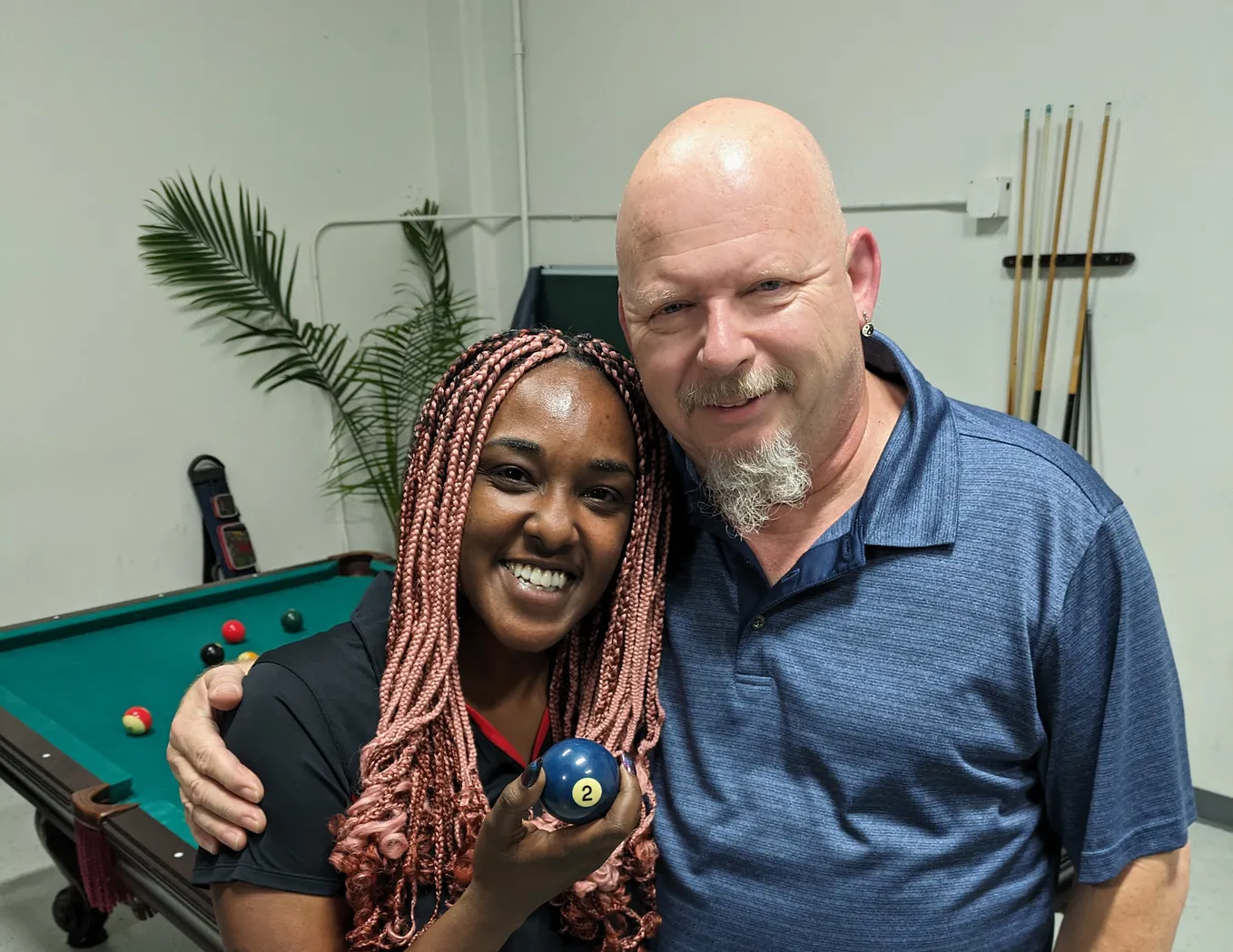
On a Saturday in April 2021, days after my 32nd birthday, I looked in the mirror and said, “I’m ready to be great” then drove down to the pool hall. I noticed an older man I’d never seen before as I took the free table next to him. Fate had intervened because we had both been displaced from our usual pool halls due to the pandemic. I had started going there recently, but never on Saturdays and this was his first time there in many years.
I was practicing a stroke drill that I learned from Oscar Dominguez, a professional pool player and owner of Hard Times Billiards in Sacramento, CA. A couple months prior, I worked on my stroke with him and Kristina Tkach, a young professional player from Russia. The stranger next to me quietly watched me warm up, then asked if I wanted to play a couple games of 9 ball.
After missing a couple routine balls and hopping the cue ball over the ball I intended to shoot, he told me that I was trying too hard. I’m used to men giving me advice and most of the time I don’t bother to listen, but his approach wasn’t condescending.
“You have a special gift,” he said, “but you’re adding unnecessary things to your game.” He was referring to me pointing to positions on the table before shooting to indicate where I wanted the cue ball to travel and general overthinking. “If you don’t get perfect shape, you get upset and when you miss, you get mad at yourself because you know you can play better than that.”
I was so taken aback by how well this stranger read me that I began sobbing. He was afraid he hurt my feelings, but on the contrary, he understood me and how hard I was laboring to become a good player. He said I didn’t need to point, I intuitively know how to get the cue ball where I want by trusting my eyes. I got down and pocketed the 8 ball from half table and played a perfect 3 rail position straight in on the 9 on the middle of the top rail.
I stared up at him in awe. I didn’t even know his name yet but I knew he was my new coach. He committed me to a year of training and promised that if I put in the work, I would be “hard to beat.”
For the first time ever, I had consistent guidance. I had taken lessons before but never had a coach who could commit to me. I showed immediate improvement. He said things that made sense. He tested me in ways that I didn’t know I needed to be tested. When I learned I had performance anxiety, suddenly my entire competitive and work life made sense. At first I was relieved because I learned that it wasn’t that I was inadequate, then I was angry at all the missed opportunities, like APA regionals.
Presently, we’re 4 months into training and he reminds me all the time that I have to let go. More than the drills, it is the work of letting go that requires the most attention. In the beginning, he pissed me off with it because what the heck does “letting go” even mean? It is only when I get angry with him, that I realize what I’m holding on to — I compare him to my parents, I’m worried what others think, I have high expectations of myself. It is a daily practice to accept that I make mistakes and I can’t have everything I want all at once. My game is a work in progress.
When I have a setback, he reminds me that I’m the only one getting in my way. I find strength in knowing that is all up to me because I control my attitude. Each time I compete, letting go of mistakes gets easier. Today I tell myself that my goal is letting go, not winning.
. . .
I often daydream about my future in this sport. One of the beauties of the game is player longevity. I can see myself playing for the rest of my life and there will always be work to be done and goals to reach. I’ve had to let go of becoming a professional not because I don’t want it but because the way I’ve pursued it has held me back from becoming a great player, which of course comes first.
I also think about how my future work isn’t just for me. I’d love to work in organizing the sport to make it anti-sexist and retire the old trope of “there’s no money in pool.” Pool Wars: On the Road to Hell and Back with the World’s Greatest Money Players, is a memoir I read by Jay Helfert who competed from the 1960s-1990s. Among his countless stories are some about the greed and mismanagement of tour organizers that harmed the sport over the years. He even describes a few instances when women were not welcomed to play with men, even when the mixed events drew more media attention.
Gender segregation wasn’t born from biology but from bias because pool is not a sport of strength. The only thing to account for the difference between men and women in billiards is the pool of available players. Additionally, integrating junior level competitions would set a precedent for the sport. The misogyny that continues to divide pool enforces stereotypes that women can’t beat men and if we do, then men should be ashamed, while women don’t get exposed to the top of the field, so it holds us all back. Part of my work is to end misogyny in pool by being vocal and by just being me. I compete in one pocket, the old man’s game, because I enjoy it, but me being there is much more important than just me.

If you like my content and want to support me in its creation, here are a few ways to do so:
- Give this article a clap and become a follower
- Subscribe to be notified when I post new stuff
- Consider buying me a game of pool or buying my tournament evaluation form
- Consider becoming a monthly supporter