Revisiting Deconstruction in Design
Earlier movements in language and design have much to teach us about social issues we face today

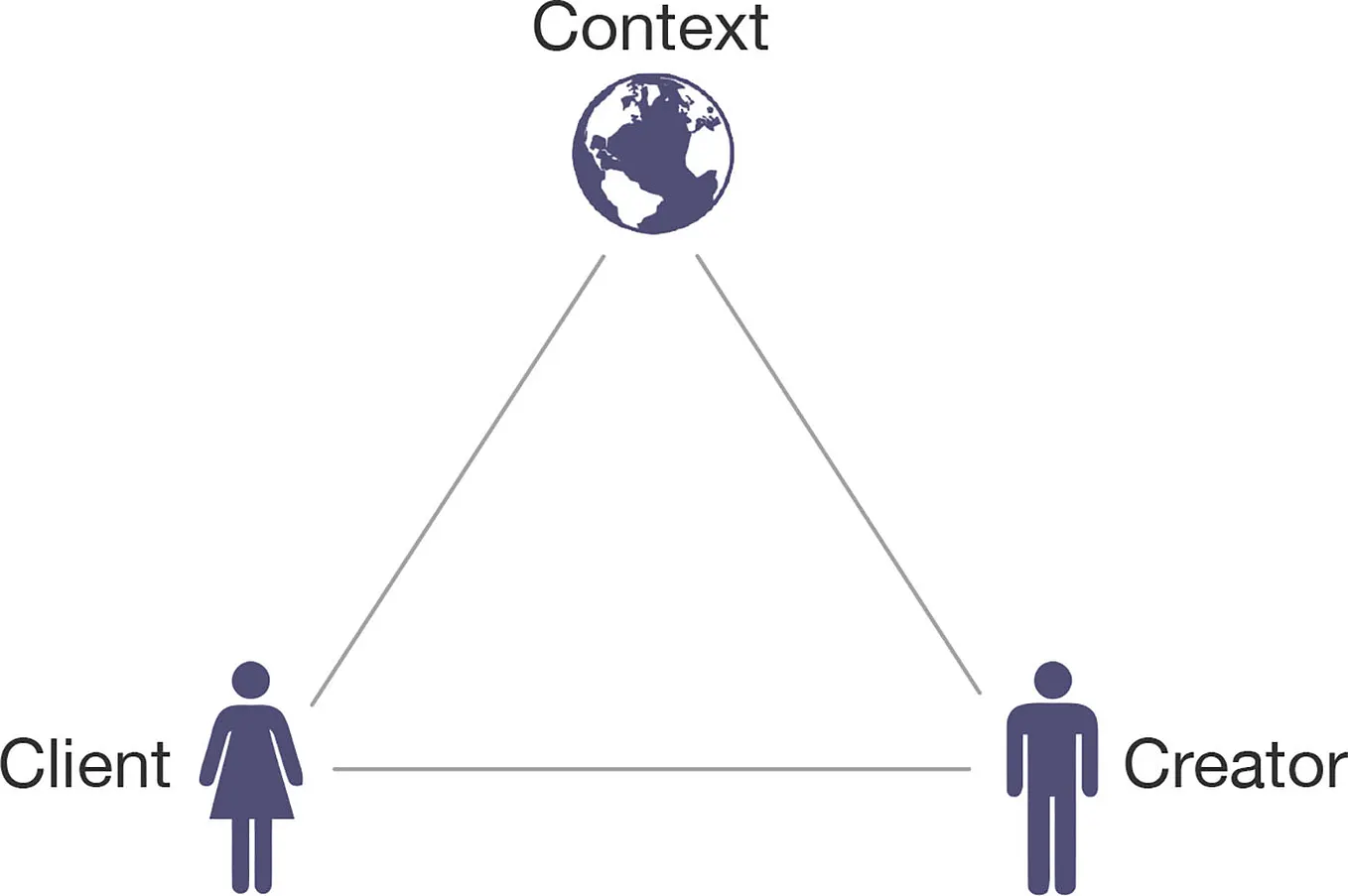
In a post about ‘The Unique Appeal of Maps’, I showed the diagram below that was inspired by the teachings of Katherine McCoy while a co-chair at the Cranbrook Academy of Art.

When I searched for the original diagram to credit, the image that came up most often is the one below. It was designed by Katherine McCoy as a promotional poster for the Cranbrook Graduate Program in Design. “See” “read “text” and “image” frame the 4 corners of the lower area of the poster.

In 1991, Ellen Lupton and Katherine McCoy wrote an article about the program titled, ‘The Academy of Deconstructed Design’. It provides a great overview of the program’s philosophy. The first page is so dense with references to literary criticism, design styles, and semiotics that I created a markup version of the first page of the article just so I could keep up. The overarching theme of the article and the program was applying the theories of literary Deconstruction to the field of graphic design. The article explains McCoy’s design philosophy this way, “Coming out of literary theory, visual phenomena are analyzed as language encoded for meaning. Meanings are deconstructed, exposing the dynamics of power and the manipulation of meaning.” My own efforts to understand the article sent me down a rabbit hole of art and literary movements. I came away feeling that the ideas the school was exploring 40 years ago are quite relevant to issues designers and citizens face today.

History of design and linguistic movements
To understand what Katherine McCoy was advocating, its helpful to understand the contemporary and preceding movements that formed the foundation of the program at Cranbrook The brief definitions below should give you a high level overview. They are all slightly reworded summaries from Wikipedia/
Deconstructivism is an architectural movement characterized by fragmented, distorted, and displaced forms, often featuring non-rectilinear shapes and conflicting geometries that challenge traditional notions of stability, order, and harmony in design. A prototypical example of this style of architecture is Frank Gehry’s Guggenheim Museum in Bilbao Spain (although Gehry famously rejected this attribution).
Modernism was a movement that crossed many disciplines including art, architecture and literature. It was characterized by a rejection of tradition and the search for newer means of cultural expression. In architecture, it favored clean lines, honesty of materials, and the absence of ornament. “International Style’ skyscrapers like the Seagrams Building in NY is a good example of modernist design. So would the strong grids and abundance of whitespace found in corporate annual reports from the 1970s.
Deconstruction is a loosely defined set of approaches to understand the relationship between text and meaning. The concept of deconstruction was introduced by the philosopher Jacques Derrida, who described it as a pivot away from the ideas of “true” form originally advocated by Plato. Deconstructivism in architecture was inspired by the Deconstruction movement in literature.
Post-structuralism was a critical response to structuralism. It questions the objectivity or stability of the structures that are posited by structuralism. It considers the patterns of meaning to be part of a broader system of power.
Structuralism advocated interpreting elements of human culture by way of their relationship to a broader system. Structuralists attempted to uncover the patterns that underlie everything we think and say.
Get Andy Proehl’s stories in your inbox
Join Medium for free to get updates from this writer.
Semiotics, Signs, Symbols, and Syntax — All the above theories can be further deconstructed into the component elements of signs, symbols, semiotics and syntax. Design is full of these elements. Typography is a system of signs and symbols. Logos are symbols of the corporations they represent. Although we barely notice ornamental elements in our environment, they all have meaning. This could be a typographic flourish, an icon button on a website, or the richly ornamented buildings of Louis Sullivan. If linguistic theory were an atomic design system, the theories would be the organisms and signs and symbols would be the molecules and atoms.
Why this is relevant today
I believe these movements have much to offer designers as we try to make sense of today’s world. First there was structuralism which postulated that meaning for any one thing (for example, the word “design”) depends on the structure of meaning around it. Structuralism, interprets elements of human culture by way of their relationship to a broader system.”
Of course with that reference to broader systems of meaning comes the potential for power differentials between who is defining the meaning and who must follow it. Post-structuralism aimed to address that issue by questioning the objectivity of those systems.
Design Systems
If you’ve ever worked on or advocated for a Design System then you are essentially thinking like a structuralist. Pattern languages bring structure to design fields and reduce the need to reinvent the wheel. Christopher Alexander, a professor of architecture at Berkeley was among the first to advocate for this in his seminal book, “A Pattern Language”. Many companies maintain pattern libraries in the form of design systems including Google’s Material Design, and Apple’s Human Interface Guidelines. They’re all seeking to define the patterns that underlie our designs.
Truth, Fake News, and being Woke
You can see some of this playing out in our current political debates. Long established news sites are being described alternately as seeking truth or dispensing fake news. Attempts to reflect on our country’s complex and sometimes flawed past is seen as either an attempt to learn and grow or as being too woke.
The topic of being woke is another lens for these issues. The word itself is ambiguous in meaning and deeply tied to the eras of its use. On one end of the spectrum, you have people trying to connect current language and feelings to our deeper history. This is classic structuralist thinking. On the other end, you have people who feel they run the risk of stepping on a landmine just for speaking their mind. We hear the words and miss the message. This is very post-structuralist. Who gets to decide what is true, or what is woke or not? All meaning is relative and affected by the person saying it and the time and political environment we’re living in. Many news sites are trying to figure out how to identify truth in a time of “alternate facts”. Do you evaluate the message or the source? Designers can play a key role in designing the way these issues are represented in online news sites.
Textualism and Originalism in Law
“We’re all textualists now” — U.S. Supreme Court Justice Elena Kagan
The current US Supreme Court has a conservative majority that favors the legal theories of Textualism and Originalism. Textualism is a method of interpreting the Constitution that prioritizes the ordinary meaning of legal text at the time it was written. It believes the lawmakers’ intent or broader policy outcomes should not be considered when evaluating a case or issue. Both Textualism and Originalism emphasize the text’s original meaning over subjective intent. Most social science theories embrace interpreting the meaning of a given text but Textualism starts with the opposite assumption. Perhaps it is a kind of deconstruction, stripping away modern meanings and understanding until all that is left is the text written over 200 years ago. But this still leaves ambiguity. The 2nd Amendment is notoriously short and ambiguous. “A well regulated Militia, being necessary to the security of a free State, the right of the people to keep and bear Arms, shall not be infringed.” Recent Supreme Court decisions have focused on the second part, the right to keep and bear arms. But earlier Supreme Court decisions considered the entire text and came up with more nuanced rulings regarding gun ownership. The fact that, even with a textualism focus, there are still debates about the specific intent and meaning of our Constitution has not gone unnoticed. It led U.S. Supreme Court Justice Elena Kagan to proclaim, “We’re all textualists now”.
AI and Large Language Models (LLMs)
Large Language Models (LLMs) are the backbone of AI and can be viewed as an interesting instance of structuralist and post-structuralist ideas. They treat language as a self-referential system where meaning arises from relations and context. At a technical level, LLMs work by recognizing statistical patterns in sequences of words. They use those patterns to predict the next word in context and excel at capturing relationships across long stretches of text. LLMs are built on neural networks which are themselves like flexible but structuralist assemblies of relationships. I asked Chat GPT to compare LLMs to Structuralism, Post-structuralism and (literary) Deconstruction. ChatGPT’s response is worth reading if you’re interested.
As AI becomes more embedded in our daily lives, people will want to investigate these structures. While it is sometimes possible to ask an LLM to explain how it arrived at an answer, it is often the proverbial black box. This could become a problem as the LLMs become more complex and opaque while our human thoughts about the structure of meaning evolve. Perhaps it’s time to restart the ‘Academy of Deconstructed Design’ and explore how designers can contribute to these fascinating topics.
Reflection
One of the artifacts designers produce is diagrams. I have always had a passion for diagrams. It was the topic of my Masters thesis. They are again, images we see and text we read. They visualize relationships in unique ways. Almost every discipline creates them (with varying levels of success). Done well, they can drive insight and alignment. This is at the heart of why I find the themes explored in this article so interesting. Design is uniquely positioned to be able to analyze the key themes of our day and visualize them in a way that highlights the risks, virtues, and critical insights. There are many examples here on Medium and out on the Internet. Here are 3 that try to deconstruct a concept and then show the relationships of the parts. A classic would be Hugh Dubberly’s Design for the Internet diagram. Imagine seeing this when most people did not yet understand what the Internet was. Jesse James Garrett’s classic ‘Elements of User Experience’ diagram was foundational to the UX community. It was something many of us referred to when trying to explain that experience design was not about “making things look good”. Finally, I have always been a fan of the work of Ben Fry. His firm, Fathom has a project called COiN that explores the byzantine and evolving nature of legal contracts.
The graphic designer David Carson famously said, “Graphic design will save the world right after rock and roll does”. This was humbling to me when I first read it. We want to think our designs are changing the world. But I also believe in design’s ability to visualize concepts and ideas. This is a critical need for societies around the World. We are a visual species and designers help people see.