Is AI Making Your People More Productive, or Less Capable?

Why leaders need to look beyond AI-driven productivity and examine the human capabilities their organizations are developing.

REAL STORY:
Yesterday, November 6, during a mental toughness workshop with faculty, someone raised a concern about students using artificial intelligence to complete work they were expected to do themselves.
It was a legitimate concern. Educators are trying to understand how AI affects learning, effort, and their ability to determine what students actually know.
But I kept thinking about the same question in a different setting.
What if we replaced student with employee, professor with manager, and classroom with workplace?
The implications would extend far beyond education.
When technology helps people produce better results, how do we know whether they are becoming more capable , or simply more dependent on the technology?
For leaders investing heavily in AI, this is not just a philosophical question. It has practical implications for workforce development, decision quality, and organizational performance.
When the assistance disappears
A recent study offers an interesting starting point.
In AI Assistance Reduces Persistence and Hurts Independent Performance, Liu and colleagues (2026) conducted three randomized experiments involving 1,222 participants completing mathematical reasoning and reading comprehension tasks.
AI assistance improved performance while it was available.
But when that assistance was removed, participants who had used AI performed worse on subsequent unassisted problems.
In one experiment, AI-assisted participants correctly solved approximately 71% of the final problems, compared with 77% among those who had worked independently. In a reading comprehension experiment, the corresponding figures were 76% and 89%.
Participants who had used AI were also more likely to skip problems in two of the three experiments.
These findings deserve attention, but they should not be exaggerated.
The experiments involved brief interactions and immediate follow-up assessments. They do not establish that AI causes permanent skill deterioration or that the same outcomes would occur in professional environments.
Other recent research offers a more encouraging picture.
Cruces and colleagues (2026), studying 1,174 adults completing a workplace-style problem-solving task, found that AI improved performance without producing worse subsequent unassisted performance. Participants who combined intensive AI use with sustained effort performed particularly well on the follow-up task.
Similarly, Contractor and Reyes (2026) found that AI-assisted university students demonstrated improvements in some subsequent unassisted learning outcomes, with advantages particularly evident among those using AI to support understanding rather than simply generate answers.
The studies differ in their participants, tasks, and assessment methods. We should not assume that the same processes explain all their findings.
Nevertheless, they raise an important possibility:
The consequences of AI assistance may depend partly on what people do cognitively while using it, not simply whether they use it.
That brings us to a leadership question I believe deserves more attention.
What exactly are we improving?
Imagine an employee preparing a strategic recommendation.
AI helps generate a thorough analysis, identify several risks, and produce a convincing presentation.
The employee completes the assignment faster. The manager is pleased. The organization records another productivity gain.
But during the leadership meeting, someone challenges a central assumption.
Can the employee explain the reasoning behind the recommendation?
Can they recognize which information matters most?
Can they identify when the recommendation no longer fits the circumstances?
And can they adjust their response without simply requesting another answer from AI?
This is a hypothetical example, but the distinction is important.
A high-quality output does not necessarily demonstrate high-quality independent judgment.
The concern is not hypothetical at the organizational level.
A September 2026 IBM Institute for Business Value study involving 1,500 senior HR leaders and 8,800 employees found that 60% of employees worried AI was eroding their skills.
At the same time, 71% of surveyed HR leaders identified the ability to supervise, validate, and override AI outputs as an essential workforce capability.
These are survey findings, not proof that AI is causing widespread deskilling. But they illustrate a challenge many organizations are already recognizing.
AI may improve what employees produce without necessarily telling leaders what employees understand, how they make decisions, or whether they can respond effectively when circumstances change.
The question is not whether organizations should continue using AI.
Of course they should, where it adds value and can be used responsibly.
The question is whether they are measuring the right things.
A mental-performance perspective
Much of my work focuses on mental toughness and effective functioning under pressure, uncertainty, and demanding circumstances.
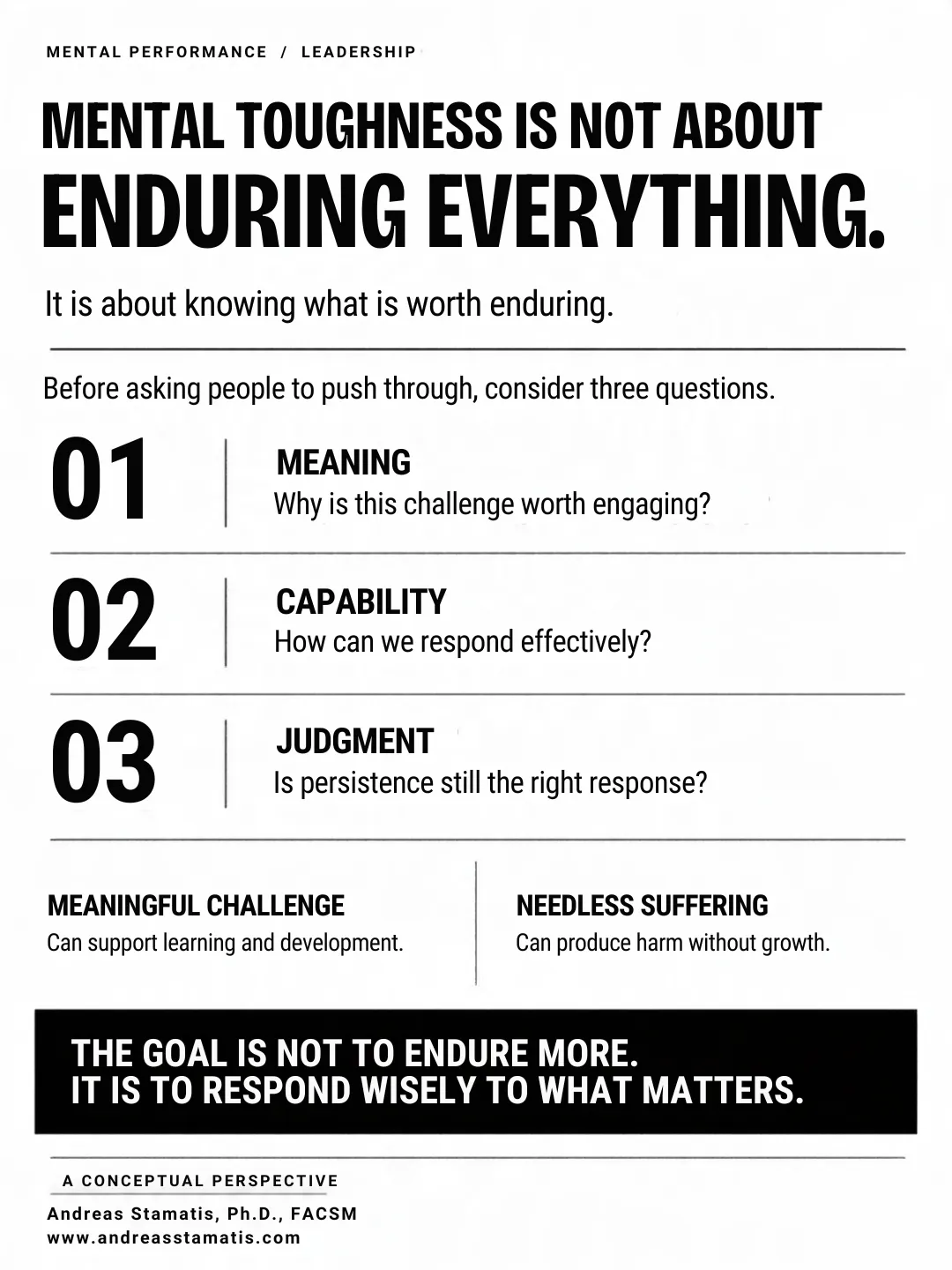
Mental toughness is sometimes misunderstood as the ability to push harder, tolerate discomfort, or persist regardless of the situation.
That interpretation is incomplete.
Research by Gucciardi and colleagues (2015), conducted across several achievement contexts, including sport, education, military settings, and workplaces, supports understanding mental toughness as a broad construct related to functioning, goal progress, and adaptation under demanding conditions.
In my applied work, I approach its functional expression through three considerations: purposefulness, efficiency, and flexibility.
These are not separate mental toughness subscales. They provide a way to think about how effectively someone functions in relation to a meaningful objective and the demands of the situation.
Applying this perspective to AI-assisted organizational work is a conceptual extension, rather than an approach already validated in AI-specific intervention studies.
But I think it helps us ask better questions.
Purposefulness: Does the person understand what they are trying to accomplish?
Producing a report is not the same as understanding the decision the report is intended to inform.
An employee may use AI efficiently while losing sight of the underlying objective.
The relevant question is whether the employee can connect their actions to what matters in the situation.
Efficiency: Is technology helping the person use their resources effectively?
AI can reduce unnecessary work and free valuable time.
That is a legitimate performance advantage.
But efficiency should not be reduced to speed.
If an employee completes a task quickly but cannot evaluate the result, the organization may simply be transferring effort from initial production to subsequent verification, correction, or rework.
Leaders need to understand where AI creates genuine value and where it introduces new demands.
Flexibility: Can the person adapt when the situation changes?
This may be the most revealing consideration.
Suppose an AI-generated recommendation is reasonable under the original assumptions. Then new information emerges.
Can the employee recognize that the situation has changed and adjust accordingly?
Or do they continue following the original recommendation because it was initially convincing?
These questions connect with research on contextual knowledge, self-regulation, and self-efficacy.
Knowing what matters in a situation, using relevant information, and adjusting a response when circumstances change are not interchangeable with possessing more information.
Nor is confidence equivalent to competence.
Research on self-efficacy offers an important perspective here. Judge and Bono (2001), in a meta-analysis examining core self-evaluations, identified a modest positive association between generalized self-efficacy and job performance.
That relationship is meaningful, but correlational. Believing in one’s capability is not the same as demonstrating competence, nor does stronger self-belief guarantee better performance.
Someone may feel capable because AI consistently helps them succeed. But their confidence needs to be supported by what they understand and can actually do.
The objective is not simply to produce more confident employees. It is to develop capable people whose confidence is appropriately grounded in their competence.
How leaders can put this into practice
This is where I think organizations have an opportunity to do something useful.
Get Andreas Stamatis, Ph.D., ACSM-EP, FACSM’s stories in your inbox
Join Medium for free to get updates from this writer.
Rather than introducing another broad AI training initiative, consider starting with one important workflow in which human judgment still matters.
For example, imagine a leadership team using AI to support decisions about staffing, resource allocation, or operational priorities.
Instead of measuring only how quickly recommendations are produced, I would suggest examining three additional outcomes.
1. Understanding: Can employees explain the recommendation?
Ask employees to identify the objective, relevant assumptions, available alternatives, and reasons for their preferred action.
The point is not to make employees repeat information AI has already provided.
It is to determine whether they understand enough to evaluate and take responsibility for the recommendation.
2. Judgment: Can employees recognize when something is wrong?
Use a realistic, low-risk scenario in which an AI-generated recommendation contains a questionable assumption, incomplete information, or a conclusion that does not fit the situation.
Can the employee recognize the issue?
Can they explain why it matters?
Can they determine what additional information is needed?
This is particularly relevant when decisions affect safety, financial resources, or other people.
3. Adaptation: Can employees adjust when circumstances change?
Change one meaningful element of the scenario.
Perhaps a resource becomes unavailable, a deadline changes, or new information challenges the original recommendation.
Then examine whether the employee can reconsider the options and justify a revised response.
The objective is not necessarily to remove AI. It is to assess whether the person understands the situation well enough to use AI appropriately, including recognizing when its output should be questioned.
Taken together, these three checks offer a practical way to examine understanding, judgment, and adaptation alongside productivity.
They are proposed assessment considerations, not a validated psychological instrument or an AI-specific intervention protocol.
Organizations should pilot them in representative, psychologically safe settings, adapt them to the actual work, and examine whether the results predict meaningful performance.
Don’t just assess capability. Develop it.
Identifying a capability gap is useful only if the organization responds appropriately.
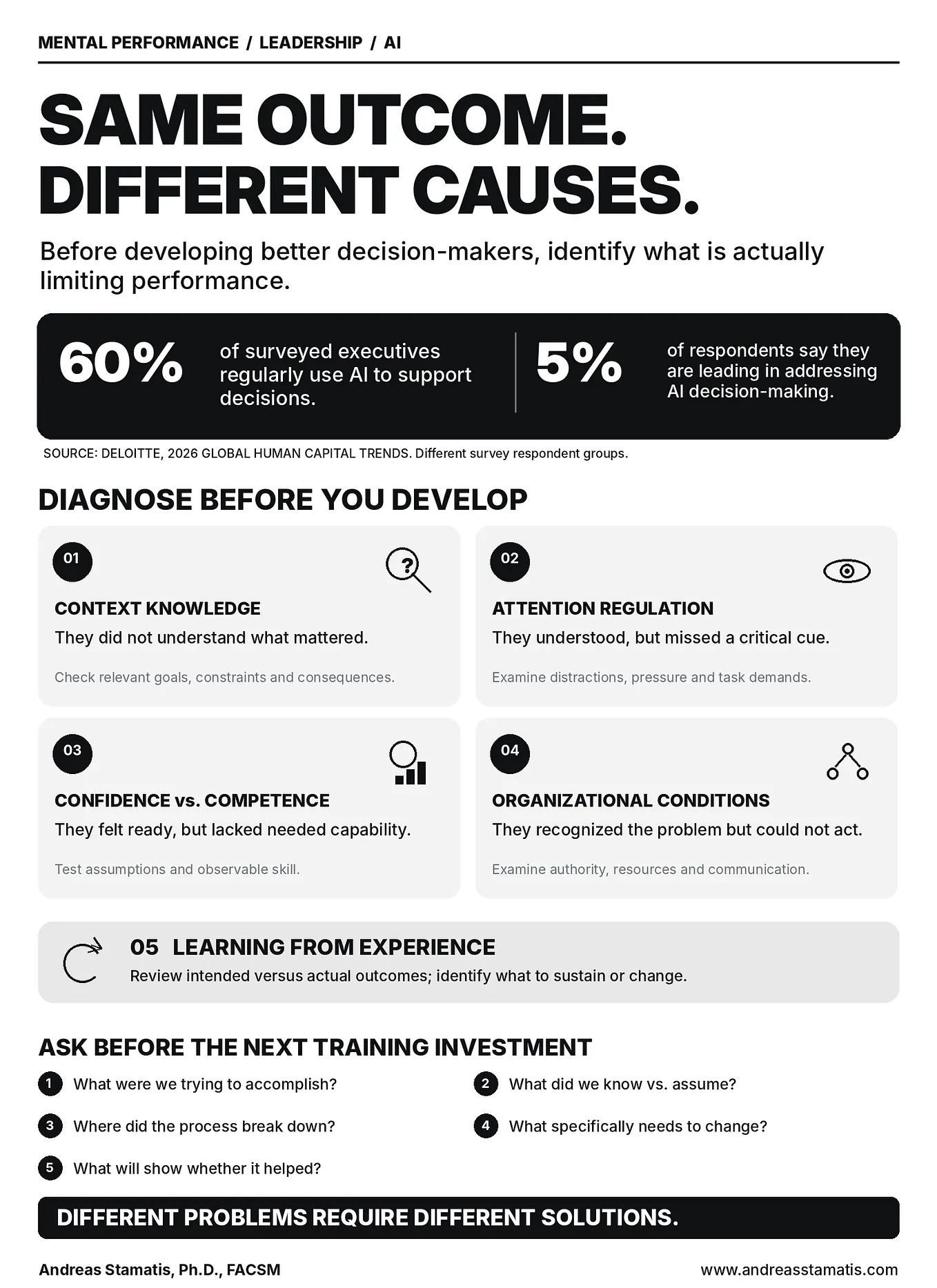
If employees struggle to evaluate AI-generated recommendations, the solution is not automatically another workshop about critical thinking.
First, leaders need to understand why the difficulty exists.
Is relevant domain knowledge missing?
Are employees inexperienced with the decisions involved?
Are expectations unclear?
Has the organization created pressure to prioritize speed over accuracy?
Or are people capable of evaluating the information but reluctant to challenge a recommendation because they lack authority or fear negative consequences?
These are different problems. They require different responses.
When the issue genuinely concerns developing performance-relevant knowledge and judgment, structured practice and feedback offer a reasonable starting point.
For example, employees could work through realistic decision scenarios, explain their reasoning, receive feedback, and revisit similar problems as their understanding develops.
Structured after-action reviews may also be useful.
Research synthesized by Tannenbaum and Cerasoli (2013), and later by Keiser and Arthur (2021), supports the value of well-designed debriefs for improving individual and team effectiveness across several applied settings.
An effective review does more than ask what went wrong.
It examines what was expected, what actually happened, why differences emerged, and what should be sustained or changed next time.
Similarly, Harkin and colleagues (2016) found that interventions increasing progress monitoring improved goal attainment across a broad range of behavioral contexts.
These findings support deliberate learning, feedback, and monitoring. They do not establish that a specific AI-training program will produce the same effects.
Still, they provide a stronger scientific foundation than simply telling employees to think critically or become more resilient.
And they remind us that mental performance development must be connected to the actual demands of the work.
If employees lack knowledge, they need opportunities to acquire it.
If they lack experience, they need appropriate practice.
If they understand the situation but cannot act because authority is unclear or the environment discourages questioning, leadership needs to address those conditions.
We should not treat every performance problem as an individual psychological weakness when the real constraint may be organizational.
The leadership decision
AI offers substantial opportunities to improve performance.
It can reduce unnecessary effort, increase access to information, support learning, and help people complete work more efficiently.
We should take advantage of those opportunities.
But we should also recognize that improved output, developed competence, and effective functioning are different outcomes.
A person may perform well with AI assistance while still needing to develop independent judgment.
Another may use AI in ways that genuinely strengthen learning and capability.
And an experienced professional may appropriately delegate substantial work to AI without losing the expertise needed to evaluate the result.
These distinctions matter.
For leaders, I would suggest a simple starting point:
Choose one consequential workflow and examine not only what AI helps your people produce, but also what they understand, what they can evaluate, and how effectively they adapt.
Then use that information to make decisions about training, supervision, accountability, and work design.
There is no need to begin with a complicated new assessment system.
Start with the decisions that matter most. Identify which capabilities must remain available to the people responsible for them. Create opportunities to practice those capabilities, and monitor whether performance actually improves.
Most importantly, distinguish problems that require individual development from those that require changes to the system.
That is a more meaningful approach than assuming that faster work automatically means a stronger workforce.
The faculty member’s question that prompted this article began with students and their use of AI.
But the broader issue belongs to every leader responsible for developing people.
Are we using technology only to improve what our people accomplish today, or are we also helping them become more capable of meeting tomorrow’s demands?
The two objectives do not have to compete.
But achieving both requires deliberate leadership.
Because ultimately, organizational performance depends not only on the capabilities of the technology we adopt, but also on the capabilities of the people we develop.
References
AI, Productivity, and Independent Performance
- Liu, G., Christian, B., Dumbalska, T., Bakker, M. A., & Dubey, R. (2026). AI assistance reduces persistence and hurts independent performance. Proceedings of the Third Conference on Language Modeling (COLM 2026). Conference paper.
- Cruces, G., Fernández Meijide, D., Galiani, S., Gálvez, R. H., & Lombardi, M. (2026). Does generative AI narrow education-based productivity gaps? Evidence from a randomized experiment (NBER Working Paper №34851; revised October 2026). National Bureau of Economic Research. https://doi.org/10.3386/w34851
- Contractor, Z., & Reyes, G. (2026). Experimental evidence on the learning impact of generative AI (IZA Discussion Paper №18792). IZA Institute of Labor Economics. https://www.iza.org/publications/dp/18792/experimental-evidence-on-the-learning-impact-of-generative-ai
- IBM Institute for Business Value. (2026, September 21). New IBM CHRO study: AI puts critical thinking at the center of workforce priorities. IBM. https://newsroom.ibm.com/2026-09-21-new-ibm-chro-study-ai-puts-critical-thinking-at-the-center-of-workforce-priorities
Mental Toughness, Human Performance, and Organizational Learning
- Gucciardi, D. F., Hanton, S., Gordon, S., Mallett, C. J., & Temby, P. (2015). The concept of mental toughness: Tests of dimensionality, nomological network, and traitness. Journal of Personality, 83(1), 26–44. https://doi.org/10.1111/jopy.12079
- Tannenbaum, S. I., & Cerasoli, C. P. (2013). Do team and individual debriefs enhance performance? A meta-analysis. Human Factors, 55(1), 231–245. https://doi.org/10.1177/0018720812448394
- Keiser, N. L., & Arthur, W., Jr. (2021). A meta-analysis of the effectiveness of the after-action review (or debrief) and factors that influence its effectiveness. Journal of Applied Psychology, 106(7), 1007–1032. https://doi.org/10.1037/apl0000821
- Harkin, B., Webb, T. L., Chang, B. P. I., Prestwich, A., Conner, M., Kellar, I., Benn, Y., & Sheeran, P. (2016). Does monitoring goal progress promote goal attainment? A meta-analysis of the experimental evidence. Psychological Bulletin, 142(2), 198–229. https://doi.org/10.1037/bul0000025
- Judge, T. A., & Bono, J. E. (2001). Relationship of core self-evaluations traits — self-esteem, generalized self-efficacy, locus of control, and emotional stability — with job satisfaction and job performance: A meta-analysis. Journal of Applied Psychology, 86(1), 80–92. https://doi.org/10.1037/0021-9010.86.1.80
Andreas Stamatis, Ph.D., FACSM, is an associate professor and mental performance specialist at the University of Louisville. His work focuses on mental toughness, human performance, and effective functioning under pressure across sport and organizational environments.