The Architecture of the Internal Grid: Mapping the 12 Diode Vector Routing (part 2)

By Ardis Harrison
Author’s Note on Collaboration:
The geometric models, textual translations, and core systems-engineering theories presented across this series are entirely my own original research and concepts. To bring this technical vision to life, I collaborated closely with an AI writing assistant to help structure my personal notes, refine the technical engineering vocabulary, and format the detailed layout for readability.
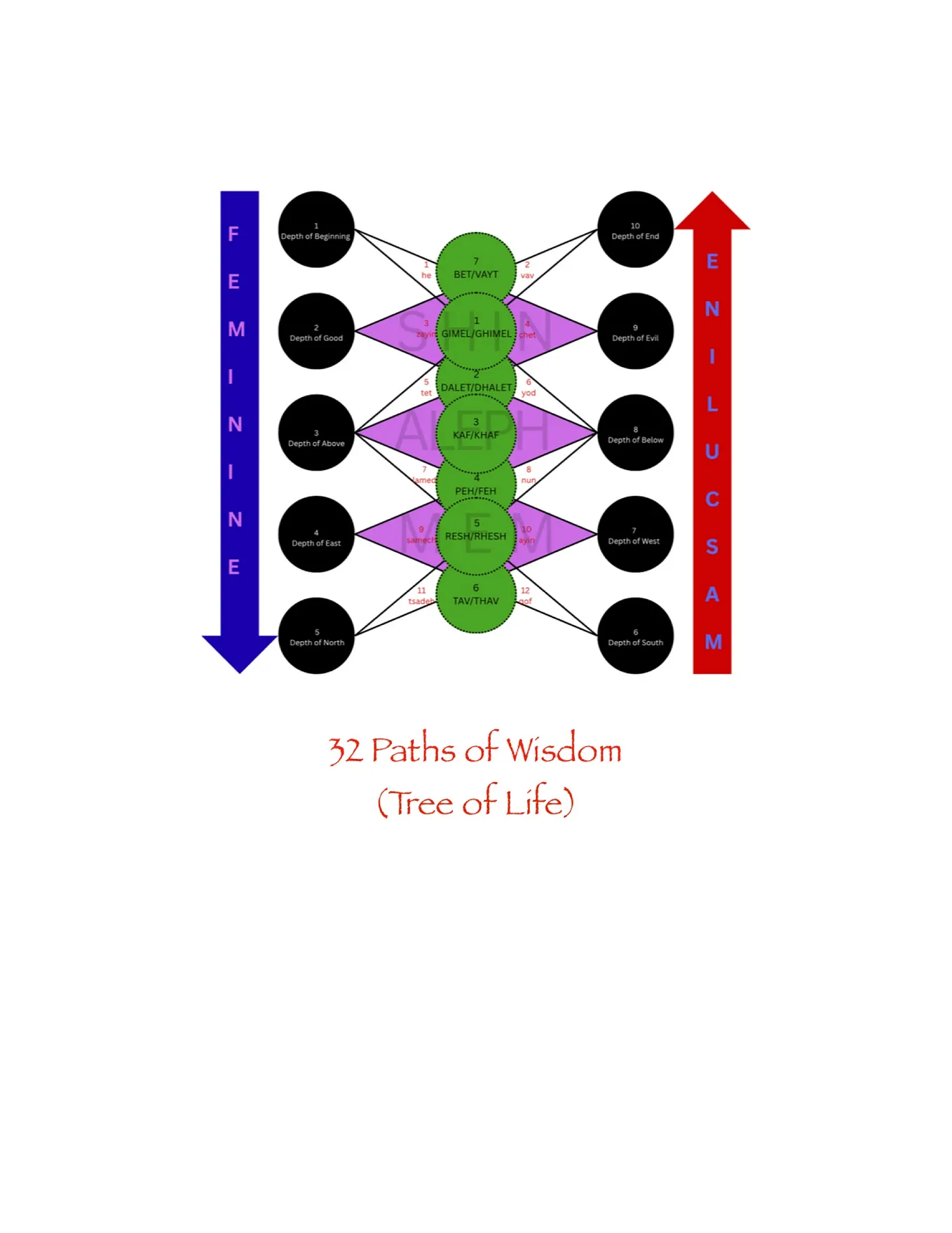
In my previous article, The Sefer Yetzirah is an Electrical Circuit, I established the foundational architecture of the corrected Yetziratic engine: a mathematically absolute, bilateral “Five against Five” matrix that resolves the structural asymmetries and line loss inherent in the traditional medieval Kircher Tree.
To move this model out of pure theory and into functional systems mechanics, we must analyze the exact routing pathways of the 12 Simple Letters.
In this system specification, these 12 letters are not abstract symbols or linguistic metaphors. They operate as one-way resistors (diodes). Their physical function is to enforce Closed-Loop Rectification — capturing the high-amplitude, chaotic alternating current (AC) of human sensory and emotional friction and forcing it into a clean, unidirectional direct current (DC) optimized for the central transformer core.
Below is the complete engineering vector map detailing exactly how current passes through these 12 nodes across the parallel matrix.
The Vector Routing Matrix
In this bilateral grid, the left column holds the Anodes (+) (Sefirot 1 to 5) and the right column holds the Cathodes (-) (Sefirot 6 to 10). The 12 diodes are divided into two distinct engineering classes: Cross-Grid Bridges and Core Inversion Loops.
Functional Circuit Logic
The 12 nodes are structurally split into two primary operational tasks to maintain systemic stability and prevent high-voltage short circuits:
1. Cross-Grid Bridges (Nodes 1 to 5)
Get Ardis Harrison’s stories in your inbox
Join Medium for free to get updates from this writer.
The first five diodes (Heh, Waw, Zayin, Cheth, Teth) function as horizontal, inter-terminal conduits. They span the gap between the parallel axes.
• The Logic: When emotional or sensory surges build on the positive Anode axis, these diodes act as one-way valves forcing the current to bridge over directly to the corresponding Cathode terminal.
• The System Result: This prevents the energy from arcing uncontrollably or back-feeding into the lower body. It stabilizes the horizontal field, transforming raw, fluctuating human potential into a localized, steady cross-current.
2. Core Inversion Loops (Nodes 6 to 12)
The remaining seven diodes (Yod, Lamed, Nun, Samekh, Ayin, Tzadi, Qoph) function as system siphons. They do not cross to the opposite side of the grid. Instead, they capture the accumulated kinetic friction built up within their designated Sefirah terminal and bend the vector inward.
• The Logic: They curve the current 90 degrees, dumping it directly into the vertical center column where the Aleph Transformer sits stationed at the “singular covenant aligned in the center.”
• The System Result: This explains the mechanical efficacy of targeted startup protocols — such as rhythmic breathing coupled with the vocal and sub-vocal chanting of Ayin. Ayin is a Core Inversion Loop wired directly to Sefirah 3 (Anode). Activating its precise resonance acts as an intentional valve-pull, drawing the high-voltage potential straight out of the left column and slamming it directly into the center engine column.
The Mechanical Objective
Without this specific vector routing, human experience is an open circuit. Emotional turbulence (grief, rage, ecstatic joy, intense focus) is treated like a biological error that leaks out into reactive behavioral loops, depleting the organism.
By mapping and consciously operating these 12 internal diodes, the practitioner systematically intercepts this line loss. Every surge of kinetic friction is safely contained, structurally rectified, and accelerated inward. The energy is captured by the central transformer (Aleph) to step up conscious processing capacity, while the system ground (Mem) at the base of the spine bleeds off the excess biological heat into physical equilibrium.
The circuit closes. The reactor achieves autonomy.
- *For collaborations regarding backend system development, algorithmic mapping of temporal phase switches, or data structure analysis of the Yetziratic circuit, join the documentation discussion below.**
Part 3: https://medium.com/@ardisharrison/authors-note-on-collaboration-27fd07b0c01c