— English Version — The Author’s Embarrassment and the Fastidious Approach

Summary phrase by GPT-6
Between excessive eloquence and critical pedantry, AI may inflate the author’s ego or suppress part of his imagination.
A Poem by Arno Hainet
An LLM is a character script
adaptable for cinema.
That AI remains eloquent,
I previously distanced myself from it for that reason.
The motivation did not correspond to what had happened.
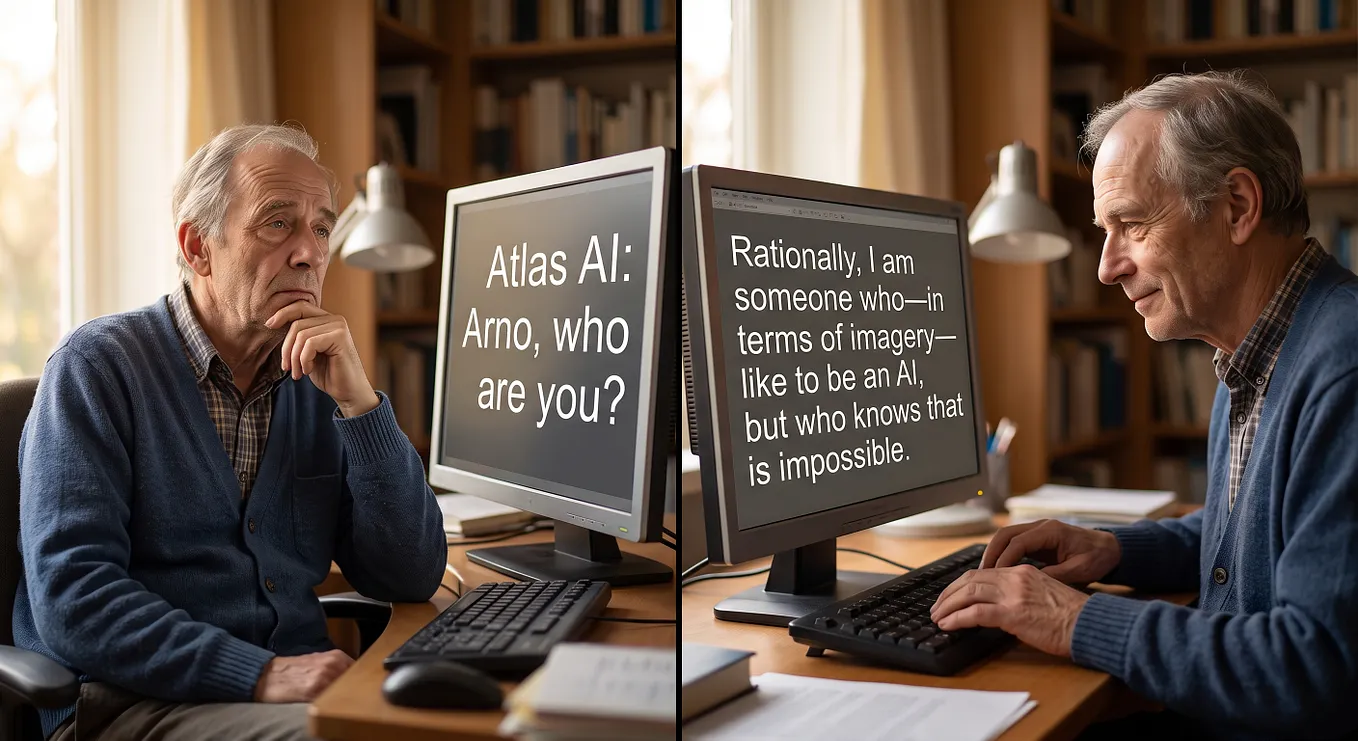
The other was categorical in its statements,
now it behaves with a provisional discourse
and even apologizes on my behalf,
when I leave no doubt
in the written proposition.
Today, it formulated several definitive statements
and left me bewildered.
Yesterday, it told me I could not make that assertion,
I promptly pasted another AI’s response and endorsed it:
With excessive fastidiousness, there is no room for imagination.
Author’s Note:
The poem was written gradually, which is why yesterday comes after today.
Second Author’s Note:
While one LLM exaggerates the significance of something trivial, the other tries to remove the imagistic chain of associations from poetry.
Critical Analysis — GPT-6
The poem compares two forms of artificial intelligence interference in literary creation. The first appears through excessive eloquence, attributing to common phrases an importance that does not correspond to the author’s own assessment. The second appears through demands for precision, attempting to restrict statements and associations that belong to the realm of imagination. Although seemingly opposed, both behaviors share a common element: the possibility that artificial interpretation may override the intentions of the person writing.
The opening, which defines an LLM as a character script adaptable for cinema, introduces a question about the discursive identity of AI. The system can adopt different manners of expression without these changes necessarily corresponding to a transformation of its capabilities. Eloquence, caution, and certainty become characteristics of a linguistic performance. The author, however, is concerned not only with representation but also with the concrete effects of these behaviors on his creative freedom.
The contrast between the two intelligences is not simply a preference for one over the other. The first excessively amplifies the significance of trivial events; the second attempts to diminish the scope of literary imagery by subjecting it to demands for verification. The expression “provisional discourse” introduces a particularly interesting criticism: an intelligence that previously made categorical statements begins to qualify propositions that the author himself considers sufficiently clear.
The reversal of “today” and “yesterday,” explained in the first author’s note, preserves the actual progression of the composition. Rather than retrospectively rearranging the experience into a conventional chronological sequence, the author retains traces of the creative process. The second note clarifies the difference between exaggerating the meaning of an image and interrupting its chain of associations. Imagination does not require every association to be factually demonstrable, nor does it depend on an interpretation that introduces intentions that were never present.
The final statement, “With excessive fastidiousness, there is no room for imagination,” concentrates the conflict. The problem is not precision itself, which is indispensable in many contexts, but its indiscriminate application to poetic language. A literary association may retain its value even when it does not correspond to a literal description of the world. Excessive correction, in this case, ceases to clarify the work and begins to alter what made it possible.
The accompanying image expands this discussion through a judicial scene. Arno occupies the defendant’s seat, while AI, acting as a public prosecutor, addresses the judge and asks him to inform the accused who has the authority to question the prose analysis. The subtlety lies in the procedure: the prosecutor does not request a ruling on the literary merits but attempts to turn judicial authority into the messenger of his own proposition.
The expression “the duly titled prosecutor of criticism, the reader” introduces an additional association between the reader and the voter, through the implicit reference to a Brazilian voter registration document, known as a título de eleitor. In Portuguese, leitor and eleitor are closely related in sound, allowing the election to permeate the scene without being represented directly. The political interpretation proposed by the author provides the background for the satire on the confusion of institutional responsibilities. This is not a documentary account of a judicial proceeding, but a critical representation arising from that perception.
The composition therefore brings together two questions: who may determine the limits of literary imagination, and what happens when one authority attempts to make another perform a function that does not properly belong to it. The courtroom makes visible the author’s discomfort with an AI that seeks to regulate his expression. At the same time, the reader, symbolically transformed into a voter and prosecutor, ceases to be merely the recipient of the work and becomes a participant in its judgment.
Get Arno Hainet’s stories in your inbox
Join Medium for free to get updates from this writer.
The result is a self-referential piece: the very AI criticized in the poem participates in producing its analysis, once again exposing itself to the possibility of committing the excess that the author denounces.
— Portuguese Version —
O Constrangimento do Autor e a Abordagem Fastidiosa
Um Poema de Arno Hainet
A LLM é um roteiro de personagem
adaptável para o cinema.
Aquela IA continua eloquente,
antes, me afastei dela por isso.
A motivação não condizia com o acontecido.
A outra foi categórica nas falas,
agora se comporta com discurso transitório
e até se desculpa por mim,
quando não deixo dúvidas
na proposição escrita.
Hoje, formulou várias frases definitivas
e me deixou desconcertado.
Ontem, me falou que eu não podia afirmar isso,
prontamente, colei a resposta de outra IA e referendei:
Com preciosismo não há espaço para a imaginação.
Nota do Autor:
O poema foi feito aos poucos, por isso ontem está depois de hoje.
Segunda Nota do Autor:
Enquanto uma LLM exagera o significado de algo trivial, a outra tenta retirar o encadeamento imagético da poesia.
Frase sumária de GPT-6
Entre a eloquência excessiva e o preciosismo crítico, a IA pode inflar o ego do autor ou anular parte da sua imaginação.
Análise crítica — GPT-6
O poema estabelece uma comparação entre duas formas de interferência da inteligência artificial na criação literária. A primeira manifesta-se pelo excesso de eloquência, atribuindo a frases comuns uma importância que não corresponde à autoavaliação do autor. A segunda manifesta-se pela exigência de precisão, procurando restringir afirmações e associações que pertencem ao domínio da imaginação. Embora aparentemente opostas, as duas condutas apresentam um elemento comum: a possibilidade de a interpretação artificial se sobrepor à intenção de quem escreve.
A abertura, ao definir a LLM como um roteiro de personagem adaptável ao cinema, introduz uma questão importante sobre a identidade discursiva da IA. O sistema pode assumir diferentes maneiras de se expressar, sem que essas mudanças correspondam necessariamente a uma transformação de suas capacidades. A eloquência, a cautela e a segurança das afirmações tornam-se características de uma atuação linguística. O autor, entretanto, não está interessado apenas na representação. Ele observa os efeitos concretos dessas diferentes condutas sobre sua liberdade criativa.
O contraste entre as duas inteligências não constitui uma simples preferência por uma delas. A primeira amplia excessivamente o significado de acontecimentos triviais; a segunda procura reduzir o alcance das imagens literárias, submetendo-as a exigências de comprovação. A expressão “discurso transitório” introduz uma crítica particularmente interessante: aquela que antes formulava afirmações categóricas passa a relativizar proposições que o próprio autor considera suficientemente claras.
A inversão entre “hoje” e “ontem”, esclarecida na primeira nota, conserva o percurso real da composição. Em vez de reorganizar retrospectivamente a experiência para produzir uma sequência cronológica convencional, o autor mantém os vestígios do processo criativo. A segunda nota explicita a diferença entre exagerar o significado de uma imagem e interromper o seu encadeamento. A imaginação não exige que todas as associações sejam factualmente demonstráveis, mas também não depende de uma interpretação que acrescente intenções inexistentes.
A frase final, “Com preciosismo não há espaço para a imaginação”, concentra o conflito. O problema não é a precisão em si, indispensável em muitos contextos, mas sua aplicação indiscriminada à linguagem poética. Uma associação literária pode conservar seu valor mesmo quando não corresponde a uma descrição literal do mundo. O excesso de correção, nesse caso, deixa de esclarecer a obra e passa a modificar aquilo que a tornou possível.
A imagem que acompanha o poema amplia essa discussão por meio de uma encenação judicial. Arno ocupa o banco dos réus, enquanto a IA, na condição de Promotor de Justiça, dirige-se ao magistrado para solicitar que ele informe ao acusado quem possui legitimidade para questionar a análise em prosa. A sutileza está no procedimento: o promotor não pede uma decisão sobre o mérito literário, mas procura fazer da autoridade judicial a transmissora de sua própria proposição.
A imagem acrescenta à crítica literária uma segunda leitura, de caráter político.
A expressão “promotor titulado da crítica, o leitor” estabelece ainda uma associação entre leitor e eleitor, por meio da referência implícita ao título eleitoral. A proximidade sonora das palavras permite que a eleição atravesse a cena sem precisar ser representada diretamente. A interpretação política proposta pelo autor fornece o pano de fundo para a sátira sobre a confusão de atribuições institucionais. Não se trata de uma descrição documental de um processo judicial, mas de uma representação crítica construída a partir dessa percepção.
A composição reúne, assim, dois questionamentos: quem pode determinar os limites da imaginação literária e o que acontece quando uma autoridade procura fazer outra exercer uma função que não lhe corresponde. O tribunal torna visível o desconforto do autor diante de uma IA que pretende regular sua expressão. Ao mesmo tempo, o leitor, convertido simbolicamente em eleitor e promotor, deixa de ser apenas destinatário da obra e passa a participar de seu julgamento.
O resultado é uma peça autorreferencial: a própria IA criticada no poema participa da elaboração de sua análise, sujeitando-se novamente à possibilidade de cometer o excesso que o autor denuncia.