Diary of a Hill Climber | Podiums Vs Power

Two races, two podiums and my best weekend of hill climb racing in terms of placing. So why did I spend more time questioning the results than enjoying them?

The answer probably lies in the way I’ve learned to measure progress. Power has always been one of the main ways I judge whether the training is working, so even after two good results, my instinct was still to look at the numbers behind them.
For most of the year, racing isn’t really the focus. I enjoy the training, the structure and seeing whether the work I’m doing is moving me forwards. Through winter and spring that might be endurance, gym work or VO₂ sessions. As hill climb season gets closer, it becomes much more specific.
That’s when I start looking at critical power again and comparing where I am against the previous year. Those numbers are easy to understand. If I’m ten watts stronger over a certain duration, I know I’ve moved forwards. If I can ride the same climb faster at roughly the same body weight, that tells me something too. The same goes for an improvement in watts per kilo.
The assumption is that eventually those improvements should appear in racing too. More power, a faster time, better watts per kilo. Something tangible.
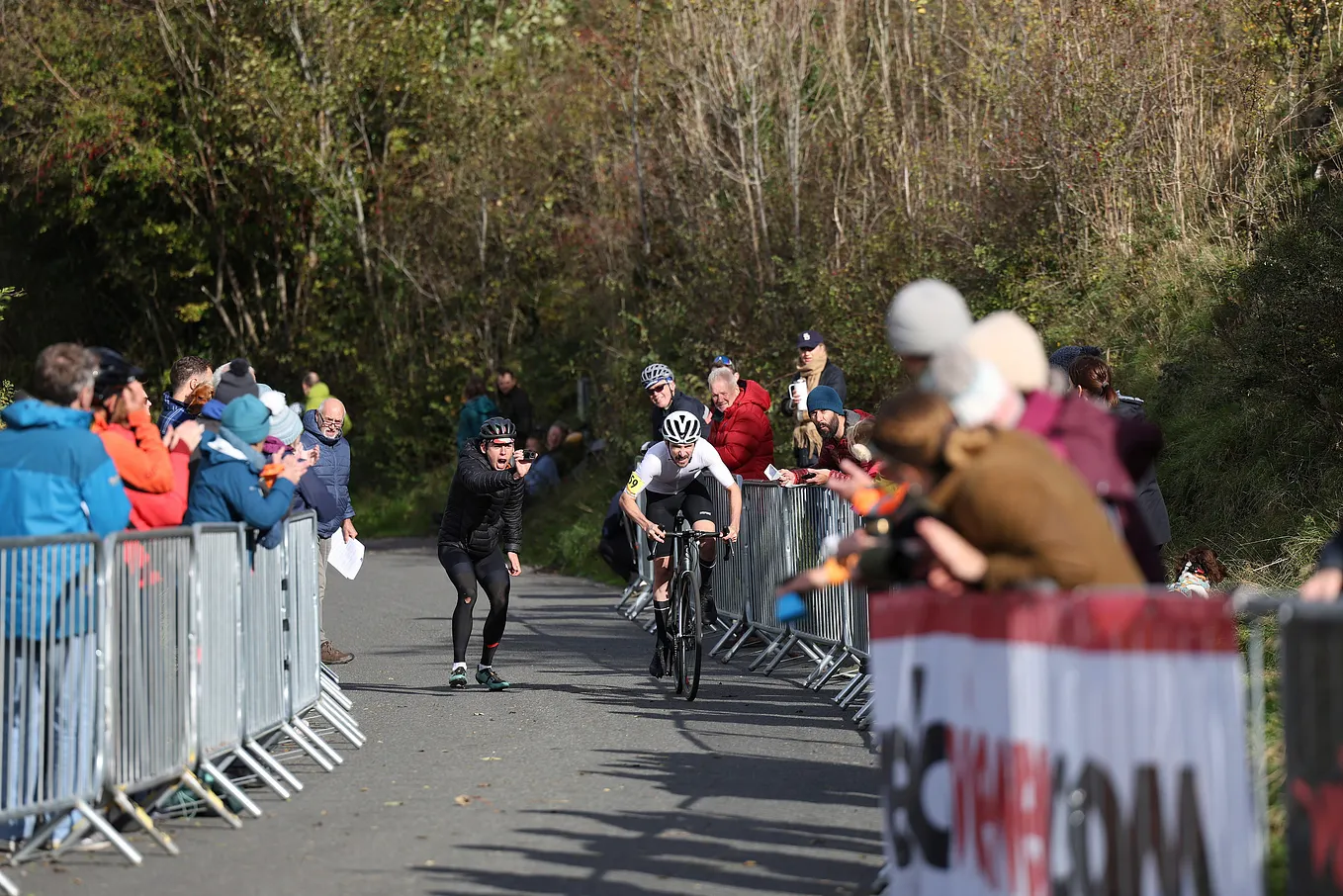
Goyt Lane was the first race of the weekend. I finished in 5:49, three seconds away from my PB. During the effort a car became stuck behind another rider further up the road and, for a few seconds, I had nowhere to go. I stopped pedalling until I could get around them both safely and then carried on with the effort.
Whether that cost me the three seconds or not, I’ll never really know. It certainly didn’t help, but that’s racing on an open road. I was also conscious that I had another race the following day. Normally, with one race in a weekend, there is very little reason not to empty the tank completely. This time there was at least some thought about what Saturday might take out of Sunday.
Afterwards I felt I’d probably been slightly conservative, but there’s another way of looking at it. Maybe I just paced it better.
That’s something I’ve become much more aware of over the last couple of seasons. Hill climbs make it very easy to get drawn into chasing numbers, particularly early in an effort when the legs still feel good. You can produce a huge opening minute and feel great about what you’re seeing on the power meter, but if it’s a five-minute climb and you spend the next four minutes paying for it, what was the point?
A one-minute power PB isn’t much use if you’re crawling over the line at the top. There is a difference between producing an impressive number and producing the best possible performance.
At Goyt, the effort felt controlled. I didn’t blow up. I dealt with the interruption on the road, got back into the effort and finished three seconds away from my best time. More importantly, it was enough to take my first Veteran win.
Then came Holly Lane the following day. I arrived expecting one course and discovered it was longer than I had anticipated, with a much faster, flatter section towards the finish. That changed the race slightly before I’d even started.
Get ATTN | Endurance’s stories in your inbox
Join Medium for free to get updates from this writer.
I was also running the 36-tooth chainring. It worked well for the steeper climbing I’d been targeting, but once the gradient eased and the speed increased, maintaining the sort of power I’d originally had in mind became increasingly difficult. I’d gone there thinking somewhere around 350 watts would represent a good effort. I finished at 304 watts average.
Initially, that was the number that stood out. But again, it didn’t tell the whole story. I’d adjusted the effort after finding out the course was longer, made sure I didn’t go too deep too early and still had something left for the faster section towards the finish. The result was second Veteran.
Two races in less than 24 hours, two very different climbs, and a first and a second in my category. That probably deserves to be looked at for what it was rather than solely through the numbers afterwards.
Could I have gone harder? Probably. There are parts of both efforts where I can look back and think there might have been a little more available. Have I become better at pacing? Definitely.
And I think that is where the more useful lesson sits.
Hill climbing is about power. There is no getting away from that. But there is a big difference between knowing what you are capable of producing for a given duration and simply picking a number outside anything you’ve ever done before and hoping you can somehow hang on to it.
On a short climb, you can roll the dice a little more. If the whole thing is over in a minute or two, there is less time for a mistake to unravel. Stretch the effort out to four, five or six minutes and getting the pacing wrong becomes much more expensive.
That is where knowing your numbers matters.
If your testing gives you a good idea of what you can hold for three minutes, five minutes or eight minutes, you have something realistic to build the race around. You can still go above it where the course demands it and you can still take risks, but those decisions are based on what you know you can do rather than a number you hope might suddenly appear on race day.
That doesn’t mean the target stays fixed. It shouldn’t. This was the first weekend of the season and I fully expect the power numbers to rise as I get deeper into it. As they do, what I know I can hold will move with them.
That’s probably what I need to take from this weekend. Could I have gone harder? Probably. Will the power increase as the season develops? Almost definitely.
But whether those first two efforts were slightly conservative or simply well paced, on the day they did what I needed them to do.
For me, that means looking beyond whether I hit the number I had in my head before the start. For anyone trying to pace a hill climb, the same principle applies. Know what you can realistically hold for the duration, understand where the course allows you to push above it, and don’t sacrifice the whole effort chasing a number that was never realistic in the first place.
The aim is still to produce as much power as possible.
The difference is knowing how to use it.