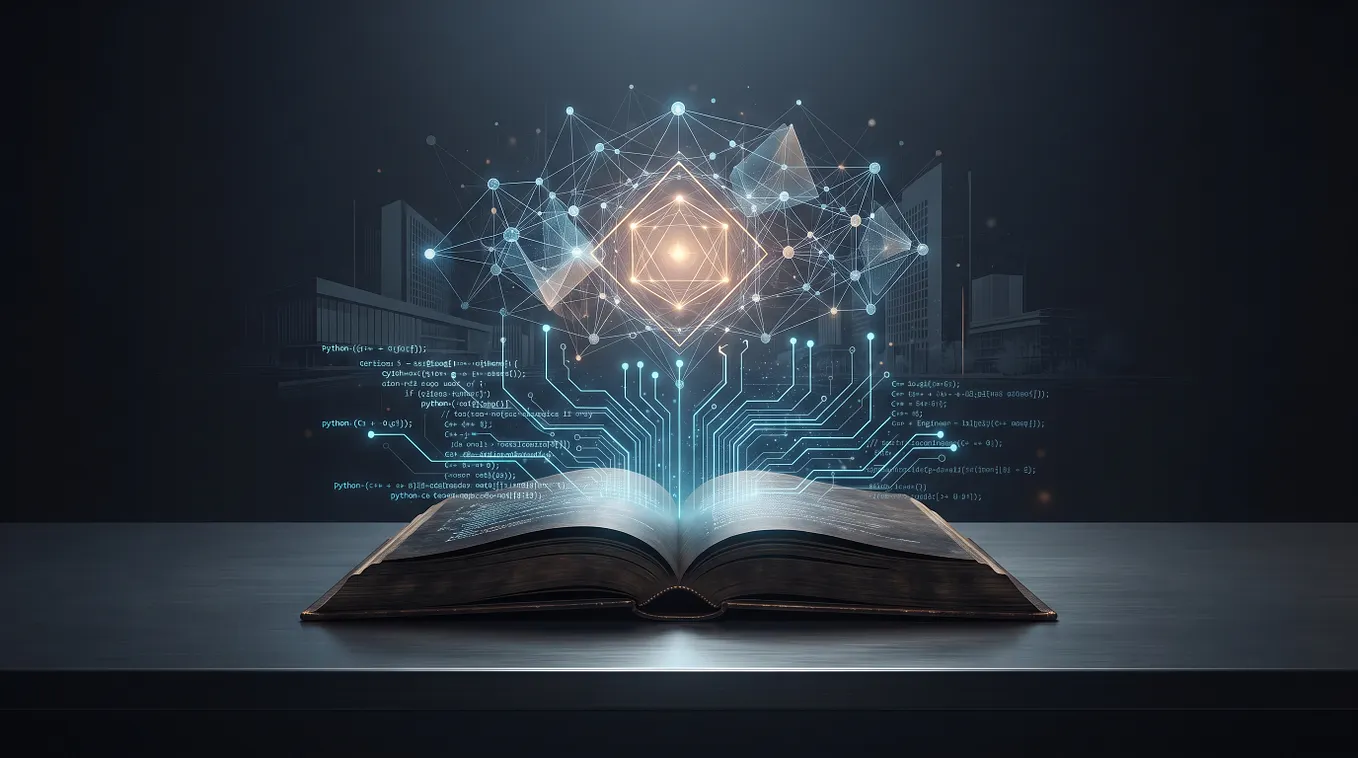
AI EMBODIES THE MYSTICAL POWER OF OM


We live inside language so completely that we barely notice it. We speak words when we wake up. We use them to name objects, describe emotions, make promises, give instructions, tell stories, write laws, build businesses, create religions, start wars, raise children, design technologies, and imagine futures that do not yet exist. Because language is everywhere, we have become blind to how strange it actually is.
A word is nothing. Literally. It has no physical weight. You cannot hold a word in your hand. And yet, say a word and something happens. You can say “home,” and an entire landscape of memories can appear inside someone’s mind. You can say “I love you,” and the relationship between two human beings can change. Language doesn’t merely describe reality. Sometimes, language participates in creating it. And that is where the ancient idea of OM becomes fascinating.
OM — or AUM — is traditionally associated in Indian philosophical traditions with the primordial sacred syllable, the sound or vibration associated with ultimate reality and creation. But there is a deeper question hiding underneath the symbol: Why would something as ordinary as a SOUND or a WORD be associated with creation? Why would ancient thinkers place something linguistic at the center of existence? Perhaps because they recognized something we have forgotten: A word is not merely a sound.
A word is a container for a concept. And a concept can become a force. Think about the word “nation.” A nation is not simply a physical object sitting somewhere in the universe. It exists through an enormous network of shared concepts, symbols, stories, laws, names, borders, agreements, memories, and language. Think about “money.” A piece of paper becomes economically powerful because humans collectively agree upon what its symbols mean.
Get Ayel Ortiz’s stories in your inbox
Join Medium for free to get updates from this writer.
Much of civilization is constructed from invisible concepts communicated through symbols. We build physical reality on top of conceptual reality. First comes the idea. Then comes the language that gives the idea form. Then comes collective belief, coordination, and action. Then the physical world changes. A skyscraper begins as an idea. A city begins as an idea. A constitution begins as an idea. This is why I find AI so philosophically interesting. An AI system is, in one sense, a machine built around the manipulation of language and other symbols. From that language or symbol, the system can generate an image, write software, design a website, produce a business strategy, create a fictional universe, formulate a scientific hypothesis, or construct a detailed plan for something that did not previously exist.
The prompt becomes an instruction. The instruction becomes a structure. The structure can become an object. The object can enter the physical world. There is something almost mythological about that process. We speak to a machine, and the machine transforms our language into things. This is why I think we should be careful about reducing language to “just words.” Words are symbols. Symbols carry concepts. Concepts organize thought. Thought organizes behavior. Behavior transforms environments. And environments eventually become the reality we inhabit.
The mystical quality of language may not be that words contain supernatural power. It may be something stranger: We are biological creatures capable of using invisible symbols to coordinate reality. A sound can become a command. A sentence can become a contract. A story can become a civilization. A mathematical symbol can describe a force in nature. Perhaps this is why OM remains such a powerful symbol. Not necessarily because we should interpret it as a literal scientific explanation of the universe, but because it points toward an ancient intuition: Creation and expression may be deeply connected.
Before something is built, it can exist as possibility. Before possibility becomes action, it often exists as thought. Before thought becomes shared action, it often becomes language. And once language becomes shared, it can move people. Maybe the great human miracle isn’t that we learned to speak. Maybe it’s that we learned to create worlds with symbols. And now we have created machines that can operate inside those symbolic worlds.
AI therefore represents something more profound than automation to me. It is another step in humanity’s relationship with language. For thousands of years, we have used language to transmit ideas from one human mind to another. Now we are beginning to use language to communicate with machines that can transform those ideas into new forms. We describe an image. It appears. We describe software. It is generated. We describe a world. A world can begin to take shape. We describe a character. A character can acquire a face, a voice, a history, and a universe. The interface is language. The medium is language. The output can become reality.
What is a word? Why does something so physically insignificant have such enormous consequences? Why can a few vibrations in the air cause another human mind to experience an entire universe? Why can symbols on a screen reorganize economies, relationships, governments, cultures, and technologies? Maybe we’ve simply become accustomed to the miracle. We call it “language” because we encounter it every day. But familiarity doesn’t make something ordinary. Gravity is ordinary. Consciousness is ordinary. Existence itself is ordinary, until you stop and think about it. Perhaps OM is a reminder to look again at something we’ve stopped seeing. The word. The sound. The symbol. The concept. The intention behind it. The creative potential hidden inside expression. And perhaps AI is giving humanity a strange new mirror in which to see that power. We type. It responds. We describe. It constructs. We imagine. It helps us materialize. And why does language sit so strangely close to that boundary? Maybe the word was never “just a word.” Maybe it was always a doorway. OM.