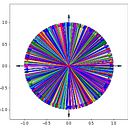
Think of your mind as a quantum system, and imagine a situation where you have been invited to a party by your friend. Now if you are an introvert like me, you would not be very pleased by the invitation and at the same time would be hesitant to instantly say no.
Your mind now assumes a superposition of ‘yes’ and ‘no’, and can be described as a quantum superposition state. Let us say it is in a state with 70% probability of deciding to say ‘yes’ and 30% of deciding to say ‘no’.
If your mind doesn’t interact with the environment, it can maintain its coherence and remain in the same state until a measurement is made- that is when your friend knocks on your hostel dorm door to finally check with you. “So are you joining?” — the question acts as a measurement and you have to make a decision- your mind has to collapse to either ‘yes’ or ‘no’. It has 70% probability of collapsing to ‘yes’ and 30% of collapsing to ‘no’. Suppose it collapses to ‘yes’- then the quantum superposition is destroyed and your mind now assumes the state ‘yes’. That is the measurement postulate of quantum mechanics.
The interesting thing here is, your friend will never know the full state of your mind just by looking at the outcome- ‘yes’ on a single measurement. That is, your friend will never know if it were 70% or 10% for ‘yes’. :)
To know the probability amplitudes associated with the state, your friend has to create exactly the same situation several times- say a 100 times and do repeated measurements to get the distribution of responses - she would get a ‘yes’ around 70 times and a ‘no’ around 30 times. This is precisely how measurements work in quantum systems…well, if we implicitly assume the ‘Copenhagen’ picture and the ‘Born rule’, which is the standard textbook framework used to describe quantum measurements.
Get Betelgeuse’s stories in your inbox
Join Medium for free to get updates from this writer.
Now suppose a different scenario: where you want to make a decision by yourself before the friend arrives, who by the way is also a quantum physicist. :) In this case, you would first make the “self measurement” or the “decision” which would make you believe that your quantum mind collapses into one of the two states — ‘yes’ or ‘no’. But now for your friend, the measurement occurs when she asks you before leaving — and so for your friend, your mind has been in a superposition all along before she did the measurement.
And now we have a strange situation. From your perspective, a measurement has already occurred when you made the decision. You know with certainty that your mind is in a definite state — either ‘yes’ or ‘no’. However, from your friend’s perspective, before she interacts with you, the entire system consisting of you and your undecided mind should still evolve according to the laws of quantum mechanics and therefore remain in a superposition.
So which description is correct? Did the collapse occur when you made the decision, or only when your friend asked the question? Can two observers legitimately assign different quantum states to the same physical situation?
This tension lies at the heart of the Wigner’s Friend paradox. The thought experiment forces us to confront a fundamental question: is wavefunction collapse a real physical event, or is it merely a reflection of what an observer knows? Different interpretations of quantum mechanics answer this question in different ways, and more than sixty years after Wigner proposed the scenario, there is still no universally accepted resolution.

P.S. Did you know: a quantum superposition state can also exist with a relative “phase” between the different possibilities ‘yes’ and ‘no’? This phase does not affect the 70–30 probabilities we discussed above, but it is a very important part in fully describing a quantum state. What do you think could be a fun analogy for this mysterious quantum phase, and how could your friend ever learn about it? Stay tuned to find out! :)