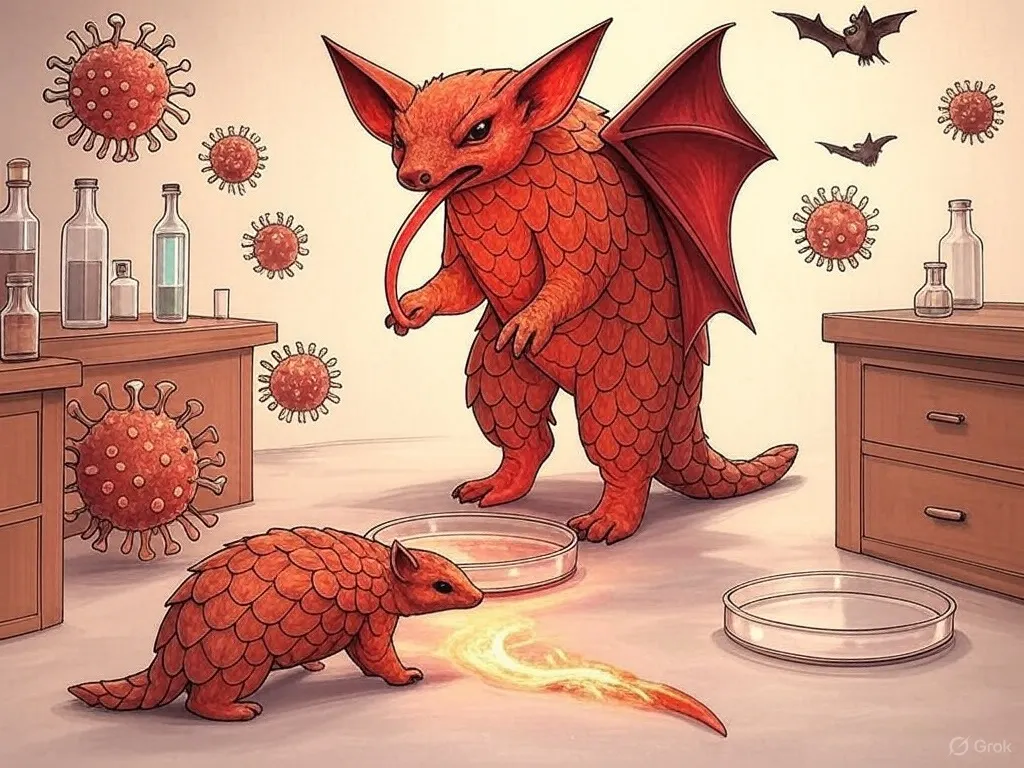
The Great Virus Safari: A Farce in Five Acts.

Five years of helping to coordinate DRASTIC (2020–2025) have left me with a liver full of gin and a heart full of contempt for the farcical virus-hunting schemes of PREDICT, EcoHealth Alliance (EHA), Metabiota, and their self-appointed high priest, Peter Daszak.
What a bloody shambles it was, a multi-million-dollar pantomime dressed up as “One Health” salvation, where scientists played Indiana Jones, swapping fedoras for hazmat suits to chase phantom viruses in bat caves and pig sties.

Their mission?
To catalogue every microbe before it sparked “Disease X,” that nebulous bogeyman of pandemics (World Health Organization, 2022).
The result?
A monument to futility, as gloriously exposed in a recent mBio paper by Aatresh and Lipsitch (2025), which I dissected with savage glee in a thread on X (Bostickson, 2025, September 24).
Allow me, dear reader, to recount this sorry tale of squandered millions and scientific hubris:
The PREDICT/EHA model was sold as the ultimate pandemic shield: swab every beast from here to Timbuktu, sequence their viruses, and, voilà, vaccines would magically appear to thwart the next plague (Preston, 2019; USAID, 2021).
It was butterfly collecting for the 21st century, only instead of pinning Lepidoptera to boards, these modern-day obsessives pinned viral sequences to databases, convinced they were saving the world (Carroll et al., 2018).
Aatresh and Lipsitch (2025) deliver a withering verdict: this viral prospecting lark has done sod-all to enhance preparedness or accelerate vaccine development.
Their paper tests two laughably optimistic hypotheses, whether prospecting spots viral threats before they hit humans and whether it speeds up medical countermeasures (MCMs), and finds both as hollow as Daszak’s promises.
Of the 250-odd viruses known to infect humans, a measly 11 were first found in animals before causing human outbreaks (Aatresh & Lipsitch, 2025).
Monkeypox, Rift Valley Fever, and Zika make the list, but their animal origins didn’t exactly usher in an era of vaccine triumphs.
No jabs exist for Zika or Rift Valley Fever, and monkeypox leans on repurposed smallpox vaccines (Shchelkunova & Shchelkunov, 2022).
The rest?
Obscure bugs causing barely a sniffle, hardly worth the petrol for the Land Rover to the jungle (Jones et al., 2008). Meanwhile, the real culprits behind 21st-century outbreaks, Ebola, influenza A, MERS-CoV, were known quantities, often first identified in humans decades ago (Carlson et al., 2023).
The World Health Organization’s Disease Outbreak News (1996–2019) shows that major outbreaks stem from familiar foes, not novel nasties lurking in a bat’s arse (Carlson, 2022).
Even Public Health Emergencies of International Concern, like H1N1 and COVID-19, involved viruses from well-studied families (Wilder-Smith & Osman, 2020).
Prospecting? It’s like hunting for a unicorn in a zoo full of rhinos.
The paper’s filovirus case study is a deliciously brutal takedown. PREDICT’s poster child, the Bombali virus, discovered in 2016, was trumpeted as a breakthrough (Goldstein et al., 2018).
A new Ebola species! Except it’s about as pathogenic to humans as a soggy biscuit, with no documented infections and no MCM development past a lab daydream (Forbes et al., 2019; Bodmer et al., 2023).
Real Ebola outbreaks, driven by Zaire and Sudan ebolaviruses, have been known since the 1970s, with vaccine efforts only kicking into gear after the 2013–2016 West Africa catastrophe, not because of some prescient bat swab (Henao-Restrepo et al., 2017).
Marburg’s no better, despite decades of chasing bats, no approved vaccine exists, and the biggest outbreak in Angola (2004) relied on human isolates for MCM work (Bausch et al., 2006).
Animal surveillance has been as useful as a “paper umbrella in a monsoon” (Amman et al., 2020).
The broader vaccine landscape is a graveyard of missed opportunities. Ten of 26 virus families known to infect humans lack any approved vaccine, one tragic example is of course, HIV. (Graham & Sullivan, 2018).
Priority lists from CEPI, WHO, and others focus on decades-old pathogens, not PREDICT’s shiny new finds (Coalition for Epidemic Preparedness Innovations, 2023). Aatresh and Lipsitch (2025) note with dry contempt that “systematic 21st-century viral prospecting efforts have not contributed any novel zoonotic viruses” to these lists (p. 8).
It’s as if the entire enterprise was a performance of Waiting for Godot, with no Godot in sight.
The dark comedy doesn’t end there. Researchers risked life and limb, bitten by virus-laden bats, no less (Amman et al., 2015), for what?

PREDICT sampled 70,000 animals, yielding 800 novel viruses, most as threatening as a kitten’s sneeze (Grange et al., 2021).
Their one “success”, a novel virus, was found during a human outbreak investigation, not some heroic jungle trek (Grard et al., 2012).
The biosafety risks and eyewatering costs make it all the more galling (Willman, 2023).
Get Billy Bostickson’s stories in your inbox
Join Medium for free to get updates from this writer.
Daszak’s vision of a “global viral surveillance network” uploading sequences in real-time to block spillovers sounds like a sci-fi fantasy, not science (Daszak, 2021).

Meanwhile, real barriers, technical challenges, market failures, global inequities,mock the idea that more viral sequences will save us (Plotkin et al., 2015).
My X thread called it a failure, and I’ll go further: it’s a scandal.
PREDICT, EHA, Metabiota, and Daszak peddled a delusion, distracting from the real work of bolstering health systems and tackling known pathogens (Jasanoff, 2021).
Mpox festered in Africa for decades before its 2022 PHEIC, with vaccines arriving in 2024, hardly a win for foresight (Taylor, 2024).
The paper’s parting shot is a polite kick in the teeth: other strategies, like human-focused surveillance or infrastructure investment, might actually work without the “tradeoffs in cost, safety, or other domains” (Aatresh & Lipsitch, 2025, p. 15).

In other words, stop mucking about in the wilderness and fix the bloody obvious.
As one of DRASTIC’s coordinators, I’ve spent years exposing the rot in pandemic narratives, and this paper is my vindication.
The virus-hunting mania was a costly sideshow, a monument to ego over evidence. While Daszak and co. played viral Pokémon, real threats, known pathogens, crumbling health systems, global inequities, laughed in our faces.
Here’s to Aatresh and Lipsitch for wielding data like a flamethrower!
May the next five years ditch the butterfly nets for something that actually matters.
References
Aatresh, A. V., & Lipsitch, M. (2025). What is the relationship between viral prospecting in animals and medical countermeasure development? mBio, 16(8), e02033–25. https://journals.asm.org/doi/10.1128/mbio.02033-25
Amman, B. R., Albariño, C. G., Bird, B. H., Nyakarahuka, L., Sealy, T. K., Balinandi, S., … Towner, J. S. (2015). A recently discovered pathogenic paramyxovirus, Sosuga virus, is present in Rousettus aegyptiacus fruit bats at multiple locations in Uganda. Journal of Wildlife Diseases, 51(3), 774–779. https://meridian.allenpress.com/jwd/article/51/3/774/132013/A-Recently-Discovered-Pathogenic-Paramyxovirus
Amman, B. R., Bird, B. H., Bakarr, I. A., Bangura, J., Schuh, A. J., Johnny, J., … Lebbie, A. (2020). Isolation of Angola-like Marburg virus from Egyptian rousette bats from West Africa. Nature Communications, 11(1), 1–9. https://www.nature.com/articles/s41467-020-14327-8
Bausch, D. G., Nichol, S. T., Muyembe-Tamfum, J. J., Borchert, M., Rollin, P. E., Sleurs, H., … Colebunders, R. (2006). Marburg hemorrhagic fever associated with multiple genetic lineages of virus. New England Journal of Medicine, 355(9), 909–919. https://www.nejm.org/doi/full/10.1056/NEJMoa051465
Bostickson, B. (2025, September 24). Personal communication [X post]. https://x.com/BillyBostickson/status/1970862955802890513
Carlson, C. J. (2022). Cghss/dons: Preprint version of the data (v0.1). Zenodo. https://zenodo.org/records/6374495
Carlson, C. J., Boyce, M. R., Dunne, M., Graeden, E., Lin, J., Abdellatif, Y. O., … Katz, R. (2023). The World Health Organization’s Disease Outbreak News: A retrospective database. PLoS Global Public Health, 3(1), e0001083. https://journals.plos.org/globalpublichealth/article?id=10.1371/journal.pgph.0001083
Carroll, D., Daszak, P., Wolfe, N. D., Gao, G. F., Morel, C. M., Morzaria, S., … Mazet, J. A. K. (2018). The Global Virome Project. Science, 359(6378), 872–874. https://www.science.org/doi/10.1126/science.aap7463
Coalition for Epidemic Preparedness Innovations. (2023). Priority diseases. https://cepi.net/priority-diseases
Daszak, P. (2021). Lessons from COVID-19 to help prevent future pandemics. China CDC Weekly, 3(6), 132–133. https://weekly.chinacdc.cn/en/article/doi/10.46234/ccdcw2021.037
Forbes, K. M., Webala, P. W., Jääskeläinen, A. J., Abdurahman, S., Ogola, J., Masika, M. M., … Sironen, T. (2019). Bombali virus in Mops condylurus bat, Kenya. Emerging Infectious Diseases, 25(5), 955–957. https://wwwnc.cdc.gov/eid/article/25/5/18-1666_article
Goldstein, T., Anthony, S. J., Gbakima, A., Bird, B. H., Bangura, J., Tremeau-Bravard, A., … Liang, E. (2018). The discovery of Bombali virus adds further support for bats as hosts of ebolaviruses. Nature Microbiology, 3(10), 1084–1089. https://www.nature.com/articles/s41564-018-0227-2
Grard, G., Fair, J. N., Lee, D., Slikas, E., Steffen, I., Muyembe, J.-J., … Leroy, E. M. (2012). A novel rhabdovirus associated with acute hemorrhagic fever in Central Africa. PLoS Pathogens, 8(9), e1002924. https://journals.plos.org/plospathogens/article?id=10.1371/journal.ppat.1002924
Grange, Z. L., Goldstein, T., Johnson, C. K., Anthony, S., Gilardi, K., Daszak, P., … PREDICT Consortium. (2021). Ranking the risk of animal-to-human spillover for newly discovered viruses. Proceedings of the National Academy of Sciences, 118(15), e2002324118. https://www.pnas.org/doi/10.1073/pnas.2002324118
Henao-Restrepo, A. M., Longini, I. M., Egger, M., Dean, N. E., Edmunds, W. J., Camacho, A., … Kieny, M. P. (2017). Efficacy and effectiveness of an rVSV-vectored vaccine in preventing Ebola virus disease. The Lancet, 389(10068), 505–518. https://www.thelancet.com/journals/lancet/article/PIIS0140-6736(16)32621-6/fulltext
Jasanoff, S. (2021). Public policy after pandemic. Boston Review. https://www.bostonreview.net/articles/preparedness-wont-stop-the-next-pandemic/
Jones, K. E., Patel, N. G., Levy, M. A., Storeygard, A., Balk, D., Gittleman, J. L., & Daszak, P. (2008). Global trends in emerging infectious diseases. Nature, 451(7181), 990–993. https://www.nature.com/articles/nature06536
Plotkin, S. A., Mahmoud, A. A. F., & Farrar, J. (2015). Establishing a global vaccine-development fund. New England Journal of Medicine, 373(4), 297–300. https://www.nejm.org/doi/full/10.1056/NEJMp1506820
Preston, E. C. (2019). PREDICT | School of Veterinary Medicine. https://ohi.vetmed.ucdavis.edu/programs-projects/predict-project
Shchelkunova, G. A., & Shchelkunov, S. N. (2022). Smallpox, monkeypox and other human orthopoxvirus infections. Viruses, 15(1), 103. https://www.mdpi.com/1999-4915/15/1/103
Taylor, L. (2024). First mpox vaccines arrive in Africa as officials work “blindly” to contain outbreaks. BMJ, 386, q1897. https://www.bmj.com/content/386/bmj.q1897
USAID. (2021). USAID announces new $125 million project to detect unknown viruses with pandemic potential | Press release. https://www.usaid.gov/news-information/press-releases/oct-5-2021-usaid-announces-new-125-million-project-detect-unknown-viruses-pandemic-potential
Wilder-Smith, A., & Osman, S. (2020). Public health emergencies of international concern: A historic overview. Journal of Travel Medicine, 27(8), taaa227. https://academic.oup.com/jtm/article/27/8/taaa227/6007450
World Health Organization. (2022). WHO to identify pathogens that could cause future outbreaks and pandemics. https://www.who.int/news/item/21-11-2022-who-to-identify-pathogens-that-could-cause-future-outbreaks-and-pandemics