Greetings to the New Brunette


England began 60 years of hurt, by winning the World Cup in the summer of 1966, a new season beckoned, and John’s front-room dreams were starting to come true.
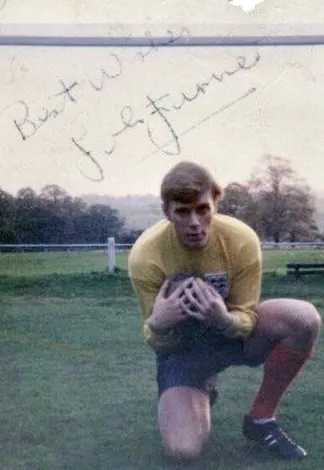
By the time Stoke’s 1966–67 campaign began in earnest, goalkeepers Lawrie Leslie and Bobby Irvine had left, Paul Shardlow had arrived, and John saw himself as number one. He had now stepped off the PMT bus and bought a second-hand sports car.
Inside forward George Eastham, who had been part of England’s World Cup-winning squad, had signed from Arsenal, and Stoke started well. They beat Notts Forest away, then Spurs at home.
A minor headache against Spurs: John’s boyhood hero, the great Dave MacKay, knocked him out. And, as if that wasn’t painful enough, Maurice Setters woke him up.
“I came out and dived at Dave MacKay’s feet and he kicked me in the head,” says John. “I was unconscious for a minute or so. I remember coming round and all I could hear was Maurice Setters’ voice. He was shouting, ‘stay down, stay down’. He was trying to persuade the ref to give us a free kick rather than a bounce-ball in the box. It wasn’t a foul. It was an accident. But the ref gave a foul.
Setters came from Honiton in Devon. He had a Devon accent. His voice was distinctive. And, John says, he did a lot of shouting.
“I remember we were playing on a tour game in America in an empty stadium once,” says John. “Setters went up front and I could hear his voice echoing around the stadium from my goalmouth. I can still hear it.”
Stoke played Spurs home and away at the start of that season. On August 31 1966, following Stoke’s 2–0 home win, Spurs’ fan John celebrated his 19th birthday by playing at White Hart Lane for the first time. Unfortunately, Spurs burst his balloons. They beat Stoke 2–0, with goals from Alan Gilzean and Greaves (yet another penalty).
Nevertheless, Stoke were flying, John was growing in confidence and thought he was getting better with every game.
They beat Everton 1–0 away, eventual champions Manchester United 3–0 at home, Sheffield United 3–0 at home, West Brom 1–0 away and Sheffield Wednesday 3–1.
(John recalls the Wednesday win being one of the oddest of his career. Stoke drove to Sheffield on the morning of the game and stopped at a hotel in Bakewell for lunch. Their coach got delayed as they approached Hillsborough and the kick off was delayed for 10 minutes. The players had to get changed into their kit on the coach and dash out as soon as they arrived.)
Stoke went to the top of the first division table in October.
By now John was thinking of England when he was lying back and doing his sit-ups during training, certainly thinking about the England under-23 side and their forthcoming international against Wales under-23s.
(‘Farmer for England’ and ‘Farmer is better than Yashin’ the Boothern End would sing. And Manchester United manager Matt Busby had written, in a newspaper article: “In Stoke, they may well say they have found the goalkeeper not only for the 1970 World Cup but 1974 as well…’ Busby said John had ‘tremendous potential’ and added: ‘This boy, a mere 18, is almost incredibly sure of himself. He catches the ball beautifully, reads situations almost before they arise, moves sharply to narrow angles, and, equally important, apparently has an equable temperament, which is probably what makes him look so cool under pressure.”)
England manager Alf Ramsey named John as reserve, to Sunderland’s Jim Montgomery, who was nearly four years older, for the Wales under-23 international. John was disappointed. In the event, Montgomery suffered a shoulder injury during training and John was drafted into the team on the day of the game. He kept goal as the England under- 23s beat their Welsh counterparts 8–0 at Molineux on Wednesday October 12 1966. John lined up alongside players who would go on to be big names: Spurs’ Cyril Knowles, Chelsea’s John Hollins and Ron Harris, Burnley’s Ralph Coates, Arsenal’s Jon Sammels, Sheffield Wednesday’s David Ford (John recalls Ramsay describing Ford as a ‘willing donkey’ before the game, and comparing him to Geoff Hurst), and Allan Clarke.

As he pointed his Sunbeam Alpine GT away from Wolverhampton and back towards Biddulph after the game, John was thinking that he’d be in the next under-23 side, thinking that he had a good chance of getting into the full England squad, and thinking that he was at the start of an international career. If only…
Local Newspaper headlines chart Stoke’s season — and John’s decline and fall.
Manager Tony Waddington tells the Evening Sentinel, in September: “This season’s Stoke side is undoubtedly the best I have been able to put into the field.”
In November, Stoke fans are “disgusted” by Waddington’s decision to sell centre-forward John Ritchie to Sheffield Wednesday in November.
Nevertheless, John is “in form” as Stoke lose 1–0 at home to Manchester City, and one of his side’s “aces” as they win 1–0 at Blackpool.
Stoke start to slide down the table after Christmas.
Get Brian Farmer’s stories in your inbox
Join Medium for free to get updates from this writer.
In February, the Sentinel tells how “Farmer blunders for Astle to save point” in a 1–1 home draw against West Bromwich Albion.
As Easter approaches, John has lost “form” and, in April, Waddington signs Banks.
Stoke finish the season in 12th place.
Stoke historian Wade Martin says, in his 1991 book: Master Potters of Stoke City F.C. — The Goalkeepers, says John was a “sensational local find” when he emerged and “on his day was without doubt one of the best around”. But Martin says John “did lose confidence a couple of times in his career and when Gordon Banks became available Tony Waddington was quick to pounce”.
Confidence is a word that often crops up when Stoke fans discuss John on internet chats side. It appears nine times in a 2009 thread on The Oatcake fanzine message board. “Cheadlestokie” says John’s confidence was wrecked by Maurice Setters “continually keeping on at him”, “AlliG” says John’s confidence was “a bit fragile”.
But John learned long ago that goalkeepers should never admit mistakes, and he has no time for any of that kind of twitter.

“My confidence wasn’t fragile, I never lost confidence in myself and I didn’t make many mistakes during that period,” he says.
“The only real clanger I dropped was at Manchester United in the third round of the FA Cup in January. I thought David Herd’s shot was going wide and let it go. But it bounced in off the post. We lost 2–0. I thought I was a better goalkeeper than I’d been when I broke into the side and was getting better with every game. I’d hadn’t lost confidence; I was getting more confident. The United mistake was probably because I was over-confident. I was thinking I couldn’t do anything wrong. I was always confident in my own ability. You can’t worry about stupid mistakes like that. You just have to forget them. That Herd goal and a goal at Chelsea in 1974, when the ball slipped through my hands, were the only really big clangers I dropped in my career. I obviously made mistakes but they were the only stupid mistakes.
“We lost 2–1 in a League Cup game at Walsall in September 1966. Those goals weren’t my fault. We just didn’t play. I’d made a couple of other mistakes in a couple of games, but nothing drastic. I got blamed for a goal at Leeds when I dropped a cross. I thought I was fouled.”
But he says his youth made him an easy target for older, more cynical, heads in the Stoke side.
“Stoke had some big names and some good players,” says John. “And they could be funny. Roy Vernon was the funniest. He used to put on one of those Sergeant Bilko shades when they played cards and he dealt. I liked Roy. Everyone called him ‘Taffy’. He was always smoking and he was very quick-witted.
“There was a story that, when he was at Everton, the manager had said at half-time, ‘you got to move more, Roy. Make yourself available. They’re looking for you but they can’t find you’. Roy had apparently replied, ‘Boss, if they can’t find me when I’m standing still, how will they find me if I start moving around?’
“But some of Stoke’s big names were old and their legs were going. They played for themselves. They were trying to find ways of getting through games without making themselves look bad. It easy to point the finger at a teenage goalkeeper. Setters was the prime example. Maurice was a good player. He wasn’t very tall. But he was perhaps the best player I played with in the air. Very good. He was a strong, loud, physically dominant man. I was the youngest player in the side and I was an easy target. I was very young and very inexperienced and I was in goal. I was also quiet. Setters would be waving his arms about when a goal went in a giving everyone the impression it was my fault.
“I thought at the time some of the things Setters and others were saying was good advice. But it wasn’t. I was too young and too inexperienced to understand. I think it was a kind of bullying. Mental bullying. It never became physical. Nobody ever threatened me or anything like that. But I think they were making me think I was doing something wrong when I wasn’t. Setters once threatened Gerry Bridgewood after a game. Bridgewood made a bighead sign to the crowd about Setters and Setters threatened him after the game.”
John recalls once even being blamed when Stoke lost a game he wasn’t playing in. In December 1966, Stoke signed Manchester United’s veteran star as cover when John picked up an injury. Gregg’s first game was at Leicester and Stoke lost 4–2.
“Greggy probably conceded a couple of goals that he shouldn’t have done,” says John.
“But, on the Monday, at the team meeting, I got the blame! Waddington asked what had gone wrong. Greggy said the problem was that the defence was ‘backing in’ on him, not giving him enough room. Setters said, ‘we back in because of John’. He meant the defence sat back a bit to protect me because I was so young. I put my hand up and asked Waddington if I could say something. I said: ‘Sorry, but how can I get the blame when I wasn’t playing?’ I remember Greggy laughing. Greggy, of course, understood that Setters backed in because his legs had gone. Setters was backing in to protect himself, not me. He was worried about being turned. I was very young, I didn’t understand that then. I thought the backing in was to help me. They were backing in to protect Maurice, not me. It’s much easier to play going forwards. Setters didn’t want to be turned because he wasn’t quick enough to get back any more. Setters didn’t blame Greggy. They were mates, they’d been at United together. He’d never clash with Greggy. He’d have known better than to upset Greggy.”


John’s last game was a 1–3 defeat at Manchester City, on April 12, 1967. He suffered a bad thigh injury in a clash with City full back Tony Book. He limped on and finished the game but wasn’t fit for the next match. Gregg played in a 2–0 home win against Blackpool — a game which marked the end of the Northern Ireland star’s playing career — and, by the time John was ready for action again, Banks of England had arrived.
His rocket had fallen back to earth as fast as it had risen, and landed in the with almighty bump in the Central League.
“I got blamed for a goal at Manchester City,” recalls John. “The problem was that Tony Book had kicked me in the thigh and I was struggling to move. There was a header at the far post but I couldn’t get across the line. Peter Dobing asked me why I hadn’t come off. But if I’d gone off, they wouldn’t have had a goalkeeper. When I got in the dressing room my leg was about four times its normal size. Waddington had a go at me, saying ‘you have cost us the game’. I remember Peter Dobing saying, ‘have you seen his thigh?’
“That was the last game I played before they signed Banks. I don’t think the Manchester City game had anything to do with it. I’m sure they’d have signed him anyway.”