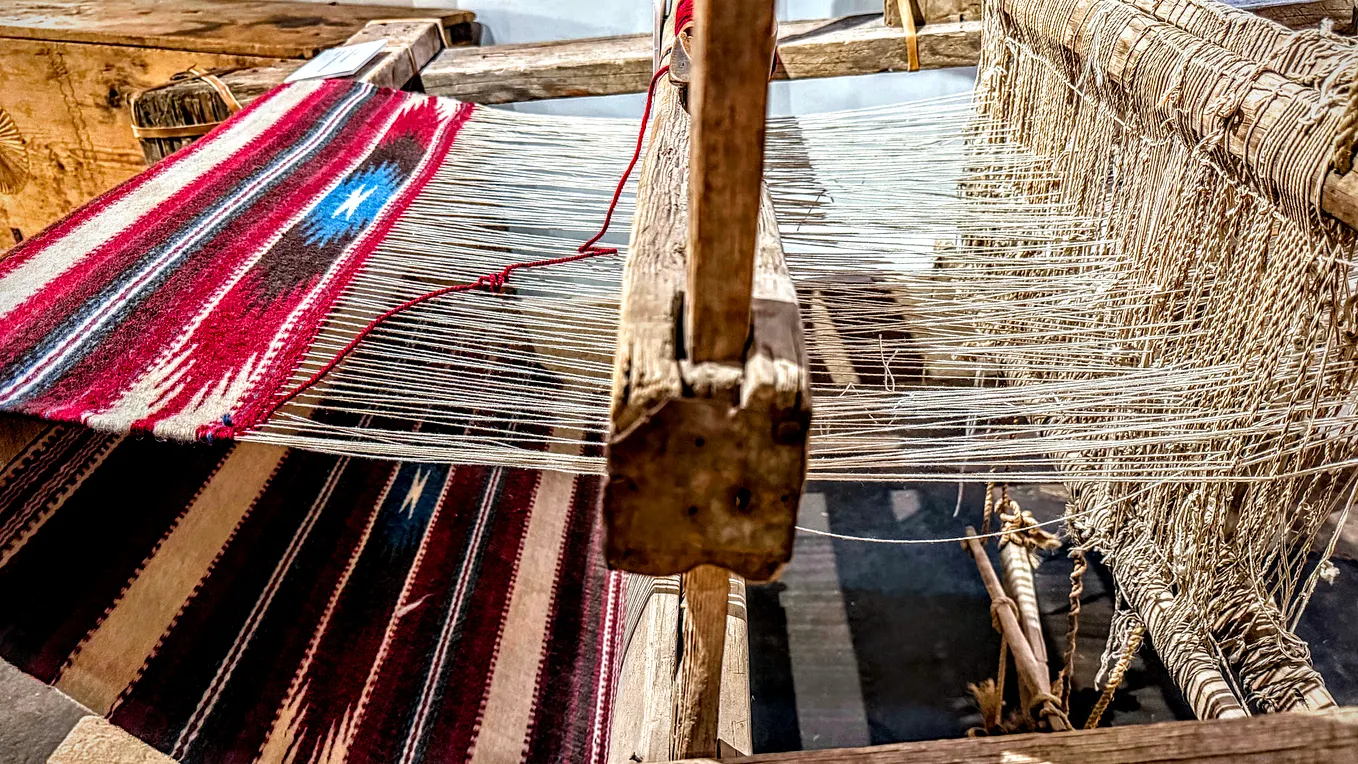
The Terrain That Made You
On the river I grew up crossing, and the valley that got in

In Albuquerque, distance was a number, and the number rose toward the west.
My grandmother lived on 63rd, in a casita in front of the house where my Auntie Dolores and Uncle Milton lived. The house is still in the family. Sixty-third meant sixty-three streets west of the railroad downtown. Aunt Debbie was farther still, near 98th, out where the streets ran into the hundreds and into the sun.
When you are small, a number that big is not an address. It is the edge of the known world. My brother and I rode toward it in the back of the car, watching the houses thin and the numbers climb. Later our two sisters rode with us in car seats in the middle row of our dirt brown Astro minivan. Nobody told me what the numbers meant, but I understood it. A number that size measured a distance and pointed in a direction. Both grew as you moved away from the water.
Because you moved away from the water to get anywhere. That was the first thing the city taught me. The Rio Grande ran the low seam of the whole valley, and the family was scattered on both sides of it. North Valley. South Valley. The West Side. We lived up in the Heights, on the east foothills, where the arroyos come down out of the Sandias.
To reach my family, I crossed the river. I did then. I still do. Most of New Mexico does.
The river comes down out of Colorado and the whole state is strung along it. Taos, where it runs in a gorge. Española. Bernalillo. Albuquerque. Bosque del Apache, where the cranes winter. Elephant Butte, where it is made to wait. T or C. Caballo. Hatch. Las Cruces. Vado. Then Texas, Canutillo, El Paso. At El Paso three states touch it, two of ours and one of Mexico’s, and it stops being ours. From there to Matamoros it is the line between two countries. On the far bank they call it the Río Bravo.
I never thought of it as a river the way a postcard means a river. It was a wide brown idea moving slowly under a bridge. Cottonwoods leaning over it. Some Junes, barely there at all. But it was the thing between me and the people I belonged to. Grandma was across it. The aunts were across it. To see family was to cross it.
Over nothing
Here is what a crossing is when you are seven.
The car climbs onto the bridge. For a moment the ground drops away and there is only the span, the slow water under it, and the far bank coming up. You are, briefly, over nothing. Not on the side you left. Not yet on the side you are going to.
The road and tires sound different, too. Vrrmbummp, vrrmbummp, vrrmbummp over and over until we reach the other side.
The tires find the far pavement and you are on the other bank, in the other half of the family’s life, and the crossing is already behind you like it never happened.
Bridge Boulevard to Aunt Felicia and Avilo’s. A flatter crossing on Central to Grandma’s. I-40, the one with a rise… when we were in a hurry.
I did this hundreds of times before I could have told you what the river’s name meant. The crossing was not a fact I learned. It was a shape my body already knew. The lift. The over-nothing. The far bank rising.
I knew it the way your hand finds the light switch in a dark room. You don’t look. It’s there.
That is the thing about the terrain you grow up in. It does not stay outside you. It gets in.
Torn open, not carved
The valley we were crossing was not made the gentle way. I learned that much later, and it changed how I see the drive.
Most valleys are cut. A river takes a high place and saws down through it. Patiently. For longer than anyone can imagine. What is left is the trough of everything the water carried away. That is erosion. It is a story about removal.
The Rio Grande valley is mostly not that story. About thirty million years ago the crust here pulled apart, east and west. Like something taking hold of the land and drawing it open. The Sandias tilted up on the east edge. The West Mesa held the sun. The middle sank, a long crack in the continent, and filled over the ages with nearly three miles of what washed into it. Millions of years afterward the river came and cut its own narrow floor inside the tear.
So the valley was not carved. It was torn open first. The river arrived to live there, in the tear.
I had it backwards for years. I even wrote it down once, in an essay about current: the river carved the valley I grew up in. In the next paragraph, in the same essay, I described the rift under the river and got it right without noticing. That is what it looks like to recognize a place instead of understanding it. I’m correcting it here, where you can watch me do it.
I sat with the corrected version for a long time, because it is the truer story of a lot of things. The deep places in a person are not always worn in slowly by ordinary days. Some are pulled open early, by something you did not get to vote on. Everything after, the river, the life at its edge, the crossings, runs through a low place that was already there.
I wrote last time about a self that is a terrain. Valleys where the data of your early life ran densest. I asked whether my work shaped my mind or found it already shaped. Here is the ground. It was shaped already… by this.
The rim you never reach
The mesa sat at the top of every drive west, and the sun set behind it, and I never once stood on it.
This is not a small detail. West Mesa was the word for over there. The higher plane you were always facing and never on. The numbers climbed toward it. The light went down behind it. On the drive to Aunt Debbie’s house it was the flat dark rim holding up the end of the day. The one edge of my whole known world I could see perfectly and could not reach.
Debbie and my cousins lived off 98th, almost at the foot of it. I didn’t know that then. I didn’t know the rim wasn’t blank, either.
Along its edge, pecked into the black volcanic rock, are more than twenty-five thousand images, by the Park Service’s count, strung along seventeen miles of escarpment. Birds. Spirals. Hands. Most were made between about 1300 and the late 1600s. A few are far older. Later the Spanish added crosses and cattle brands of their own. You are not supposed to touch them. The oil on a fingertip is enough to start one fading, and the dark skin of the stone took thousands of years to form.
They are not my family’s marks. The people whose ancestors made them are still here, and the marks are not mine to explain. Go to the monument and listen.
And the rim itself was never the far wall of the tear. It is the valley’s old floor, left standing when the river cut down below it.
I did not have words for what this meant. But the shape was clear even to a child. There is a high place you spend your life looking toward and never standing on. It already has marks on it. They were put there by hands older than anyone I could claim. And the high place is a floor.
The map without consent
Somewhere in those years the whole city became a map inside me, without my consent.
Get Chris Perkins’s stories in your inbox
Join Medium for free to get updates from this writer.
I knew which streets were one-way and which way they went. I knew the fast roads and the slow ones. The long arteries that ran the length of the valley, and the short streets that dead-ended at a ditch. A ditch I’d later learn had a name, acequia, and a man whose job was to walk it. I knew Coors ran north and south along the west bank and Central cut east and west across the river. I knew the corner of 4th and Menaul, on our side of the water, where my other grandfather had his market. I could not have drawn any of it. But I could route through it in the dark, the way you route through your own house.
My grandmother had the same map on paper. A bound organizer with every phone number, every address, every birthday in the family. The map of us existed in her handwriting before it existed in me.
That map was not decoration. It was a model of where you could go and where the land would not let you. Some moves the grid allowed. Some it forbade. A one-way street is a decision the city already made for you. You can go this direction and you cannot take it back. And the river was the biggest constraint of all. There were only so many places the map let you cross it. You did not ford the Rio Grande wherever you liked. You went where there was a bridge, and the bridges were few.
So the whole geometry of reaching your family bent around a handful of narrow places where crossing was permitted.
Here is the part I only saw later.
The river is physics. The bridges are decisions.
Somebody chose where they went and where they didn’t, and somebody’s Sunday got longer or shorter because of it. I remember Montaño before there was a bridge there. People fought over that bridge for years. Then one day it was there. Nobody asked the back seat. We used it anyway.
The river had been decided on, too. Before I was born, the channel was straightened and a levee was raised along the bank to hold it there. The levee stands on the ground it is defending. The river I crossed at seven was already a river someone had argued with and, for the moment, won.
I carried that. Not the streets. The shape of a bounded space you have to route through, where the water sets the terms and the crossings are rationed.
Valley before variable
I have spent my working life thinking about how trust moves between people. How it builds, where it pools, why it fails, what it costs to cross from one person to another. I built a whole framework for it. It has a landscape in it. Deep organizing places the self settles into. A flow of experience that cuts and shapes them. Edges where a person can and cannot go.
At first I thought I had reached for that landscape. Borrowed it from physics, the way you borrow a good metaphor because it clarifies. Valleys and flows and slopes you can feel but can’t see the whole of. Surely that came from the papers, the equations, the diagrams of energy settling into low places.
It did not come from the papers.
I learned valley before I learned variable.
There was a wash behind the houses, the Embudo, that we walked through dry a hundred times. Sand and beer cans and the bones of a shopping cart. A place so empty it was hard to believe it was ever anything else. Then one August a storm broke somewhere up in the mountains I couldn’t see, and I watched that same dry ground come alive with brown water moving faster than a boy could run, dragging a fence post and half a tire in the space of a breath. Nobody was in it. But you understood, standing on the bank, that if you had been, it would not have cared.
I learned arroyo, the dry wash that runs empty for months and then floods at killing speed, before I ever learned a word for a system that stays quiet and quiet and quiet and then floods all at once. I learned that you reach the people you love by crossing water at the few narrow places the land allows. A bridge costs once. After that it is free to cross. Trust is not. That was before I had any theory at all about how trust gets from one person to another.
Not long ago I wrote about a hunter and an elk, two animals the same terrain made. I was thinking of the Gila. I should have been thinking of this. The terrain made the one doing the looking, too.
The physics did not teach me the shape. The shape was already in me, put there by a valley that was pulled open before the river came. The rim I spent a childhood facing turned out to be a floor. I spent my adult life building instruments delicate enough to measure what my body learned on a bridge at seven.
Geology in a lab coat
There is a version of this that sounds like a confession. The framework is just autobiography. Geology in a lab coat. A man mistaking his hometown for the structure of the mind.
I used to have an answer for that. I don’t anymore.
The valley is real. The rift really did open the low place. The arroyo really does flood out of a dry sky. These are not my feelings about New Mexico. They are how rock and water and thirty million years behave. I was handed them early enough that they set before I had any say. What I built later was a way of listening to the valley. Closely enough to hear something like the same physics under a marriage, a betrayal, a company, a country.
Something like. That’s as far as I can honestly go. From inside a valley, all you can feel is the slope. I cannot tell you whether I have understood the world or only recognized the place that made me. I have been trying to tell the difference for most of my life. The trying is most of the work.
You think with the terrain that made you. Whether the terrain is right is a separate question, and it isn’t mine to settle.
Downstream
More than ten years ago I moved to Las Cruces. About 225 miles down I-25. The river followed me down.
I live on the east side of it, the same as when I was small. The land across the water is called the West Mesa here too. The sun goes down behind a rim I haven’t climbed. When I drive up to Albuquerque I cross the river twice before I get there. The water swings under the highway and back. Most crossings I don’t count anymore. Those two I do.
Here the river is mostly a decision. Below Caballo it runs for a hundred miles inside a floodway the engineers drew, shortened and leveed, carrying whatever the dams upstream let go. They straightened it here too. At El Paso one dam takes our share and a treaty takes Mexico’s. Then it turns the corner and becomes the border, and keeps that job all the way to the Gulf.
This summer the river barely flowed. We drove over it late in the season, on the way to a gala. There was only a small stream down the middle of the sand. A wide brown idea with most of the idea gone. By August it was dry through Albuquerque, from Paseo del Norte to Rio Bravo. It had happened in 2022 too, the first time in forty years. A few weeks later the September rains came, and parts of the valley flooded. Dry, then too much. The arroyo’s two settings. The river’s too, now.
When I was eight or nine I stood on the bank of this river and threw sticks into the current. Each one was a vessel. I was sure it carried something to someone downstream I would never meet. I wrote about that once and tucked the answer into a parenthesis, like a joke. It turns out I met her. It wasn’t a joke. She grew up in Las Cruces. Her people are from Garfield, a farming village on this same water, below Caballo. Nayomi. My best friend, my partner, the first reader of every sentence here. We live on her stretch of it now, in Hillrise, in the foothills of the Organ Mountains. The river I crossed to reach the people I was born to is the river that carried me to the one I chose.
On the bridge again
We are on the bridge again. The ground has dropped away and there is only the span and the slow brown water and the far bank coming up. The mesa is flat behind us, holding the last of the light, the marks up there facing our backs the way they always have.
Downtown on the right, the pink mountain turning purple, then black. Maybe there will be a moon tonight. I like when there’s a moon.
In a second the tires will find the far pavement and we will be across, back to Hoffmantown, up in the Heights.
Except the car is mine now, and the seat beside me is hers, and the Heights are a place we visit. In the morning we go home the other way. South, the way the water goes. Two more crossings. Those I count.
The river will be there before us. It always is.
This essay joins Different, and Held, a collection in progress. Previous: The Geometry and the Terror. Next: Put a Person There.