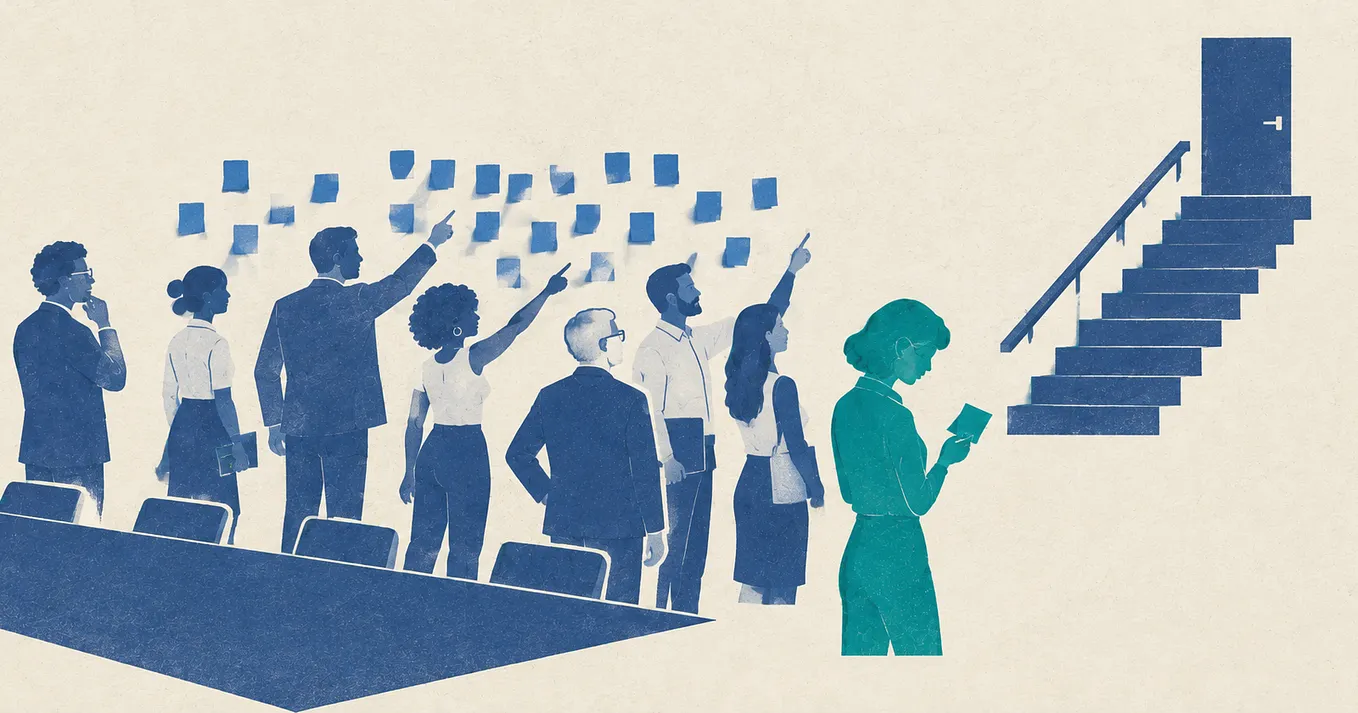
Your culture is not the problem. Your architecture is.
A room of leaders refused a simple fix outright. What they were protecting shows where to look before you blame culture.

The Behavior Architecture · Base essay
In this article: if you have ever heard a leadership team say “this will never work here” and then watched everyone move on, this article looks at what that sentence is usually protecting, and why the fix is rarely the one you expect.
Introduction
“This will never happen here. We can never do that!”
The response came fast, and loud. I had just proposed something very simple, in a design workshop at a financial services company: make the return on every transformation investment visible to senior management, including the investments that were not paying off. A basic feedback loop, the kind several of their competitors already had in place.
I was leading their transformation. My brief was not to deliver one more programme from outside, but to help their own teams build the capability to run change themselves, long after I had left.
And yet I answered faster than I should have. “With that attitude, it surely never will. And your competitors are already doing it.”
I did not make much progress that day. It took a few more conversations over the following weeks to understand what the refusal was protecting.
For years, the leaders in that room had been covering for each other. Investments that everyone privately knew were not working were waved through, because if you named one failure too loudly, the next one named might be your own. Nobody had ever built a way to say it out loud safely.
From outside the room, it may have looked irrational. But research by Adam Grant and his colleagues shows that proactive behaviour, such as naming a problem out loud, is not necessarily seen or recognised as honest, even if that is what you were trying to achieve. People first decide why you did this, and that judgement shapes everything that follows.
Depending on how people already viewed you, admitting that an investment was failing could seem courageous or incompetent, and no one in the room could predict how their own honesty would be judged.
My proposal made that risk worse, not better. I was asking them to be open with me, while I offered nothing in return. And I was asking this of a group who, over the years, had slowly fallen into quiet ways of protecting each other. That is what people do when they do not trust the system to protect them. To a group like that, a rule that asks for openness and gives nothing back does not feel like a gift. It feels like a threat.
At the time, I heard the refusal as a culture unwilling to face facts, and I reacted harder than the moment needed. Looking back, I saw a room full of people protecting themselves, in a structure that had never given them a safe place to fail.
The two patterns one stalled transformation taught me to watch for.
That moment stayed with me, because it holds two patterns I now look for in every transformation.
The first is that a transformation is often designed as a theoretical exercise. The people who will have to work differently are not part of the design itself.
I did exactly this in that room. I brought a best practice, based on how their competitors were organised, and assumed visibility would be welcomed. I never asked who would be exposed the moment it existed, or what those leaders would need to feel safe being seen. That day, I was the one who had left the people out of the design.
The second pattern showed up on the other side of the table. When a transformation gets difficult, culture is usually the first explanation people reach for. A culture that does not want to change. A leadership team too afraid to decide. Some version of it, aimed at the people, and rarely at the structure around them.
But what the room called culture was not separate from the architecture. It was architecture nobody had designed on purpose. Years without a safer alternative had hardened into a structure, every bit as real as a deliberate one, with a cause that could be found and redesigned.
Interestingly, Gartner, who still describe this work as culture change, land in a similar place. In a September 2026 note for CIOs, Mary Mesaglio and her colleagues write: “Ultimately, culture is shaped by what the organization rewards and recognizes.” And what an organisation rewards and recognises is something someone designed, or left undesigned. So naming culture is fine. Stopping there is where it goes wrong.
The difference between a rule and a condition.
Think of the difference between a speed limit sign and a street redesigned to feel narrow, with trees close to the kerb and cars parked on both sides.
The sign tells you to slow down and leaves the rest to you. Many drivers speed up again once they have passed it. The street works differently. Nobody tells you anything, yet it changes what feels like a sensible speed, along its whole length.

Dave Snowden and Alessandro Rancati describe the same distinction for organisations. A governing constraint sets a specific outcome, whatever the context. That is the sign. An enabling constraint makes an outcome more likely without dictating it. That is the street, a condition people adjust to with their own judgement. They developed this for crisis governance, so using it for a transformation workshop is my choice, and mine to defend.
In that sense, the workshop was an argument about which kind of structure already existed. The informal arrangement the leaders were protecting, you cover for me and I cover for you, was an enabling condition too. It had simply grown around the wrong instinct, because nobody had designed a safer one. My proposal was a governing rule dropped in cold, visibility with no protection for the people it would expose first. No wonder it was refused.
Neither kind of constraint is right by default. The mistake is expecting a rule to produce behaviour that only a condition can produce.
You see the same choice in how companies govern their investments. A mandatory stage gate review is the sign: easy to prepare for, and easy to work around once everyone knows the script. A portfolio rhythm where stopping a bad bet early earns a team visible credit is the street.
A lens for what the structure rewards.
One useful lens here is ACDR, short for Architecture, Competence, Drivers and Resistance, a quick scan method developed by the Behavior Change Group. Architecture in this sense is not a building. It is the policies, processes, governance and incentives an organisation runs on, whether anyone designed them on purpose or not.
Get Christophe Windelen’s stories in your inbox
Join Medium for free to get updates from this writer.
ACDR helps you spot where things go wrong. It is not a scorecard to prove one theory over another. And underneath it sits one question to ask first: what does the structure in front of you reward right now, whatever people say they want?
The question I wish I had asked that day.
Go back to that room for a moment. No design, whether built on purpose or left to chance, produces only the behaviour it was meant to produce.
That company already had an accidental structure, mutual protection, long before I arrived. And my carefully designed proposal still triggered a reaction neither of us had planned for.
We were both inside a complex system, and not a broken one waiting for the right rule. What mattered most was how quickly we noticed the gap between what we intended and what was happening, and how cheaply we could correct it.
W. Ross Ashby described why this matters in 1956, with his law of requisite variety: a system can only deal with as much complexity as it is able to sense and respond to. It is less about predicting problems, and more about having the capacity to notice one once it is under way.
A structure that never closes that loop will keep producing the same refusal, in a different room, for a different reason. My proposal was an attempt to build that loop before either of us understood why the organisation could not yet hold it.
It was only partially resolved. We made a few great improvements, but the appetite among the senior executives to go all the way was not there. You can only move a group so far.
What did change was me. One of the senior executives at the customer took the time to coach me. He helped me see that my response in the room had not helped a thing, and offered me other ways to work with people who do not want to move. I showed up in much better shape in the sessions with that company that followed.
The point of the question below is not that you will fix everything you find. It is that you will be looking at the real thing, instead of the explanation standing in front of it.
Where to start
Before your next retrospective or postmortem on a stalled initiative, and before anyone in the room says resistance or culture, do one thing first.
Tomorrow, find three or four people who have lived inside the initiative, not just reported on it. Ask each of them the same question, separately, in about five minutes: what does this reward, measure or make easy right now, whatever we say we want? Do not explain the question, and do not defend the structure while they answer. Just listen.
You do not need seniority to do this. Someone who cannot change the structure on their own often gets a more open answer, as curiosity feels safer than power.
Expect different answers, and pay attention to how people answer as much as to what they say. If two or more of the four hesitate, change the subject or cannot answer at all, that tells you something too. Often it is what the room in my story was protecting: saying the truth out loud has never felt safe there.
Then bring what you heard to the meeting that is already planned. One sentence is enough to open with: “Here is what I heard when I asked what this rewards, and it does not match what we are telling ourselves.” That gap is your finding. If several people could not answer, that is the bigger one.
References
Snowden, D. and Rancati, A. (2020). Managing Complexity (and Chaos) in Times of Crisis: A Field Guide for Decision Makers Inspired by the Cynefin Framework. Publications Office of the European Union, Luxembourg.
Ashby, W.R. (1956). An Introduction to Cybernetics. Chapman and Hall, London.
Grant, A.M., Parker, S. and Collins, C. (2009). Getting credit for proactive behavior: Supervisor reactions depend on what you value and how you feel. Personnel Psychology, 62(1), 31 to 55.
Grant, A.M. (2013). Give and Take: A Revolutionary Approach to Success. Viking.
Mesaglio, M., Carter, J., Mullery, A., Paulman, T. and Grafeld, S. (2026). How to Hack Your Culture in the Age of AI. Gartner, ID G00856588, 16 September 2026.
ACDR-Toolkit Behavior Change Group, https://behaviorchange.group/insights/tools/acdr-toolkit/
If you want to look at your own transformations this way, follow along. The next piece looks at the explanation people often reach for next when a transformation stalls, blaming the C-suite, and why that explanation is so easy to believe.
This article is part of The Behavior Architecture, a series for transformation leaders on why designs, governance models and policies do not produce the behaviour they were built for, and what to do about it.
The full series, in reading order, also kept as a Medium list:
- Base essay: Your culture is not the problem. Your architecture is. (you are here)
- Article 1: The C-suite did not stall your transformation. You did.
- Article 2: Your data governance was designed to fail before anyone broke a rule. (coming soon)
- Article 3: Nobody starts a transformation. They start a next step. (coming soon)
- Article 4: It was never the rule. It was the reason you left out. (coming soon)
- Article 5: You gave the team freedom. Nobody told them it was safe to use it. (coming soon)
- Article 6: People do not resist change. They resist not knowing where they stand. (coming soon)
- Article 7: Get the small yes before you need the big one. (coming soon)
- Article 8: They are not ignoring your policy. They have not seen anyone else follow it yet. (coming soon)
- Article 9: Your organization cannot learn from a loop nobody closes. (coming soon)