Cognitive Personal Informatics

Consumer neurotechnology is arriving en masse, yet those of us working in related scientific fields know that the best tools, worth £30k+, lead to poor accuracy when trying to recognise cognitive changes, or classify types of cognitive state. These new wearables are going to shake what we know about personal informatics. Consumer neurotechnology is going to raise massive socio-technical trust, privacy, and ethics (neuroethics) concerns as they create societal transformations about norms and behaviours. Especially when companies are starting to make $315 million profit from mass tracking of employees using EEG.
The big questions now are Human-Computer Interaction questions — how will this fly at the socio-technical level? How will people change their behaviours? What will people DO with their own [largely inaccurate] personal neurotechnology?
Even excluding consumer brain tech, our current wearables are trying to help us think about our cognitive activity. Without much transparency, Apple watches recommend we take breathing exercises for mindfullness. Spire Health have, over time, released a range of breathing detectors worn on the waistband or upper-body clothing. Garmin devices track physiological indicators of stress and show you your day, largely based on heart rate variability data, using a body battery metaphor for good and bad stress. Device-agnostic personal informatics apps like Welltory use this data to teach users about ‘optimal stress’, giving users advice from day to day about good physiological stress that comes from e.g. exercise. Oura rings also calculate a daily readiness score, on how mentally prepared they estimate you are to take on the day, also discussing good and bad stress levels.
Consumer Neurotechnology
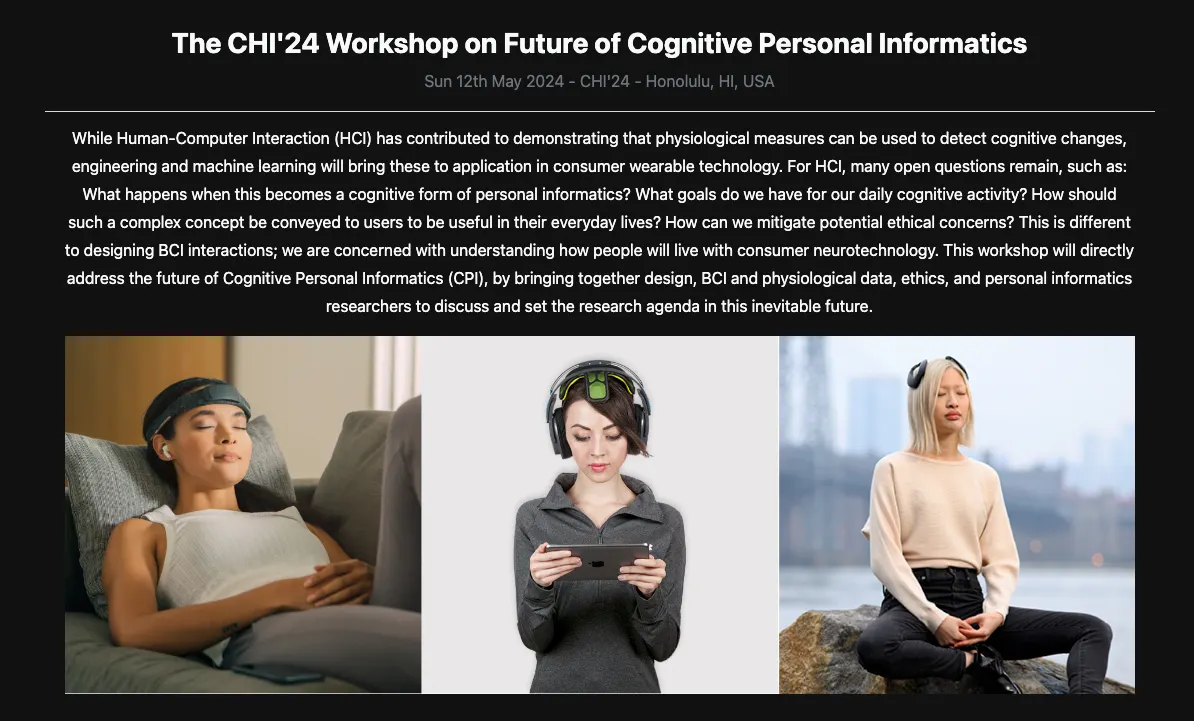
So. Here it comes. The onslaught of personal consumer neurotechnology, most coming in for less than $300, for personal tracking, mindfulness, focusing on work, and play. Lets not even get started with the personal brain stimulation devices that probably need their own post. Some of the first we played with in research was from Neurosky — a single dry EEG sensor on the forehead, with apps to enable different interactions with gaming, APIs, and developer kits. We used it to determine the scene changes in two brain-controlled movies. Since then, we’ve played with Muse, a forehead band of several dry EEG sensors, with an app to help you mediate, or sleep. We see lots of similar start ups including soft EEG wearables for sport, which literally say ‘like a smart watch for your brain’. Most exciting for us, since we have used fNIRS in HCI research for 10 years, is the emergence of what we understand is the first consumer fNIRS from Mendi (we’ll let you know more when we’ve played with it). With a little bit more of a price tag, the Neurosity Crown uses dense groups of dry (and in my opinion, slightly painful) EEG spikes to measure your focus during work tasks. These dry connectors are similar to those in the OpenBCI EEG kits.
New Forms of Personal Informatics
In our recent CHI2022 Discussion Forum, we proposed that Cognitive Personal Informatics, that we now have at our finger tips, is a dramatic shift in what we will track about ourselves, and what our goals for healthy living will be. We estimate that Cognitive Personal Informatics is where Physical Activity Tracking was around 20 years ago — when it was trying to use gyroscopes to recognise walking in controlled conditions, but phones were beginning to offer activity tracking. This is way before we had what we consider to be actual accurate activity tracking in the wild, and indeed being able to accurately differentiate between different types of activity (my watch would regularly congratulate me on my swimming). Right now, cognitive activity tracking is about at that stage, with e.g. Garmin’s HRV tracking of stress as perhaps the nearest we have in the real world to longitudinal cognitive activity tracking.

What we are no where near yet, is understanding the implications for Personal Informatics — Cognitive Personal Informatics. Soon we’ll see the quantified self behaviours of logging more and more data about our cognitive activity before we understand it. Meanwhile research into personal informatics more broadly has been maturing, understanding stages of personal informatics, motivations for personal informatics. We understand more about the goals people set for their physical activity, and even for tracking behaviours like working and eating. Further, research is bringing post-personal informatics views on lived experiences, habit formation, and the abandonment of personal informatics data.
Cognitive Activity Goals are different to Physical Activity (?)
What are our goals for cognitive activity tracking. Reducing stress is the most commonly argued desire for people when they try to manage their work and fatigue and discuss notions of work-life balance. But can wearables detect feelings of stress? or just the body’s stress response, whether good or bad. Its good to put ourselves into positions of high physiological stress response, to achieve difficult things.
Get Cognitive Personal Informatics’s stories in your inbox
Join Medium for free to get updates from this writer.
Another massive area in neuroergonomics is optimal mental workload. This more emotionally agnostic term, where mental workload is ideally high for hard tasks, but not too high that we begin to fail the task. Where research into Mental Workload has traditionally focused on work tasks, being at the optimum manageable level. We have studied whether neurotechnology can detect different levels of mental workload in office work created by doing easier and harder forms of writing and reading tasks.
Further, though, our recent research has focused on what people’s expectations are for Mental Workload across e.g. a whole day. We’ve started to document the goals people have for when to enjoy high mental workload, and how to balance it with productive periods of low mental workload. What should our ideal mental workload be at work? The basic (and somewhat over used) assumption of activity tracking is that more steps is better. Should our mental workload be high if we are good at your job? Or does high mental workload mean that we find our job difficult? Is it good that we have low mental workload breaks? Are breaks where we use our phones to engage with media examples of when we fail to reach low mental workload? and the reason that we feel tired after our breaks? Many people find gaming fun and regenerative — we find it an enjoyable recovery activity after a hard day — yet inevitably involves high mental workload.
At a more socio-technical level, we wonder what it means that we keep and might share information about cognitive activity. Our participants were more comfortable with independent people knowing about their brain data, than people they knew. What does it mean that your boss can see your brain data, and they also dont know the answers to the questions above. As a member of the IEEE Brain Neuroethics committee for work, we are asking these questions.
So what now…
We aim to bring together different people’s perspectives on Cognitive Personal Informatics, as an increasingly important research agenda. We aim to understand what new things consumer neurotechnology will bring to the field of Personal Informatics, and which things will translate it from it ready for these new devices to become part of the ecology of wearables. Our recent discussion forum, and forthcoming events, aim to:
- Identify the size of this community
- Collectively identify and explicate the RQs and Topics of interest
- Establish a research agenda
Join Us and Get Involved
You too can join in. For now, we’re planning a series of medium posts to chronicle the thoughts and ideas that come from members of our growing community.