Originally Posted: NOVEMBER 3, 2007
Getting around Sol Space

Interplanetary travel is pretty arduous based on current technology — chemical rockets and solar-powered ion-drives. Back in the late 1960s NASA was seriously developing a nuclear rocket called NERVA, but it wasn’t really much of an improvement on chemical rockets for anything other than trips to the Moon. NERVA’s exhaust velocity was about 8,500 m/s to about 9,500 m/s, while advanced chemical rockets get about 4,700 m/s — sounds like a big improvement, but getting to Mars in a decent time requires a lot of delta-vee.
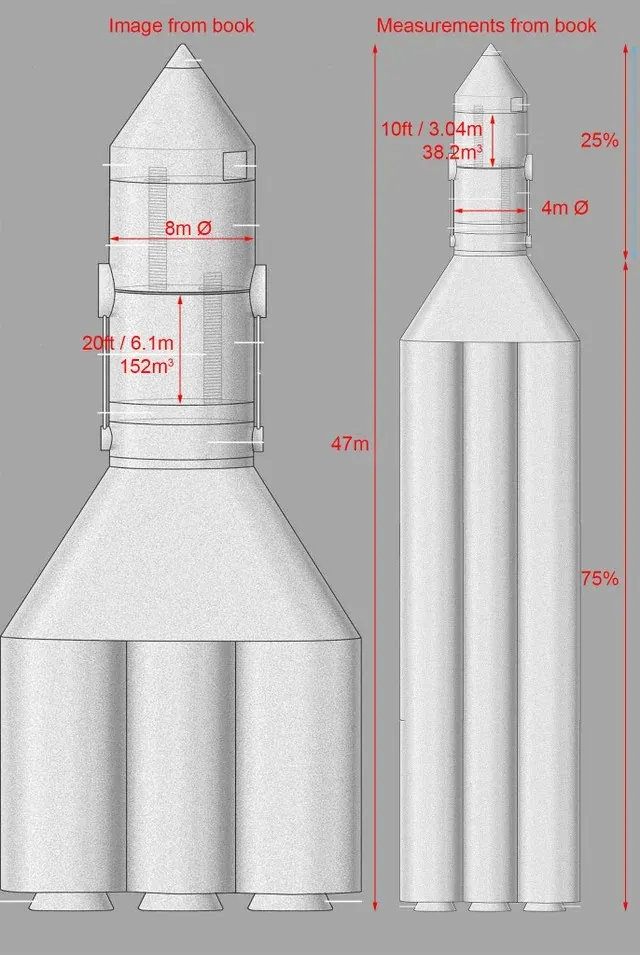
The minimum energy Mars mission with a transfer time of 250 days — a Hohmann transfer — meant a Mars ship with six crew and a 50 ton lander needed an initial Earth-orbit mass of 727 tons. The vehicle had several major sections — Planetary Mission Module (crew habitat, life support & power), Primary Propulsion Modules (3 modified nuclear Moon shuttles), and the Mars Excursion Module — each of which would be launched via up-graded Saturn V Heavy-Lift Vehicles. Thus we’re talking over 15,000 tons of on-Earth mass to land a single lander with 3 crew on Mars for a 30–60 day stay. Some missions required another PPM thrown in, but the total trip-time didn’t improve even with that extra power. Plus the expedition had to do a Venus fly-by to reduce the total propellant mass required and the total stay-time on Mars — pure Hohmann missions need over two years lay-over on Mars.
Mission designs since then involve trickier orbits which expend a bit more propellant to cut down the trip-times by almost half. When Mars is at perihelion, on arrival, the trip-time can be as low as 130 days, but when it is at aphelion it’s more like 180 days. That’s a long time travelling even so.
What if we want to go further out? Robert Heinlein’s “Farmer in the Sky” (1950) is set on a terraformed Ganymede which has been slowly colonised via fleets of small ships carrying 500 people at a time. These fly on Hohmann transfer orbits that take almost 1,000 days (two-and-a-half years). The Earth Government wants to speed the process up, so a high-speed torch-ship is launched carrying 6,000 people on a 60 day flight. You can imagine the chaos on Ganymede of handling so many people at once — it makes up a significant part of the story.
Get Crowlspace’s stories in your inbox
Join Medium for free to get updates from this writer.
What’s the difference in flight-plans? Well the previous ships were all nuclear powered, but the new ship — the Mayflower, of course — uses a Total Conversion reactor to accelerator reaction mass to high speed. Kind of what an antimatter reactor would do, without the messy magnets to channel pions. With a relativistic exhaust velocity the Mayflower accelerates to 93 miles per second (150 km/s) using only a tiny bit of mass-energy. On a Hohmann transfer the ship maxes a mere 24 miles per second (38.6 km/s) — why then does such a trajectory take 1,000 days if you’re only travelling about 4 times slower than the Mayflower?
Earth itself travels around the Sun at 18.5 miles per second (29.8 km/s), so 24 mi/s isn’t much faster and the orbit the ship follows is more like a circle and less like a straight line path. Plus it is slowed down mightily by the Sun — by the time it reaches Jupiter a Hohmann orbit ship is doing just 4.6 mi/s. The Mayflower doing 93 mi/s follows an almost straight line to Jupiter and slows to 89.5 mi/s (144 km/s) — virtually no slowing by the Sun at all. Thus the Mayflower takes a mere 60 days.
To travel via Hohmann transfer to Jupiter a ship needs to increase its speed around the Sun from 18.5 mi/s to 24 mi/s, and to also escape the Earth’s gravity. Say it takes off from the ground — the speed needed is 14.2 km/s, neglecting gravity losses. Once it has escaped Earth’s Hill Sphere it’s in the Sun’s gravitational dominance and is moving 8.8 km/s faster than Earth. It arrives in Jupiter’s Hill Sphere doing about 7.42 km/s relative to the Sun and 5.64 km/s relative to Jupiter. It falls towards Ganymede’s orbit, about 1,080,000 km from Jupiter’s centre, and is doing 16.4 km/s relative to Jupiter when it arrives — needing to slow by 5.52 km/s to match speed with Ganymede. Thus to arrive in Ganymede orbit from Earth’s surface takes about 19.7 km/s. More than any rocket ever built and pretty heavy going for a nuclear rocket, but doable. Might need to refuel in Earth orbit.
To match the Mayflower we’d have to increase in speed by 120 km/s relative to Earth initially, then deccelerate at Jupiter by about 144 km/s. Total velocity change: 264 km/s… which is over 13 times the velocity change needed for a Hohmann trip. No chemical or nuclear rocket — short of actual nuclear detonations — could achieve the exhaust velocity needed to make such a trip practical. The most efficient energy use would need an exhaust velocity of 165 km/s and about 4 times the empty mass of the ship in propellant — there’s a theorem that the mass-ratio using the least amount of energy for a given velocity change is 4.92, and an exhaust velocity of 1/1.6 the total velocity change (mission velocity.) Such a jet would be like riding a nuclear detonation — say your ship masses 1,000 tons and is accelerating at 1 gee. The power output is 0.4 trillion Watts — the equivalent of 100 tons of TNT exploding every second.
And, of course, there is a rocket which could get such performance — the Orion Nuclear Pulse Rocket — which really would have been propelled by nuclear explosions. Some of its developers (between 1958–1964) were hoping to visit moons of Saturn by 1970, and it could have quite easily made the trip. Small nuclear “pulse units” equivalent to 1 kiloton of TNT energy would have exploded just behind the ship’s massive “pusher plate” — the explosion could be shaped into a jet of hot plasma that would have splashed around the plate, barely heating it at all. The bigger the plate, the more efficient the energy transfer — thus the highest performance would have been achieved by multi-million ton “Orions” using megaton pulse units. That system could land a ship the size of a city on any object with a solid surface in our Solar System in a matter of weeks.
Of course, in the process, all the Earth’s fission explosives stocks would be burnt up… so what’s the problem?