Not Every Return Belongs Back in Sellable Inventory


A returned unit shows up on the intake shelf. It looks fine. The box is a little dented, but the product inside seems untouched. Someone on the warehouse team makes a call in about four seconds: back on the shelf, order fulfilled from it next week. Nobody writes the decision down, because it didn’t feel like a decision. It felt like common sense.
Most of the time, that instinct is right. A return caused by the wrong size or a change of mind carries almost no downstream risk — inspect it, restock it, move on. The problem is that the same instinct gets applied to units it was never designed for, and the failure doesn’t show up at the shelf. It shows up three weeks later, in an inbox, when a customer opens a “new” order and finds the same defect that triggered your last wave of complaints.
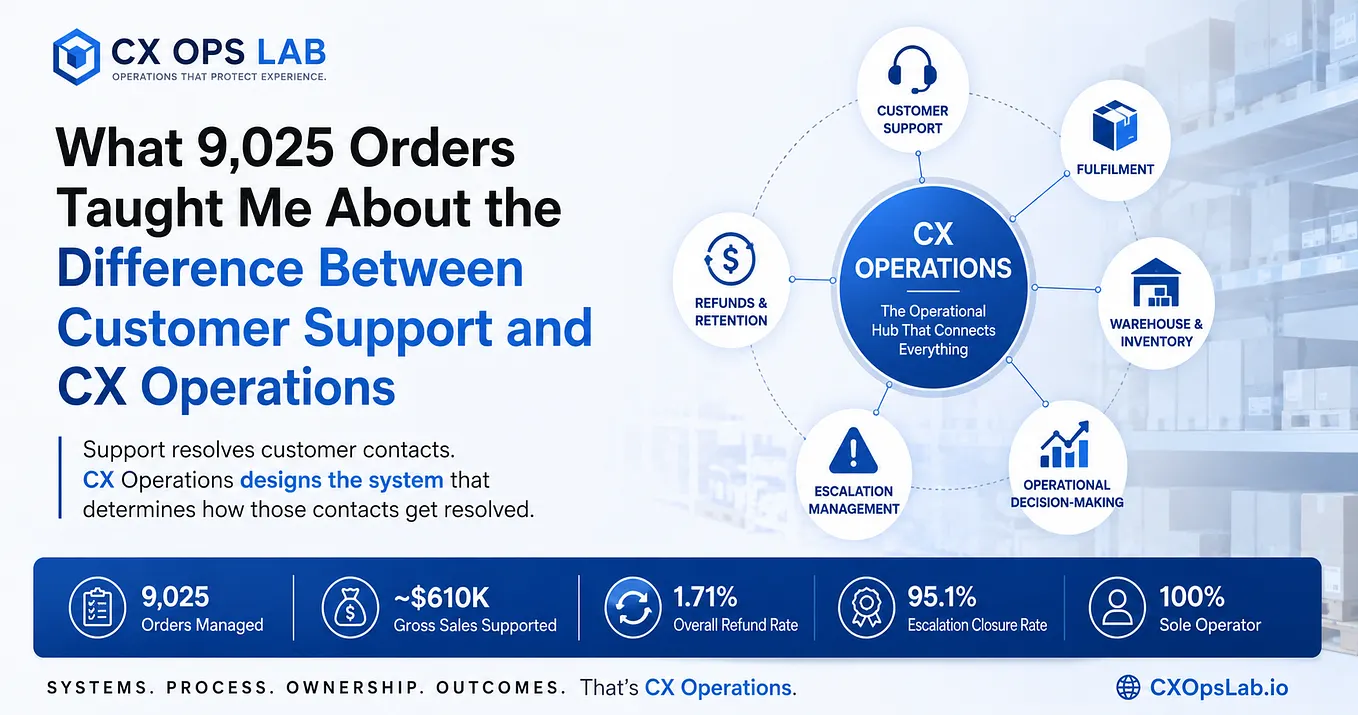
I ran CX and operations solo across a multi-platform DTC operation — Shopify, Shopee, Lazada, and Facebook — for nine months, processing 9,025 orders and roughly $610,000 USD in gross sales, with a 1.71% overall refund rate and a 95.1% escalation closure rate across 95-plus crisis cases. One of those cases was a product defect crisis that touched several hundred units. It’s also where the resale-versus-dispose question stopped being theoretical and started being expensive if I got it wrong.
The mistake isn’t the bad call. It’s the missing rule.
Warehouse teams under time pressure don’t make bad decisions because they’re careless. They make bad decisions because nobody gave them a rule that survives contact with volume. “Use your judgment” works fine at ten returns a week. At eighty or a hundred, judgment turns into speed, and speed turns into a defective unit going back into the outbound queue because it “looked fine on the outside.”
That’s the part people underestimate: a genuinely defective unit very often does look fine externally. Visual inspection catches cosmetic damage reliably. It does not reliably catch the kind of fault that triggered the return in the first place. Treating “passed a glance” as equivalent to “safe to resell” is where the risk actually lives.
A three-category sort, decided before anyone touches the unit
The fix that held up under real volume was a simple three-way sort, applied at intake — before condition, before inspection, before anyone starts thinking about resale value.
Get CX Ops Lab’s stories in your inbox
Join Medium for free to get updates from this writer.
Normal returns — wrong size, changed mind, color didn’t match. No product fault. This is the only category where reselling is the default outcome, and even here it’s default, not automatic: every unit still gets a basic condition check before it goes back into sellable stock.
Defect-related returns — anything tied to a confirmed or suspected product fault. These go straight to quarantine, no case-by-case resale decision at the warehouse level. A small number of samples get retained for supplier or quality review. Everything else is disposed of, regardless of how it looks on inspection. This is a standing rule, not a judgment call, because it’s exactly the category where judgment fails.
Damaged packaging only — the box took a hit, the product looks intact. This is genuinely context-dependent. An isolated damaged-packaging return can usually be evaluated case by case and repacked if the product checks out. But if that unit traces back to the same batch as a known defect issue, the packaging damage stops being incidental — dispose, don’t repack. The salvage value of one unit is never worth reopening a complaint cycle you already closed.
Segregation is the rule that makes the sort real
None of this works if defect-related and normal returns sit in the same bin waiting to be sorted later. “Later” is where the mistakes happen, because whoever is unpacking that bin under deadline pressure will sort by speed, not by category. Physical segregation has to happen at the moment of intake — a separate shelf, a separate bin, decided before inspection even starts. It costs nothing more than a label and five minutes of training. What it buys is a hard stop between a return that’s safe to resell and one that isn’t, before anyone has the chance to guess wrong.
Why this belongs on an ops leader’s desk, not just the warehouse floor
The dispose-versus-resell decision looks small — a few dollars of salvage value per unit. It isn’t small. It’s the last checkpoint between a closed complaint and a reopened one, and reopened complaints cost far more than the unit they came from: refunds, one-star reviews, and in a multi-platform environment, disputes that eat into the same closure metrics you spent months building. A refund rate under 2% and a 95%-plus escalation closure rate don’t hold on their own. They hold because the systems feeding them — refunds, escalations, and yes, returned inventory — are built to hand off cleanly to each other.
If your brand doesn’t have a written rule for this yet, that’s the gap worth closing before volume forces the issue. The full decision framework — including the segregation protocol, the audit rhythm, and the disposition table used to run this at scale — is on CXOpsLab.io.