Hungary's paks reactors hit output cuts as danube levels drop


Low water on the river has forced reduced generation at Hungary's only nuclear plant, pushing the country onto expensive emergency imports.
The river that cools a country
On 13 August 2026, Balázs Orbán — political director to Prime Minister Viktor Orbán, no relation — posted a familiar kind of attack. Hungary's Brussels-backed government, he wrote, had been "caught completely unprepared for the summer weather." The Danube's water level had fallen dangerously low. The Paks Nuclear Power Plant, which draws its cooling water from the river, had been forced to cut output. "Hungary is becoming a banana republic," he concluded, "without the bananas."
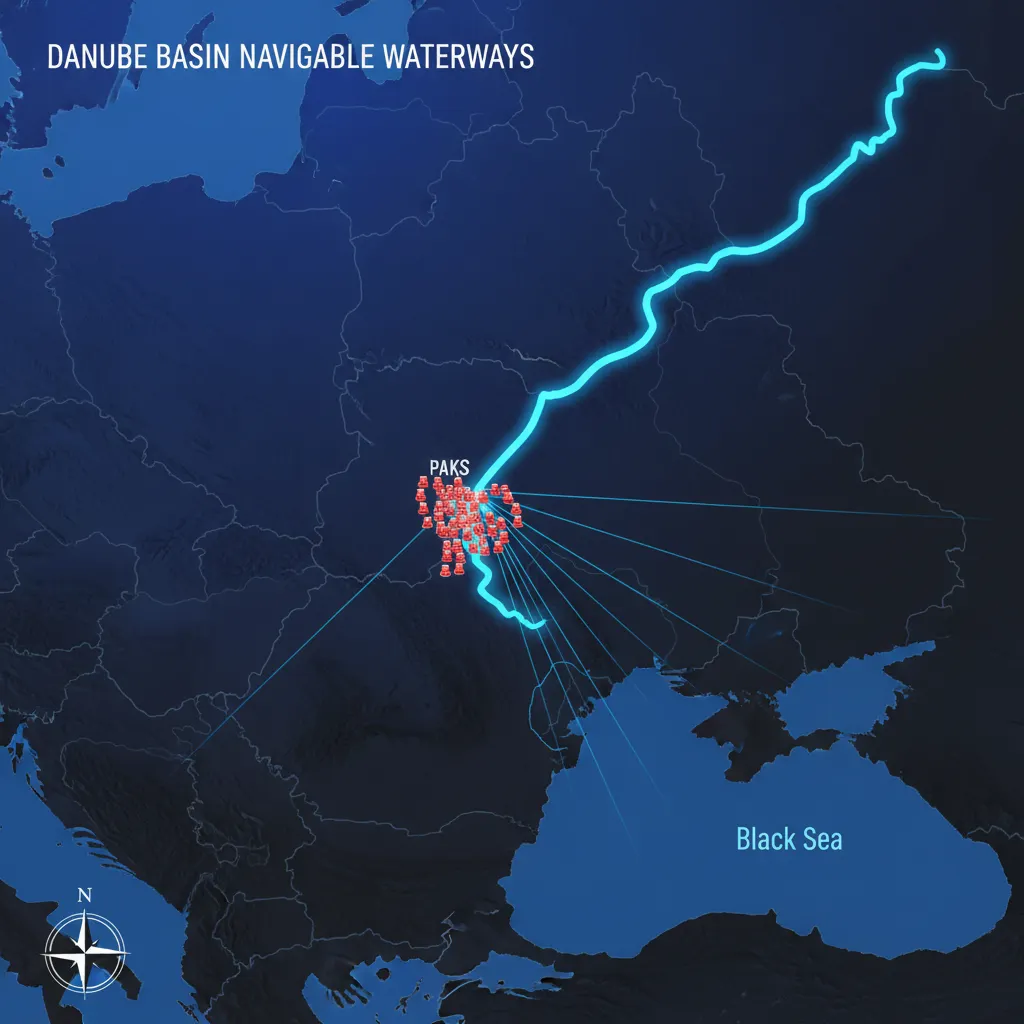
Strip out the party politics and the underlying fact is real and boringly physical. Paks sits on the right bank of the Danube about 100 km south of Budapest. Its four VVER-440 units produce roughly half of Hungary's electricity — around 15 TWh a year in a normal year. They need river water to condense steam. When the Danube drops and its temperature rises, the plant can't dump heat into it without breaching its environmental permit, so the operator, MVM Paksi Atomerőmű, throttles back or shuts units. This isn't new. It happened in the drought years of 2003 and 2015, and it happened again this summer. The novelty is who is now using it as ammunition.
Why low water is a security problem
A nuclear plant that depends on a river is a nuclear plant that depends on rainfall in the Alps. The Danube's summer lows are driven by snowmelt and precipitation across Bavaria, Austria and Slovakia — 2,850 km upstream of the Hungarian border. That is a supply chain with no contract, no storage and no alternative. When it fails, the replacement is imported power at whatever the day-ahead market charges, and Hungary's interconnectors run mostly to Austria, Slovakia, Ukraine and Serbia. In a regional heatwave, all of them are bidding for the same megawatts.
Get Danube Dispatch’s stories in your inbox
Join Medium for free to get updates from this writer.
This is the Central European security story that doesn't fit neatly into a NATO communiqué. It's not tanks on a border. It's the slow realisation that the region's heavy infrastructure — Paks in Hungary, the Kozloduy plant in Bulgaria, the Iron Gate dams between Serbia and Romania, the barge traffic that carries grain and fuel down to the Black Sea — was designed for a river that no longer behaves as it did when the concrete was poured. Kozloduy has had its own low-water interruptions. The Iron Gate hydropower system, shared by Serbia and Romania under a 1963 treaty, has seen navigation restrictions in dry summers. Every one of those is a shared problem with no shared operator.
The alliances that actually exist
If you read X, you'd think the Danube basin was being carved into a "Danube-Black Sea Alliance" of Slovakia, Hungary, Serbia, Romania and Russia, a sovereign Eurasian partnership free of EU directives. That pitch circulates regularly and has no institutional existence — no treaty, no secretariat, no budget, no members. Romania is a NATO member with a French-led battlegroup on its soil and a US missile defence site at Deveselu. Serbia is a military-neutral state negotiating EU accession. Hungary is in both NATO and the EU and, for all Orbán's noise, has never proposed leaving either. The alliance is a mood, not a map.
The formats that do exist are duller and more consequential. The Odesa Triangle — Ukraine, Moldova and Romania — was launched four years ago and now covers the Black Sea, the Danube, defence, transport corridors, border infrastructure, cybersecurity and hybrid threats. Foreign Minister Andrii Sybiha said in September 2026 that Moscow "weaponises energy and food" and seeks to destabilise the Black Sea region. Romania and Bulgaria run a joint EU-funded programme, worth over €200 million, that includes AI monitoring of ship pollution on the Danube. These are the real institutions. They have phone numbers.
What the water tells you
Here's the uncomfortable part for everyone in the basin. The Danube is the region's shared artery and its shared vulnerability, and the two roles can't be separated. A drought in Bavaria becomes a power cut in Hungary becomes a price spike in Serbia. A sunken barge near the delta — the kind of thing that gets flagged on X as an oil shipment from Romania to Moldova — becomes a navigation closure that costs Romania and Ukraine hard currency. The river doesn't recognise the alliance map or the EU map or the NATO map. It just flows.
Which is why the Paks story matters more than the scandal framing suggests. Balázs Orbán's post is a party attack on Péter Magyar's government, and the specific allegation — that a state secretary went to Austria on holiday and the Austrian government confirmed no meeting took place — is his claim, disputed and politically loaded. But the water level is not disputed. The reduced output is not disputed. The expensive imports are not disputed. Hungary has spent a decade arguing about Brussels and Moscow while its biggest power plant waits for rain in the Alps.
The fix isn't glamorous. More cooling capacity. More grid interconnection. Better forecasting. A serious regional water protocol that treats the Danube as infrastructure rather than scenery. None of that makes a good post. All of it keeps the lights on. The river will keep falling in dry summers. The question is whether the politics catches up before the reactors do.
---