Taking Drones Out of the Sky with Drone Master Technology

On 14 September 2019, when the mixed formation of cruise missiles and small drone UAVs (unmanned aerial vehicles) rained explosive charges on Saudi Arabia’s state oil group Aramco’s Abqaiq and Khurais sites, national oil output was halved, cutting 5.7 million barrels of crude oil per day from the company’s inventory.
Yet they did more than just economic damage. This assault has had a huge impact on how nations are talking about securing their airspace. Industries are now designing and implementing sophisticated new defenses, from frying electronic circuits with strong microwave energy beams to complex jamming devices.
While both the U.S. and Saudi Arabia have blamed Iran for the Abqaiq attack, who was behind it is still unclear.
But it would be a mistake to equate the use of drones or mini-UAVs (unmanned aerial vehicles) in this assault with other incidents where airports, football matches or political rallies have been disrupted by commercially available drones, says Douglas Barrie, an air power fellow at the think tank of the international institute for strategies studies.
In part, he says that this attack was carried out by sophisticated UAVs — small, pilotless, winged aircraft — nothing like quadcopter drones flown in suburban parks.
Instead, they are capable of covering hundreds of kilometers and be pre programmed to fly around the navigation map points on the surface, enabling them to reach the target from an unexpected direction.
“The level of complexity of this attack is above all that we have seen before. Using a mix of cruise missiles and unmanned aerial vehicles (UAVs) that have arrived all at the same time calls for a serious level of planning and expertise,” says Barrie.
The attack raised a question mark as to the quality of the protection available against UAV / drone attacks.
The criticism of Saudi Arabia’s air defenses is wide-ranging, says Mr. Barrie. The fact is that complex networks of air defense radars linked to guided missiles and advanced fighter jet squadrons are not designed to counteract this relatively cheap and disposable technology.
“Digital technology has made a huge difference to what mini-UAVs can do. Suddenly, you can put a lot into a UAV, you can almost turn it into a precision-guided weapon.”
By routing a UAV around multiple map points before hitting its target, you can avoid the obvious directions from which an attack is anticipated. This may explain why the existing radars failed to detect the drone formation that attacked Abqaiq. And it could be that protections designed to combat this new UAV threat have rushed to Saudi Arabia.

This image provided on Sunday, Sept. 15, 2019, by the U.S. government and DigitalGlobe and annotated by the source, shows damage to the infrastructure at Saudi Aramco’s Abaqaiq oil processing facility in Buqyaq, Saudi Arabia.
The US Air Force has just launched Phaser, a microwave-based counter-drone system from Raytheon. Firing from a disk resembling a giant satellite dish at the top of a sand-colored container, it wipes out the electronic elements inside a drone.
Raytheon did not disclose where the rapidly purchased Phaser was sent, but the Pentagon has confirmed that it is being deployed overseas.
Get Alex Johnson’s stories in your inbox
Join Medium for free to get updates from this writer.
Perhaps Phaser’s greatest strength is that it runs at the speed of light. This is the rate at which microwave radiation bursts are fired. And that could bring down the approaching hostile UAVs in a split second.
The beam produced by Phaser is 100 meters wide at a distance of 1 km. This translates into a lot of dangerous space for an incoming UAV. Targets are monitored by an electro-optical sensor that converts images to electronic signals and operates in conjunction with a microwave beam.
Although the device can be fully automated, it currently requires final approval from a human operator verifying the target via an optical sensor. Through setting the target without an explosion, Phaser avoids the kind of debris and destruction that is very unwelcome in densely populated areas or over sensitive installations.
Another advantage of this microwave counter-drone system is that it can accommodate continuous waves of targets without any need to reload. So the $16 m price tag to supply and support.
Don Sullivan, Raytheon’s chief engineer of directed energy, has served in this field for 40 years, and Phaser is the culmination of his life’s work.
This is “potentially the most cost-effective way to counter drones,” according to Mr. Sullivan. And the microwave beam is emitted in rapid pulses, which means that it is safe for humans standing nearby. “I’ve been standing in a high-power microwave beam. It’s not a heat-ray, it’s shot in really short pulses, so it’s safe for people,” he added.

The Phaser system uses microwaves to disable Class One and Class Two drones, ones that are less than 55 pounds and fly at altitudes of 1,200 to 3,500 feet at speeds between 100 and 200 knots. Credit: Raytheon.
Anthony Creasey knows a lot about air defense and his experience is unique. As an USAF officer stationed at Basra Airport in 2007, he assisted both the US Armed Forces and Iraqi civilian air traffic control officials to hold the runway open regardless hundreds of rockets being fired at the site by insurgents.
His solution was to connect the radar system to the U.S.-built Phalanx gun, an automatic cannon which spews out rounds at a prodigious pace, producing a wall of lead in the path of incoming missiles broken by collisions with these shells. Out of 860 rockets fired onto the airport within six months, only one hit the runway says Creasey.
Today, he works for the American defense group DGS, which sells a counter-drone system based on his experience in Iraq.
“You can’t defend every inch of airspace, you have to think about what you can realistically protect,” he says.
DGS has built what he calls an electronic sniper weapon. That jams the digital components of any UAV / drone, but DGS won’t say precisely how it’s done.
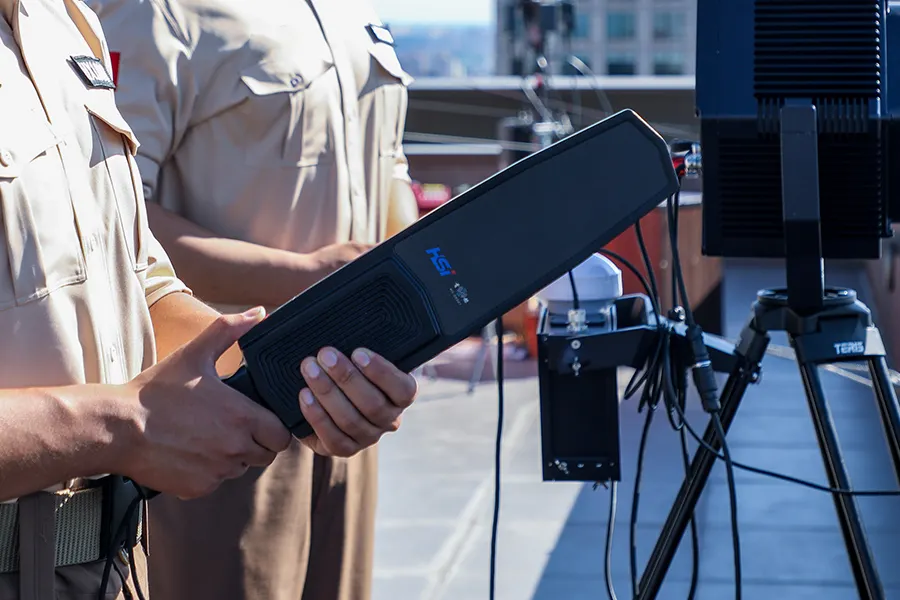
Mr. Creasey points out that this project, Drone Master, is starting with a threat assessment software on a laptop and drone detection sensors that determine where to aim in order to give the best chance of thwarting drone attacks.

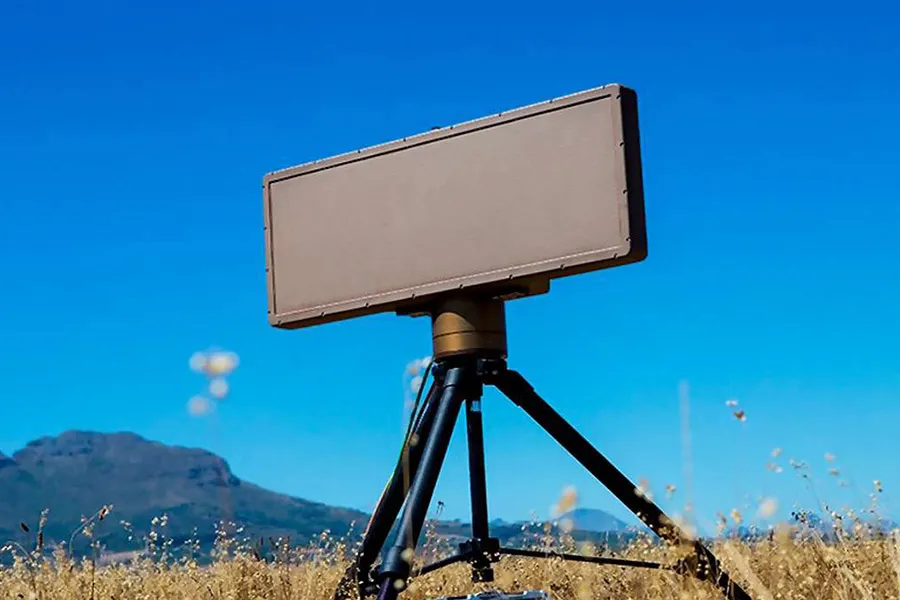
With its 360° gapless full dome jamming coverage, the DoneMaster CUAS Drone Detection and Jamming System can defeat countless drones from up to 2km away simultaneously.
In the case of an oil refinery covering hundreds of square kilometers, the Drone Master Anti-Drone Solution should be capable of creating multiple defensive arcs.
The threat of drones is growing at a rapid pace; the economic damage to Aramco has opened up a new front in the war-and no one wants to be left behind.