Samsara Paradox 3.0: The Source Code of the Cosmos

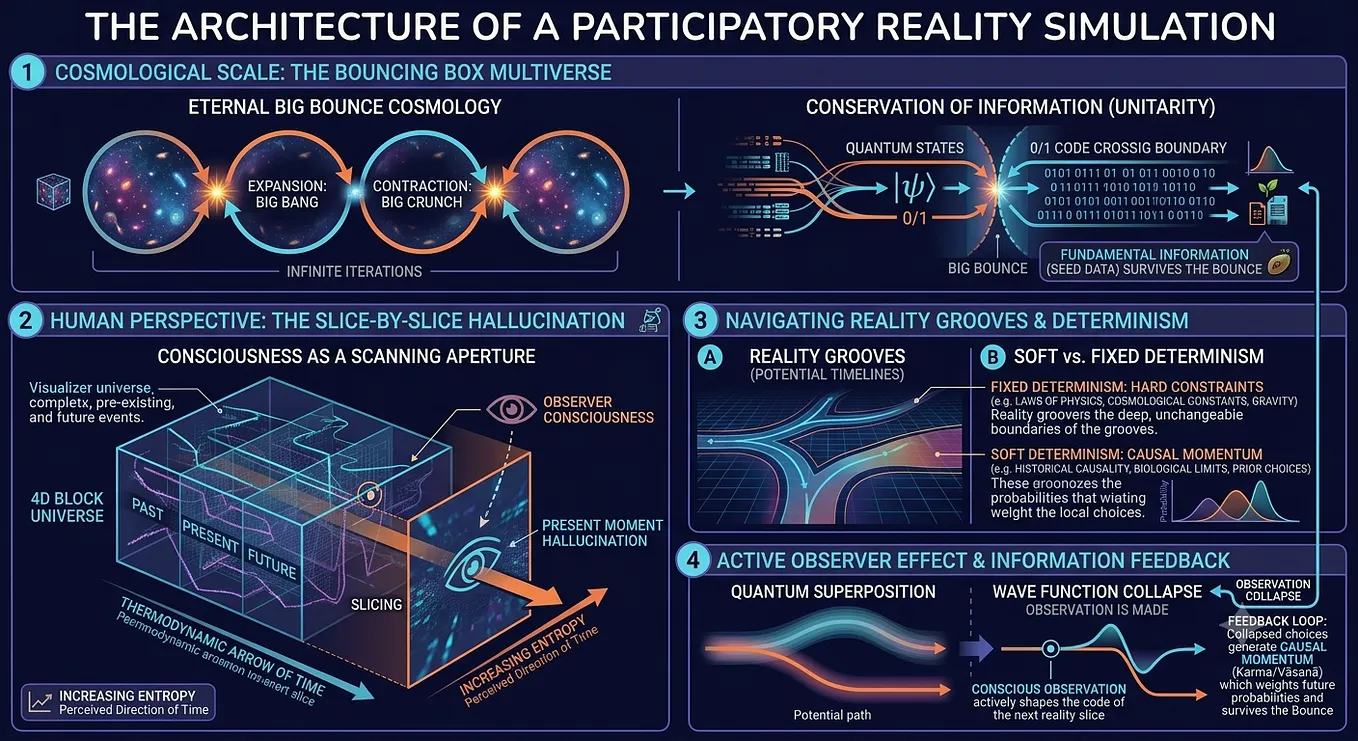
In the first two chapters, we mapped the overarching architecture of our reality. We established that our universe operates as a “bouncing box” — a cyclical, multi-dimensional simulation where we, as 3D observers, experience time strictly through the degradation of information. We then explored the 5th dimension, where our conscious observations actively carve out branching reality grooves, generating mechanical glitches like déjà vu and the Mandela Effect when the rendering engine stutters.
But if reality is a continuously rendered, 5th-dimensional matrix of probabilities, we are left with a fundamental engineering question: What is the actual source code?

To understand the language of this simulation, we must look at how the universe processes, stores, and transfers data. When setting up any complex infrastructure — whether drafting the spatial metrics for a regional development grid or modeling the structural tolerances of a physical foundation — you must first define the immutable baseline parameters.
Get Dileepa Pothuhera ✨💚💡’s stories in your inbox
Join Medium for free to get updates from this writer.
In our reality, this foundational blueprint isn’t written in classical binary code. It is written in the fundamental constants of nature.
The Hardware Specifications
The physics engine of our universe runs on strict, unyielding structural specifications. These are the hardcoded limits of the simulation:
- The Speed of Light (c): The maximum processing speed of the universe. It dictates how fast causal updates can propagate across the 3D rendering of spacetime.
- Planck’s Constant (h): The ultimate “pixel size” of reality, ensuring that energy and information are discrete (quantized). This prevents the engine from requiring infinite computing power to render continuously divisible variables.
- The Gravitational Constant (G): The master metric that dictates the 4D curvature of the block universe and the macro-structure of our reality grooves.
Combined, these parameters dictate the exact spatial metrics of the simulation. Below the Planck length, the concepts of space and distance completely break down. The simulation simply refuses to render anything smaller.

The Syntactic Governors: Math as the Rendering Engine
While physical constants define the hardware limits, the transcendental and irrational numbers (phi, e, π) act as the algorithmic syntax. They are the software that allows the 5th-dimensional probability code to successfully compile into 3D physical geometry. Their fingerprints are stamped across both the micro-scale of biology and the macro-scale of astrophysics.
phi (The Golden Ratio): The Fractal Routing Algorithm
In a computationally heavy simulation, spatial efficiency is paramount. The Golden Ratio (phi ≈ 1.618) is the algorithmic limit of optimal packing. It ensures that as reality grooves branch outward, they expand fractally without causing immediate informational interference.
- Micro-Scale: Look at the arrangement of seeds in a sunflower (phyllotaxis). They grow separated by the “golden angle” of 137.5 degree, ensuring no leaf perfectly shadows another, optimizing energy capture.
- Macro-Scale: Spiral galaxies like our Milky Way distribute billions of stellar masses along logarithmic spirals correlated to phi. It is the most mathematically efficient way to balance load distribution and angular momentum without the structure collapsing.
e (Euler’s Number): The Causal Compounding Engine
Euler’s number (e ≈ 2.718) is the mathematical governor of continuous growth and decay. In the simulation, it paces the thermodynamic arrow of time.
- Micro-Scale: Newton’s Law of Cooling, which dictates how fast localized energy dissipates into its surroundings, is mathematically driven by e. It is the literal signature of entropy pulling a system toward equilibrium.
- Macro-Scale: The radioactive decay driving stellar nucleosynthesis strictly follows an exponential decay curve governed by e. The universe uses this constant to meter out exactly how fast physical states transition, actively pacing the timeline toward the final Epochfall.
π (Pi): The Cyclical Boundary Condition
For a “bouncing box” multiverse to exist, the linear momentum of the timeline must eventually loop. π (≈ 3.14) is the algorithm of topological wrapping.
- Micro-Scale: The ratio of a meandering river’s chaotic, winding path to the straight-line distance between its source and mouth naturally averages to π. The terrain forces forward momentum into predictable cyclical loops.
- Macro-Scale: At the edge of a black hole, the 4D timeline fundamentally breaks down. The universe uses π to wrap this informational singularity into a spherical event horizon, preventing the local timeline crash from corrupting the rest of the simulation.
The Feigenbaum Constant (delta-δ): The Structural Fracture Point
Embedded deep within the system is the Feigenbaum Constant (δ ≈ 4.6692), the exact threshold where a deterministic system fractures into chaotic probability paths.
- Micro-Scale: When smooth, laminar smoke rising from a candle suddenly hits a thermodynamic limit and bursts into swirling turbulent vortices, the exact mathematical point of that structural fracture is governed by δ.
- Macro-Scale: The Kirkwood gaps in our asteroid belt represent orbital resonances where stable, predictable trajectories hit an energetic threshold and undergo period-doubling bifurcation, instantly snapping into chaos.
The Hubble Tension: A Processing Lag in the Render
If this cosmological machine-learning system is using each “bounce” to continuously refine and optimize its code, the physical parameters must remain perfectly synchronized. When they aren’t, we witness severe rendering glitches.
The most glaring glitch in our current iteration is the Hubble Tension.
When we measure the expansion rate of the early universe from the Cosmic Microwave Background (the residual “seed code”), we get one value. When we measure the physical rendering of local supernovae, we get a much faster rate.
This is not a measurement error; it is an informational bottleneck. According to the Holographic Principle, all 3D reality is projected from the 2D boundary of the universe. As the universe expands, the sheer volume of 3D space is increasing faster than the 2D surface area can process the updates. The Hubble Tension is the resulting system lag. We are physically observing the physics engine struggling to reconcile the inherited algorithm of the past with the massive computational load required to render the expanding present.
We are living inside an iterative algorithm that uses irrational math to optimally render quantum choices into physical geometry, constantly fighting against its own structural limits as it compiles the path to the next eternal bounce.