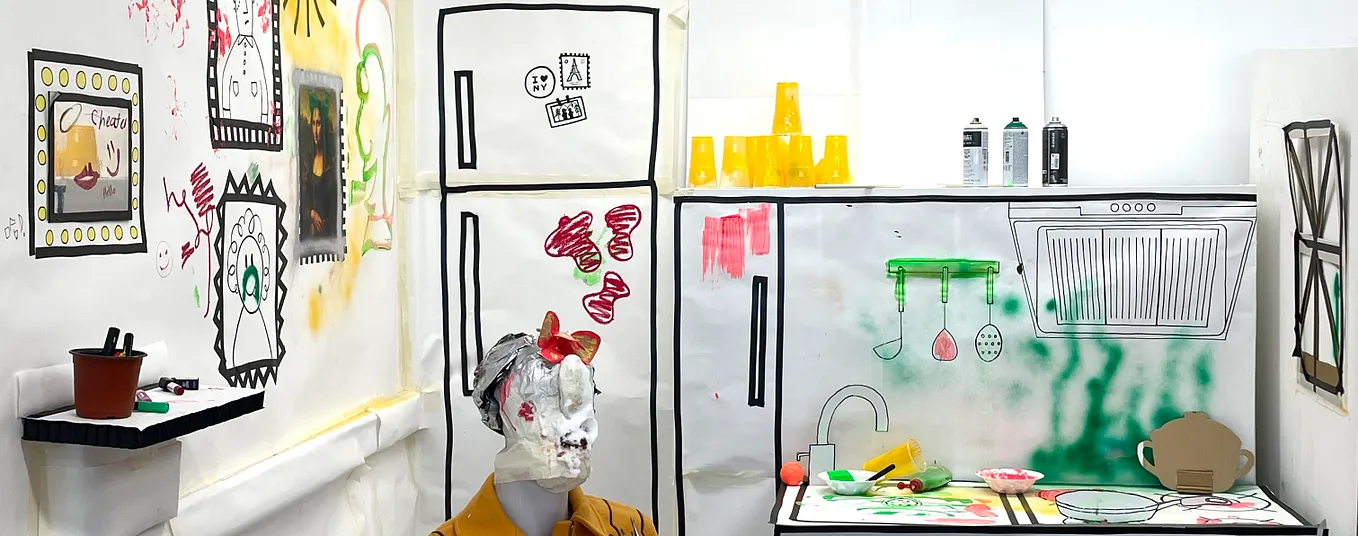
Lights, Camera, L.A.R.P!
Brief: Design and build a L.A.R.P. (Live Action Role-Play) themed around a future dead zone of light
Research Methods: Iterative Live Action Role-Play (L.A.R.P.)
Team: Diya • Chaitanya • Sakshi • Primrose • Stav • Sian • Lancy • Mustafa • Uday • Dabeen • Grania
Week 1
What is a Live Action Role-Play (LARP), really?
Getting ready for the week, I read LARP Design: Creating Role-Play Experiences with no prior context (Brown, 2017). I had more questions than answers at this point; how is a LARP different from theatre, films, or design role-plays?
I found some clarity through play-testing in class.

So, a LARP blends improvisation, role-play, and interactive storytelling into a lived experience.
From Light to Darkness: Designing Our LARP
Diving into the unit, our group was allocated “Light” for our dead zone. We started off with noting down initial thoughts and mind-mapped interpretations of light, from which the idea of artificial light was taken forward to build the LARP world.

I was concerned that our LARP lacked a clear purpose; what question were we trying to explore? I raised this with the group, where some suggested letting the question emerge during runtime. However, without a defined focus, making design decisions felt difficult. We took this into the feedback session, where our tutors agreed that the LARP needed a deeper question, with every element in the magic circle contributing to it. Their challenge led us to rethink artificial light, shifting towards a blackout scenario.
In an effort to understand how we interact in the complete absence of light, we played blindfolded games.


The question that emerged through the common themes mapped was;
Can humans build trust without sight?
Humans instinctively feel safer in the light, as visibility allows us to assess surroundings and potential threats, reinforcing control and security. Exploring the Effects of Light and Dark on Crime in London by Erturk, Raynham, and Unwin highlights how well-lit environments reduce crime, suggesting darkness fosters uncertainty and fear. Out of Sight — Out of Trust? shows that reduced visibility and interaction, such as in workplace isolation, erodes trust. In darkness, where facial expressions and body language vanish, the cues we rely on for trust diminish (van Zoonen, Sivunen, and Blomqvist, 2023).
Our LARP thus explores if and how humans can build trust when sight is compromised
Week 2
The Complexity Trap: Simplifying Through Iteration
As we built out our LARP, it became too complex. There were too many mechanics, too many character layers. We traced this back to two factors:
- Thinking in terms of game-heavy systems like Dungeons & Dragons, where elaborate rules govern play.
- A disconnect between approaches; some focused on character backstories, while others prioritised props and mechanics.
- Discussing but not playtesting!
To fix this, we restructured our process. Instead of designing top-down, we built bottom-up, constantly play-testing and iteratively adding / refining elements.


Lights, Camera, LARP!
Scenario:
London, 2030. Climate change has overwhelmed flood defences, submerging large parts of the city. A group of survivors are trapped inside a flooding tube station.
In the chaos, all have lost vital belongings, without which they cannot leave. Most crucially, the exit requires the TFL worker’s keys, which is also lost in the chaos. Floodwaters are rising, and time is running out. The blackout makes it impossible to verify identities or read facial expressions.
Gameplay:
Get Diya Paode’s stories in your inbox
Join Medium for free to get updates from this writer.
Players must go underwater to retrieve their precious belongings, every 2 minutes they must come back to the “safe” zone above water to “catch their breath”. The TFL worker’s keys are the way to escape, and players can only leave when they have retrieved their item.


On-Boarding:
After a safety and rules briefing, players received their Character Cards, costumes, and ‘precious belongings’. They had one minute to step into character before being told that they were trapped. Then, blindfolds were placed on them, and the runtime began.


Off-Boarding:
With snacks at the table to replenish after a physically demanding LARP, we encouraged participants to explore their thought processes, decision-making strategies, and emotional responses throughout the game.

Tutor Feedback & Refinements
✅ What Worked
Seamless Onboarding: Players felt guided into roles smoothly, making immersion natural.
Design Details Mattered: Costumes, character prompts, and environmental sounds deepened engagement.
Player Commitment: Even in short gameplay, characters felt real, decisions felt meaningful.
🔄 What Needed Refinement
Sound as a Game Mechanic: Water sounds were meant to obscure voices, but did not work as intended, highlighting the need for iterative sound testing.
Language Constraints: A non-English-speaking character led to isolation rather than innovation, raising questions on accessibility in role constraints.
Trust vs. Chaos: Did the LARP test trust, or simply create chaotic navigation? A longer runtime might deepen interpersonal trust dynamics.
In Retrospect
Throughout the LARP, I tried to align the process to its practical implications in my professional practise.
LARP as a “Carrier Bag” of Possibilities
A particularly striking analogy of the LARP was to Le Guin’s idea of an experience as a bag; not something rigidly designed with a fixed outcome, but a collection of opportunities for players to explore, interact with, and expand upon (Le Guin, 1986). Instead of designing for a singular narrative, LARP invites improvisation and emergent storytelling.
World Creators Are Not Always in the World
One key realisation was that those who design systems often do not experience them firsthand. LARP offers decision-makers a chance to step into the world they shape. By immersing themselves in real interactions, struggles, and behaviours, they gain a deeper understanding of how their systems truly function.
Players Shape the World
Once participants entered the space, they took what they liked and made it their own. Some created a fictional “turkey language”, while others used objects as sound cues for navigation. This emergent creativity reinforced that design is never static; a designer sets rules, but players define the experience.
Onboarding is Omnipresent
The way participants are onboarded into a LARP mirrors onboardings in apps or even jobs. Just as digital products guide users through features and functions, our onboarding helped understand rules, roles, and mechanics before stepping into the experience. Similarly, LARP can serve as a tool for onboarding in workplaces, helping new employees navigate company culture and collaboration in an experiential way.
A Research Tool for Sensitive Topics
Stepping into character was unexpectedly freeing, making me realise that LARP can be a powerful tool for user research on sensitive topics. Participants can share experiences through role-play rather than direct exposure, reducing discomfort, bias, and personal stakes.
Reference List
Brown, A. (2017) LARP Design: Creating Role-Play Experiences. New York: Routledge.
Erturk, H., Raynham, P., and Unwin, J. (2024) ‘Exploring the Effects of Light and Dark on Crime in London’, ISPRS International Journal of Geo-Information, 13(6), p. 182. Available at: https://www.mdpi.com/2220-9964/13/6/182 (Accessed: 20 March 2025).
Le Guin, U.K. (1986) The Carrier Bag Theory of Fiction. Available at: https://stillmoving.org/resources/the-carrier-bag-theory-of-fiction (Accessed: 20 March 2025).
van Zoonen, W., Sivunen, A.E., and Blomqvist, K. (2024) ‘Out of Sight — Out of Trust? An analysis of the mediating role of communication frequency and quality in the relationship between workplace isolation and trust’, European Management Journal, 42(3). Available at: https://www.sciencedirect.com/science/article/pii/S0263237323000488 (Accessed: 20 March 2025).