What Five Photographs Confirmed This Morning

A field observation from a MOMAX3® Moringa plantation — pods at 40–60cm, simultaneous bloom active, and everything the camera cannot see

I did not plan to write today.
I planned to walk the rows, check the probe readings, confirm the Phase 4 drip schedule, measure fifty pods across ten trees, and go back to the office with numbers.
But five photographs changed that plan.
Not because they were extraordinary photographs. The light was harsh. The sky was pale. The soil was the familiar red-ochre of Rajasthan sandy loam in the late morning heat. No golden hour. No dramatic canopy silhouette against a burning sunset.
Just five images taken on a phone, in the practical light of a working farm visit, that together told a story I have been trying to articulate for twenty-seven seasons.
This is that story.
Image One — The Man and the Evidence

The first photograph shows a man standing in front of a MOMAX3® Moringa tree with his arms crossed.
Behind him, the tree has become a curtain of pods.
Long green pods — forty, fifty, sixty centimeters — hanging vertically in dense cascades from arching primary branches that have been shaped by nine precise pruning cycles into the exact load-bearing architecture that carries this weight without structural failure. Not scattered across the canopy. Not occasional. Every branch contributing. Every axillary node productive. The weight of developing seeds bending the outer branches into the graceful downward arc that mature, correctly managed MOMAX3® trees produce when they are doing exactly what their genetics were designed to do.
At the top of the frame, where the branches reach toward the pale Rajasthan sky, yellow flower clusters are still visible — the secondary and tertiary bloom that MOMAX3® sustains simultaneously with pod fill, the developmental asynchrony that means this plantation is not finishing in one go.
The man standing in front of it has his arms crossed and his sunglasses on and the expression of someone who has seen this twenty-seven times and still finds it worth stopping for.
That expression is not pride.
It is recognition.
This is what the genetics were always capable of.
This is what nine seasons of Elite 8 Protocol gave them the infrastructure to produce.
Image Two — The Architecture of Abundance

The second photograph removes the human reference point and lets the tree speak for itself.
It speaks loudly.
The canopy is simultaneously carrying three biological processes — pod fill, active bloom, and new vegetative growth — across a single branching architecture that nine seasons of correct pruning have shaped into something that looks less like a managed tree and more like a biological system that has learned its own optimal geometry.
The pods dominate. Long, green, trigonal in cross-section — the three ridges that run the length of each MOMAX3® pod are faintly visible where the light catches them at an angle. These ridges are not ornamental. They are the structural reinforcement of the pod wall — the plant’s engineering solution to carrying the internal pressure of fifteen to twenty seeds expanding simultaneously as their oil bodies fill with triacylglycerols assembled from the fatty acid biosynthesis running at full capacity inside each embryo.
At 40 to 60 centimetres, these pods are in the final phase of that assembly.
The composition of the oil inside them — the oleic acid percentage that will determine whether this harvest qualifies for pharmaceutical-grade certification — was determined six weeks ago. At pods five to ten millimetres. When Bloom Power Spray Number Three delivered chelated zinc to the FAD2 enzyme’s di-iron active site and suppressed the reaction that would have converted oleic acid to linoleic acid during the enzyme’s peak expression window.
The pods at sixty centimetres this morning are not building oil quality.
They are delivering it.
The yellow flower clusters visible in the upper canopy are not the remnants of a flowering cycle that has passed. They are the continuation of one that never stopped. The MOMAX3® tree at Season Nine — its canopy shaped by nine pruning cycles, its root system supported by nine seasons of mycorrhizal network expansion, its soil buffered by the biochar applied in Year One and still performing in Year Nine — does not choose between completing a harvest and initiating the next.
It does both.
At the same time.
On the same branch.
What the Camera Cannot See
Before the third image, I want to describe something that no photograph can capture.
Inside the pods visible in Images One and Two — inside tissue so dense and so metabolically active that the pod wall is warm to the touch in the Rajasthan midday heat — an assembly process is running that began six weeks ago and will complete in the next eighteen to twenty-two days.
Each seed in each pod contains an embryo surrounded by cotyledon tissue loaded with the enzymatic machinery of fatty acid biosynthesis. The endoplasmic reticulum of each seed cell is dense with enzyme complexes — the Δ9-desaturase that converts stearic acid to oleic acid, the ACCase that determines the total rate of fatty acid production, the enzymes of the Kennedy pathway that assemble individual fatty acids into triacylglycerols and package them into oil bodies surrounded by phospholipid monolayers.
Once those oil bodies are sealed — once the triacylglycerols are packaged and the phospholipid coat is complete — the composition they contain is permanent.
The GC-MS laboratory will measure it. The pharmaceutical buyer will evaluate it. The price per kilogram will reflect it.
But none of those measurements will change it.
The composition was set at five millimeters.
The pods at sixty centimeters are simply honoring that commitment — one oil body at a time, one seed at a time, across every pod on every branch of every tree in this Rajasthan plantation on this pale-sky morning in Season Nine.
This is what a kept promise looks like from the outside.
Image Three — The Row That Smells Like Bloom

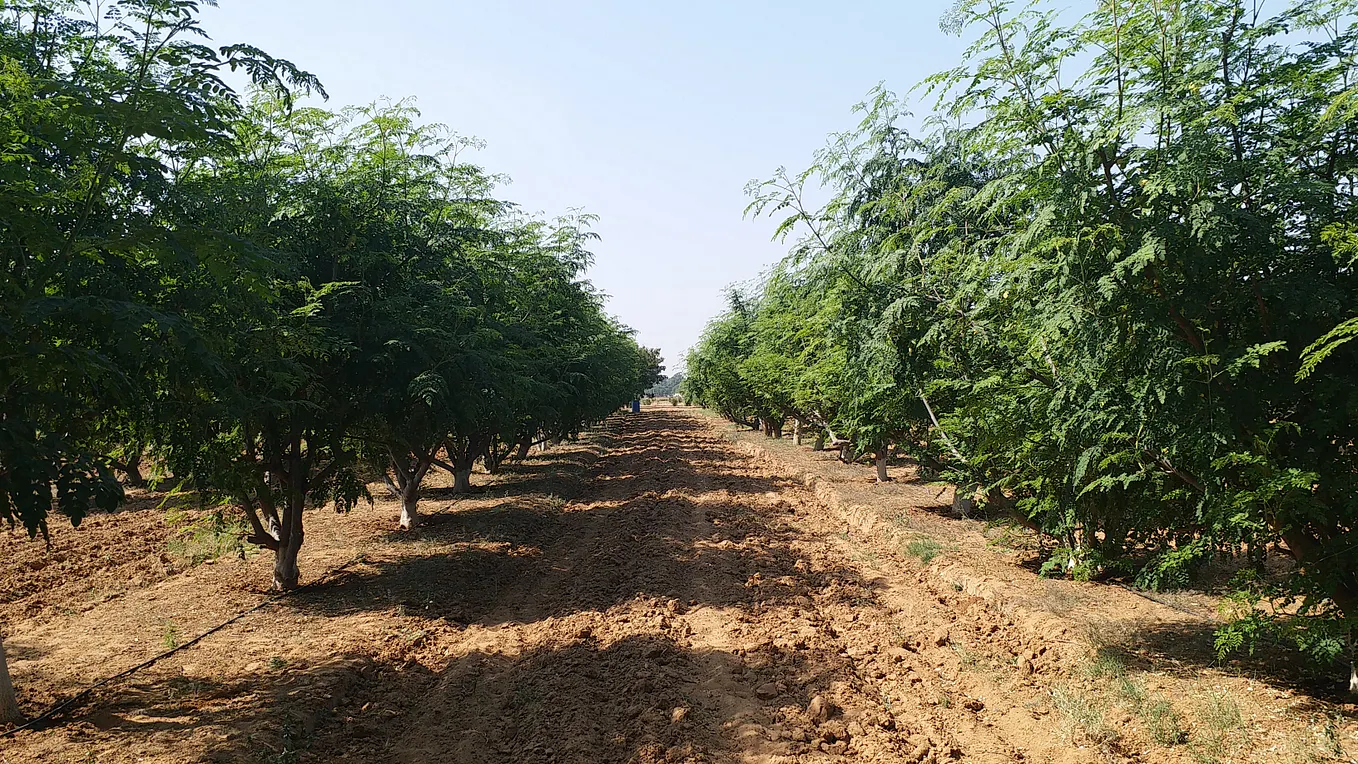
The third photograph is a corridor shot.
Standing between two rows of MOMAX3® trees, looking down the red-ochre soil path that runs between them toward a softly blurred horizon — the plantation extending beyond what the frame can contain.
On both canopy walls: white flowers.
Not yellow. Not spent. White — the fresh five-petalled bloom of MOMAX3® Moringa at active anthesis, petals spread open, disc florets releasing pollen, the subtle sweet fragrance that this specific cultivar produces at full bloom hanging in the still Rajasthan air between the rows.
This is not the main bloom that initiated the pods currently at forty to sixty centimeters. That bloom was six weeks ago. These are the flowers of the next — the second wave the flowers continuously across its canopy because its developmental architecture, shaped over nine seasons of correct pruning, creates a permanent gradient of phenological stages from the older axillary positions carrying mature pods to the younger terminal nodes initiating new panicles.
Standing in that corridor, the agronomist reads the situation immediately.
The pods at forty to sixty centimeters will be harvested in eighteen to twenty-two days.
The flowers currently open in this image will set pods in the next seventy-two hours — as the Bloom Power Spray Number Two was applied correctly at sixty to seventy percent bloom open, delivering the cytokinin fraction that shifts the ethylene-to-auxin ratio at the pod base toward retention rather than abscission.
In six weeks, those pods will be at five to ten millimeters — the window for Bloom Power Spray Number Three.
The Phase schedule for the new cohort is already calendared.
The soil between the rows — the fine red-ochre Rajasthan sandy loam visible in the path — carries below its surface a mycorrhizal network that has been expanding for nine seasons. Hyphae extending outward from every root tip in every direction, accessing phosphorus and zinc from soil mineral fractions that conventional roots cannot reach, delivering those micronutrients to the canopy above in the form that the developing embryos in the long pods need right now to sustain Δ9-desaturase activity through the final phase of oil assembly.
The camera recorded a corridor with white flowers.
The agronomist walked through a biological system that never stops.
Image Four — The Infrastructure

The fourth photograph shows the same corridor — a different section, slightly further along the row — and reveals something the third image did not.
A black drip irrigation lateral, running along the soil surface between the rows.
This is the detail that separates a farm that consistently achieves pharmaceutical-grade oil certification from a farm that aspires to it.
The drip lateral in this image is delivering the Phase Four weekly nutrition schedule: 12–0–44 potassium nitrate at forty kilograms per hectare for osmotic maintenance in expanding seed cells, calcium nitrate at fifteen kilograms per hectare for cell wall integrity in the developing seed coat and endosperm, potassium silicate at five kilograms per hectare for pod wall structural reinforcement against fungal penetration and physical stress.
But its most critical function at this moment — beyond the nutrition it carries — is water.
The Elite 8 Protocol requires soil moisture to remain above sixty percent field capacity throughout Phase Four pod fill. Below sixty percent, ABA is synthesised in the root zone, transported to the developing seeds, and activates FAD2 gene expression — triggering the oleic-to-linoleic acid conversion that can lower the GC-MS reading from 82.9 percent to below 82.0 percent in a matter of days.
Get DP Maharshi’s stories in your inbox
Join Medium for free to get updates from this writer.
The drip lateral visible in Image Four is the physical infrastructure that prevents that from happening.
The black pipe running along red Rajasthan soil is not a farming convenience.
It is the boundary between pharmaceutical grade and commodity grade — expressed as irrigation infrastructure.
This image is also the one that contains the Ethiopia Block-7 lesson most directly. Five hundred hectares. Every Elite 8 element executed correctly. One pump failure. Five days without irrigation during pod fill. Soil moisture dropping below sixty percent field capacity. ABA surge. FAD2 activation. Oleic acid reduced by two point one percentage points. Pharmaceutical certification failed by zero point two percent.
Forty point seven million dollars. From one pump that was not backed up.
The drip lateral in Image Four is backed up.
The backup pump is pre-connected and tested.
The lesson was expensive. It was learned completely.
Image Five — The Full Story in One Frame
The fifth and final photograph is the one I keep returning to.
Another corridor. Another receding row of red-ochre Rajasthan soil between two canopy walls. But something about the specific alignment of this frame captures the complete biological narrative in a single image.
Left canopy wall: Long pods cascading downward from heavily loaded branches — forty centimeters, fifty centimeters, some reaching further — the weight of them bending the branch tips toward the soil. Pod fill. Phase Four. Oil assembling. Eighteen to twenty-two days from harvest. The GC-MS certificate already written at five millimeters six weeks ago, currently being honoured at the molecular level inside seeds I cannot see through the pod wall.
Right canopy wall: White flowers. Open. Fresh. Mid-bloom. A panicle of five-petalled white Moringa bloom visible just above the soil line at the canopy’s lower edge, another cluster visible higher, another at the branch tip. Pollen releasing. Bees working. The next cohort of pods being initiated. Phase Three Bloom Power timing already being tracked.
The corridor between them: Red-ochre Rajasthan soil, slightly raised at the centre where the drip lateral runs beneath it, receding into the plantation distance under a pale hot sky.
This corridor is not a path.
It is a timeline.
Walk down it from the camera toward the vanishing point and you are walking from this season’s harvest into next season’s promise. The pods on the left are completing the cycle that the flowers on the right are beginning. The drip lateral beneath the soil is sustaining both simultaneously. The mycorrhizal network below the drip lateral is supporting the root system that is feeding both the oil assembly in the long pods and the embryo initiation in the newly fertilized ovules.
The plantation is not doing two things at once.
It is doing one thing continuously — with different parts of itself at different stages of the same biological cycle.
This is what nine seasons of compounding biology produces.
Not a more productive farm.
A farm that has transcended the concept of seasons altogether.
The Numbers Behind the Images

Five photographs. Five compositions. Five angles on the same Tuesday morning visit.
What they document — stripped of poetry and returned to the agronomic ledger — is this:
The pods visible in Images One and Two are at forty to sixty centimeters. Phase Four nutrition is running on schedule. Soil moisture probes read above sixty-five percent field capacity. Pod length measurement from this morning’s fifty-pod sample across ten trees: average fifty-four centimeters. Rate of elongation: approximately zero point eight centimeters per day. Estimated days to harvest trigger: eighteen to twenty-two.
The flowers visible in Images Three, Four, and Five are the follow-up cohort. Approximately sixty to seventy percent bloom open on the trees carrying them. Bloom Power Spray Number Two application window: today or tomorrow. Spray Number Three for this cohort: calendared for twenty-two to twenty-five days from now, at pods five to ten millimetres. Zero days tolerance.
At harvest in eighteen to twenty-two days:
Oil yield projection: 3.94 t/ha. GC-MS oleic acid: 82.9 percent. Market classification: pharmaceutical grade. Gross revenue: $140,300 per hectare.
Not a projection from a model.
A delivery from a system.
Why Nine Years Matters More Than Nine Weeks

The pods in these photographs are the most visible evidence of nine years of decisions — but they are not the most important evidence.
The most important evidence is invisible.
It is the mycorrhizal network that has been expanding beneath this Rajasthan soil since Season One — now so deeply integrated into the root architecture of these trees that removing it would be like removing the vascular system from a body. It is the biochar applied in Year One that is still buffering moisture in Year Nine, still providing habitat for the microbial community, still increasing the cation exchange capacity that keeps zinc and boron and iron in the root zone rather than leaching with every irrigation event. It is the canopy architecture that nine seasons of correct pruning have shaped into the pod-carrying structure visible in Image Two — not by designing it in advance, but by making the right cut each season and allowing each season’s correct decision to inform the next one.
This is what compounding looks like when applied to biology rather than to capital.
Capital compounds through interest. Biology compounds through infrastructure.
Every correct decision this season is infrastructure for next season. Every correct decision next season is infrastructure for the season after.
The pods at sixty centimeters in Image Two are not the product of this season’s management.
They are the product of nine seasons of management that made this season’s management possible.
The Certificate

In eighteen to twenty-two days, the pods visible in these photographs will be dry.
Seed moisture will reach nine to eleven percent. The cold press will be prepared. The GC-MS samples will be drawn from the first pressing of the harvest. An ISO 17025-accredited laboratory will measure the fatty acid profile of the oil pressed from seeds that were assembling their composition inside pods that were forty to sixty centimeters long on this Rajasthan morning.
The certificate will read:
Oleic acid: 82.9 percent.
Not because of what the photographs documented.
Not because of what the Phase Four drip schedule is delivering this week.
But because of what was done at 05:30, six weeks ago, when the pods were five to ten millimeters long and nobody was watching and the FAD2 enzyme was at peak expression and the chelated zinc in Bloom Power Spray Number Three occupied the di-iron centre and held it.
The certificate the laboratory will issue is not a measurement of this morning.
It is a measurement of every morning since Season One.
Every probe reading at 08:00. Every pre-dawn spray. Every AMF inoculant mixed into a planting ring. Every gram of the $1,840 per hectare protocol applied without skipping a week. Every backup pump tested before pod fill began. Every decision, correct or corrected, across nine seasons of a plantation that never stopped learning how to compound.
Five photographs confirmed what twenty-seven seasons have been building toward.
The pods at forty to sixty centimetres. The flowers still opening above them. The drip lateral running between the rows. The mycorrhizal network invisible below all of it.
And a man standing with his arms crossed in front of a curtain of pods —
not celebrating a harvest,
recognizing a system.
The pods are forty to sixty centimeters this morning in Rajasthan.
The flowers above them are still open.
The certificate is already written.
The laboratory will read it in eighteen days. 🌿
DP Maharshi is the founder of MOMAX3® Moringa Partners and the Advanced Biofuel Center. The Elite 8 Protocol is verified across 41,000 hectares in 14 countries.
If you want to follow this harvest through to the GC-MS certificate — or if you are evaluating a MOMAX3® planting and want the complete Elite 8 Protocol guide — comment “SEASON 9” below or send a direct message. Free to all MOMAX3® seed buyers.