What Happened to Data Products?


AI dominates the data-platform conversation, from foundation models and copilots to agent frameworks and enterprise AI budgets. In my discussions with data platform providers, data products still come up early because providers are building internal marketplaces, product views in catalogs, semantic definitions, contracts, lineage, quality signals and governed access for AI agents. These investments show where they expect enterprise demand to grow: trusted, reusable and governed data offerings for business users, applications and agents.
The market needs a more precise reading than “data products are rising” or “data mesh failed.” Attention, adoption and business value measure different things. The data mesh movement made data products widely known, yet the full operating model proved difficult for many organisations.
Data product thinking has since moved into a more practical phase, where it is being embedded in existing platforms and tied to specific business and AI use cases.
From data mesh ambition to data product delivery
Data mesh proposed a major shift in how organisations organise data. It linked four principles: domain-oriented ownership, data treated as a product, self-service data infrastructure and federated computational governance. A domain team would own and improve the data it produced, while a shared platform would provide the tools and shared rules needed for other teams to find, trust and use it.
That model required far more than a new data architecture. It required changes in funding, roles, decision rights and accountability. A business domain needed to accept responsibility for the quality, meaning and lifecycle of data that other teams depended upon. A central data team needed to shift from delivering every request to operating shared services, standards and governance.
The evidence shows that many organisations found this transition hard.
- BARC’s 2024 survey of 197 data and analytics professionals found that 20% had data mesh underway, while 24% planned an implementation.
- The planned figure had fallen from 35% in 2023, and 27% of respondents considered data mesh to have little or no relevance for their organisation.
- Research based on 15 expert interviews reached a similar finding: federated governance, distributed responsibility for maintenance and shared understanding of the model created the main barriers.
The slower adoption of full data mesh does not remove the business problems that data products were designed to address.
- Finance still needs trusted profitability data.
- Operations still needs reliable exception and performance data.
- Customer teams still need approved views of customer behaviour.
- AI teams still need data with defined meaning, quality and access rules.
Many organisations are addressing those needs without attempting a full enterprise-wide decentralisation programme.

Data products became independent from the architecture debate
Gartner named highly consumable data products as one of its top data and analytics trends for 2025. Its guidance focused on business-critical use cases, reusable and composable minimum viable products, and KPIs agreed between producing and consuming teams. The guidance places the emphasis on delivery and measurable use rather than a prescribed architecture.
Thoughtworks made the same distinction in its 2025 Technology Radar. It recommends data product thinking as a standard management practice whether an organisation operates a data mesh, lakehouse or another model. This reflects a change in the market. Data products are increasingly treated as a practical delivery discipline that works within centralised, federated and hybrid data environments.
A product therefore needs more than data stored in a named location. It needs a stated purpose, a known consumer, an accountable owner and a usable output. It also needs enough business and technical context for the consumer to understand what the product represents, when it is suitable for use, what quality it provides and which access rules apply.
A table, dashboard, API or machine-learning model may all form part of a data product. None of those technical assets becomes a product merely because someone labels it as one. The difference lies in the relationship between the asset, its user, its owner and the outcome it supports.
Demand is established — Delivery discipline is not
KPMG’s 2025 survey of 250 executives offers useful evidence about the gap between intent and execution.
- 92% of respondents viewed well-constructed data products as critical to organisational success, and
- 96% said they were moving from legacy data assets toward modern data products.
- Only 35% reported extensive value from their data product initiatives, while ambiguous ownership, slow data acquisition and poor data quality emerged as major barriers.
The survey does not provide a universal enterprise adoption rate because it focuses on executives engaged in data modernisation. It does show that data products have become a serious investment topic, while the operating practices needed to produce value have not matured at the same speed.
This is where many initiatives lose momentum. Teams begin by documenting assets, building taxonomies or publishing large numbers of datasets.
They invest less effort in identifying which business decision, workflow or AI use case needs support, who is accountable for the result and how value will be measured over time.
The product approach begins with a narrower question. Which consumer needs which governed data offering to complete an important task?
Once that question is answered, teams can define the output, owner, quality expectations, access model and measures of use. The work becomes smaller, more measurable and easier to improve.
Get Dr. Jarkko Moilanen’s stories in your inbox
Join Medium for free to get updates from this writer.
For a practical introduction to this way of thinking, my Data Product MasterClass covers how to move from raw assets toward reusable, business-focused data products: https://www.udemy.com/course/data-product-mindset/
Platform providers are building the product layer
The product roadmaps of major data providers support this interpretation. Snowflake made its Internal Marketplace generally available in November 2024. Its documentation describes a place where companies publish documented and governed data products that internal consumers can discover and understand.
Databricks expanded Unity Catalog in 2025 with governed business metrics and a curated internal marketplace for high-value data and AI assets organised by domain. Its wider direction brings data, models, applications and agents into a shared governance layer, where business context and access controls apply across different asset types.
Alation announced its Data Product Marketplace and Data Products Builder Agent in 2025. Collibra and Atlan have also made data products central to their marketplace and governance positioning. Although these announcements do not prove that customers have solved data product management, they demonstrate that vendors see the product layer as a necessary part of data discovery, governance and consumption.
The marketplace is becoming the visible part of that layer. It gives a business user or technical consumer a place to find an offering by purpose, assess its quality and lineage, understand access requirements and request or use it. The catalog remains important, yet a catalog describes an estate while a marketplace presents a curated offering for a specific consumer need.
AI created a new consumer of data products
AI agents make the need for this product layer more concrete. An analyst with domain knowledge may recognise a suspicious metric, investigate an unfamiliar table or ask a colleague for clarification. An agent works at speed and scale, which means weak context, unclear ownership and poorly governed access produce weak results faster.
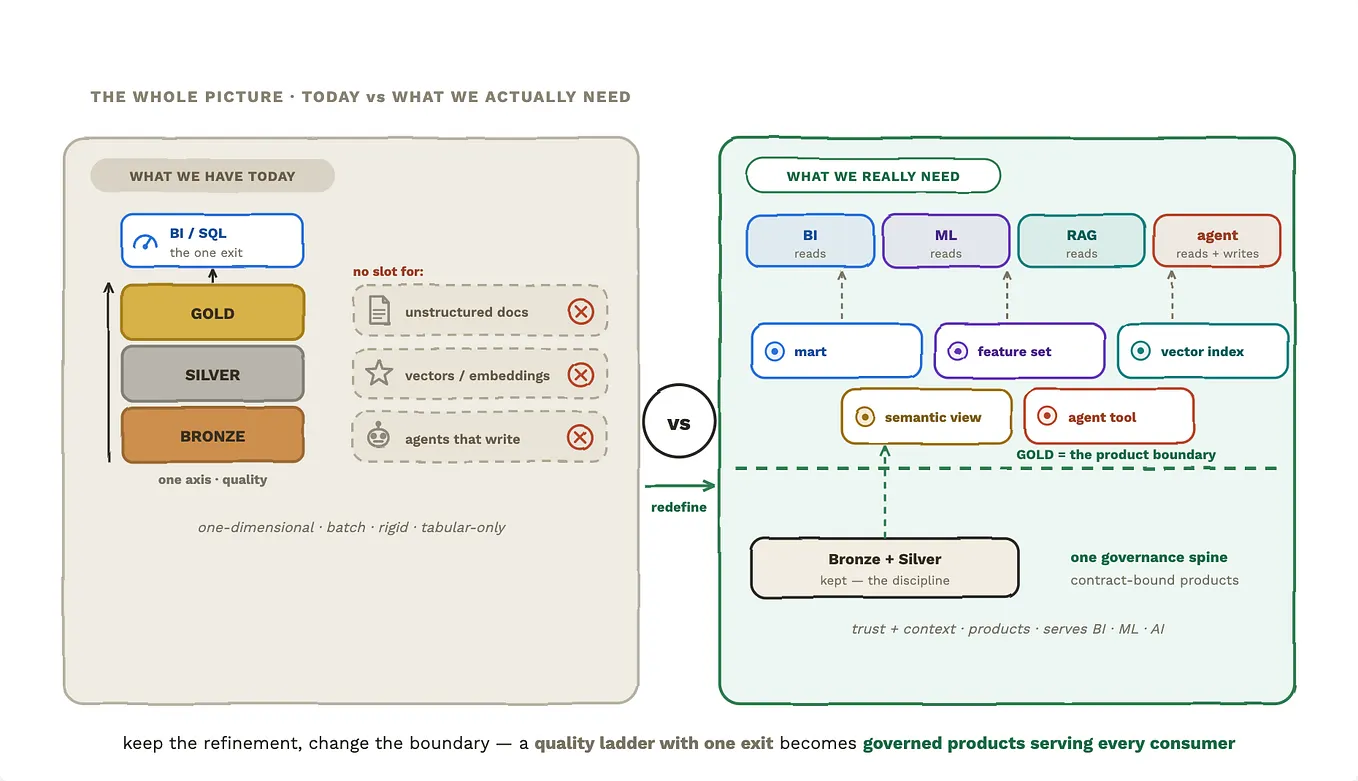
An agent needs to know which source is authoritative, what the measures mean, who owns the product, how current it is, which policies restrict its use and what type of output it is allowed to create. A data product provides a bounded context for that work by grouping the relevant assets, semantics, quality expectations and access rules around a defined business purpose.
I cover the practical implementation side, including ODPS, product catalogs, value graphs, validation and agent-ready workflows, in Scalable Data Product Value Management with Agent-Ready SDK: https://www.udemy.com/course/scalable-data-product-value-management-with-agent-ready-sdk/

Gartner placed highly consumable data products, metadata management, agentic analytics and AI agents in its 2025 trend set. The connection between those trends is practical. Metadata supplies context. Governance establishes controls. A data product packages the assets for use. An agent then operates within that governed context rather than searching an uncontrolled estate.
Early technical research is testing this model. The 2026 Data Product MCP paper describes a data marketplace where an agent finds, requests and queries data products while machine-readable contracts enforce access and policy rules. The study involved 16 data-governance experts, so it should be read as early design evidence rather than broad adoption evidence.
It still illustrates the direction of travel: agentic data access needs structured products and enforceable controls.
Dawiso offers a concrete example of this shift. Its data product layer is built on the Open Data Product Specification, ODPS, alongside ODCS and data-mesh ports. Dawiso maps these standards into its Unified Data Product Model and exports validated ODPS and ODCS definitions. This gives the product a portable, machine-readable form rather than leaving its definition trapped inside one catalog. help.dawiso.com
Through its MCP integration with Databricks, Dawiso makes the resulting context available to AI agents: business terms, data products, ownership, classifications and lineage. The agent receives more than table names. It receives the product definition and governance context needed to interpret data and work within the relevant access rules.
The next challenge is product management and interoperability
Most organisations already have core technical capabilities. They have data warehouses, lakehouses, pipelines, APIs, catalogs, data-quality tools and access controls. The more difficult question is how they decide which data products deserve investment, who owns them, how they measure reuse and value, and when a product should change, merge or retire.
This is product management applied to data. It requires a portfolio view that connects strategic objectives, use cases, consumers, products, owners, costs, quality, usage and outcomes. Without that view, teams often create overlapping assets that solve the same problem in slightly different ways, while important needs remain unserved.
Interoperability is becoming equally important. Large organisations operate across several clouds, catalogs, warehouses, lakehouses and AI environments. A data product should not lose its identity, business definition, contract or ownership information when it moves between those systems.
This is the problem that the Open Data Product Specification, ODPS, addresses. I maintain ODPS under the Linux Foundation as a machine-readable and portable specification for data products. It does not replace a data catalog, marketplace or cloud platform. It gives those platforms a common product definition to work with, which supports more consistent governance and easier exchange across the wider ecosystem.

Data products have not disappeared from enterprise data strategy. The evidence shows a change in where they are being implemented and why. Full data mesh programmes have slowed because the organisational transformation is demanding, while product thinking is being absorbed into existing data platforms, marketplaces, catalogs and AI governance models.
AI has increased the need for that discipline because an agent needs more than data access. It needs a defined and governed context that links data to business meaning, ownership, quality and permitted use.
Organisations that build that product layer around important outcomes will have a stronger basis for human self-service, trusted analytics and responsible AI delivery.
If you are building a data product strategy, marketplace or agent-ready data foundation, book a 30-minute conversation. Come to the source, dont trust 2nd hand information: https://jarkkomoilanen.com/engage

Sources
BARC, Data Mesh and Data Fabric, From Theory to Application, 2024: https://barc.com/research/data-mesh-data-fabric-2024/
Bode, Kühl, Kreuzberger and Holtmann, Towards Avoiding the Data Mess, 2023: https://arxiv.org/abs/2302.01713
Gartner, Top Trends in Data and Analytics for 2025: https://www.gartner.com/en/newsroom/press-releases/2025-03-05-gartner-identifies-top-trends-in-data-and-analytics-for-2025
KPMG, Harnessing the Value of Data, 2025: https://kpmg.com/us/en/media/news/harnessing-the-value-of-data.html
Snowflake, Internal Marketplace: https://www.snowflake.com/en/developers/guides/sharing-data-and-ai-on-snowflake-internal-marketplace/
Databricks, Unity Catalog updates, 2025: https://www.databricks.com/blog/whats-new-databricks-unity-catalog-data-ai-summit-2025
Alation, Data Product Marketplace: https://www.alation.com/news-and-press/alation-announces-data-products-marketplace/
Tonnarelli et al., Data Product MCP, 2026: https://arxiv.org/abs/2601.08687