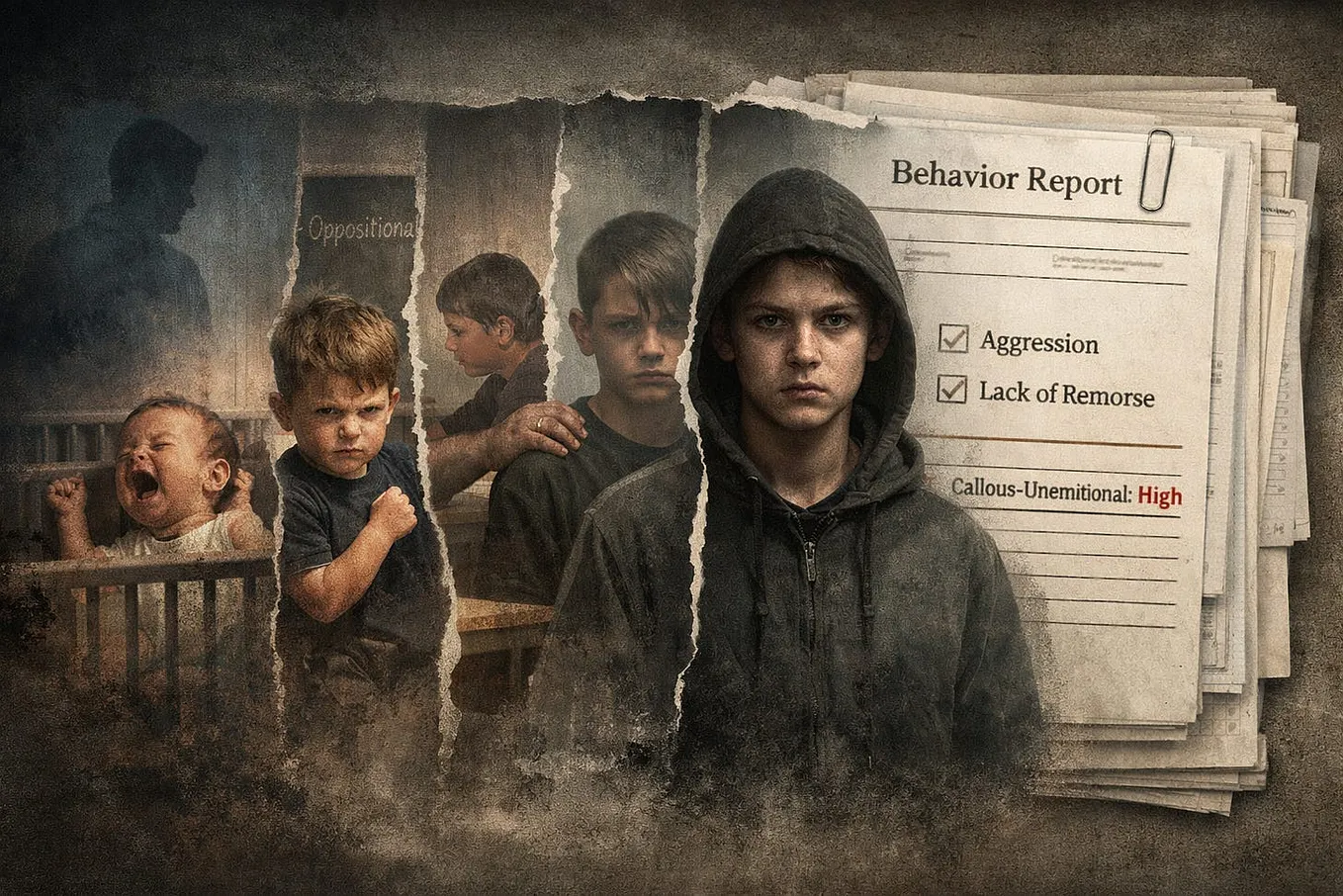
The Original Crime Scene

The story of serial killer David Carpenter usually starts on the hiking trails, and that’s the first mistake. Eight people were killed in the Bay Area between 1979 and 1981, on trails and in parks, and the story almost always opens there, with the bodies, the geography, the terror of women being warned not to hike alone in Marin County. Starting there means you’ve already skipped the part of the story that actually explains what happened.
And as we see in all cases involving serial killers, the real starting point is a household.
Carpenter’s mitigation record describes severe childhood abuse, humiliation, coercive control, an environment where the people responsible for protecting him were instead damaging him in ways that reorganized how he understood power, bodies, and other people. His own defense described him as a “personally damaged human being” who suffered under abusive parents. That description got dismissed during proceedings, treated as a legal maneuver rather than a factual claim worth examining. But the developmental record is what it is. A teenager who is sexually offending against younger cousins has a history behind that behavior, and that history begins in the family.
When an adolescent is acting out sexually against younger children, the clinical question is what had already happened to that child’s own sexual development before the offending began. What had already been crossed in his own life? What had been modeled, violated, or normalized inside the household? In two decades of forensic work, the pattern holds consistently: children who sexualize other children almost always have their own story of prior sexualization, boundary violation, or exposure to adult sexual behavior they had no framework to process. The behavior they’re showing is a symptom of something that happened to them first. Carpenter’s adolescent offending was documented. It should have opened an immediate inquiry into what had already happened inside that household. Instead it became the first data point in a file that would keep growing.
The file grew because the institutions that had contact with Carpenter after the family also failed him. He was institutionalized as a teenager. He spent years cycling through systems that were supposed to assess, intervene, and change the trajectory. Juvenile sexual offending is one of the clearest early markers clinicians have for identifying a young person whose developmental damage is severe enough to require serious, sustained intervention. It signals that the underlying damage is real and that without meaningful treatment, the behavior tends to escalate rather than resolve on its own. Carpenter moved through years of institutional contact and came out the other side without anything having fundamentally changed. The trajectory kept going.
Then he raped a woman. Then he kidnapped someone. These were convicted offenses, not suspected behaviors or theoretical risks flagged in a clinical file. The criminal justice system had him in its hands, officially recognized that he had committed serious sexual violence, sentenced him, and released him. The adult rape and kidnapping convictions came before anyone died on a hiking trail. The escalation from adolescent sexual boundary violations to adult rape is a line, and the line was visible in the record for anyone reading the full length of it. Multiple systems had access to that record. What they did with it, how carefully they read it, how seriously they weighed what it meant to release him back into proximity with other people — those questions disappear after the murders, because by then the story has already been reframed into something much more convenient.

Once Carpenter is convicted of the trail killings, the narrative resets. District Attorney Posey stands up and says the adolescent sexual offending was “indicative of a sociopathic personality disorder,” and calls it evidence that “a lot of these personalities start at a very, very young age.” Posey is a prosecutor, not a psychologist, and “sociopathic personality disorder” is not a formal clinical diagnosis in any version of the DSM. But the deeper problem is what the framing accomplishes. By calling the adolescent behavior proof of an inherent personality disorder, Posey converts a symptom into an origin. The childhood becomes evidence of what Carpenter always was, rather than evidence of what had already been done to him and what every subsequent system failed to adequately address.
Get Dr Rachel Toles’s stories in your inbox
Join Medium for free to get updates from this writer.
This is where the logic becomes circular, and the circularity is the point. He did horrific things because he’s inherently disordered. We know he’s inherently disordered because he did horrific things. There’s no outside referent in that loop. Nothing points back to a cause that anyone had to respond to and didn’t. The disorder explains the behavior, and the behavior proves the disorder, and the whole structure turns on itself without ever requiring an accounting of what came before.
Antoine de Saint-Exupéry wrote a character in The Little Prince who drinks because he’s ashamed, and is ashamed because he drinks. The loop is total. There’s no entry point, no place where outside cause becomes visible, no interruption that the logic allows for. The “born evil” verdict in cases like Carpenter’s works exactly the same way. The beginning of the story gets erased, the ending gets treated as its own cause, and the circularity protects everyone inside the system from having to answer for what was visible and ignored.
The loop has to stay closed because opening it means specific institutions have to answer for specific failures. The family has to be examined seriously. Juvenile institutions have to explain what they saw, what they assessed, and what they actually did with a documented escalating pattern of sexual offending. The criminal justice system has to explain why repeated convictions for serious sexual violence didn’t produce a different response before eight people were killed on hiking trails. As long as the verdict is “he was born this way,” none of those questions need answering. The evil was internal and inevitable, so there was no intervention point anyone missed, no decision that should have gone differently, no gap in the system that needs closing.
The same circular logic operates at the individual level, and this is where accountability goes to die. When the official story about a person is that he is categorically, fundamentally different from other people, a fixed type rather than a human being whose behavior developed through a sequence of causes and conditions, he loses access to the only framework that makes accountability possible. Accountability is a cognitive operation that requires a causal story, a sequence of events, decisions, and conditions that a person can actually trace. To say “I did this because that happened, and that happened because of this before it” is an act of comprehension that depends entirely on having a timeline with real content in it. Replace that timeline with a label and you’ve removed the structure the comprehension would have to run on.

This is what actually happens inside forensic institutions when the psychopathy label gets applied early and applied heavily. Clinicians start managing the category rather than asking what produced the behavior. Treatment goals shift toward behavioral compliance, because the assumption underneath the label is that the person’s interior life is either absent or irredeemably distorted. The person on the receiving end of that assumption learns the same thing the institution is modeling: your behavior is what you are, what you learned, what was done to you, what you developed in response to specific conditions. So when a clinician or a parole board eventually asks “do you take responsibility for what you did,” the person has been given no tools to do that in any meaningful sense. He can perform contrition, say the right words in the right order, which institutions often reward as evidence of progress. Tracing the sequence that produced the violence requires a framework, and the institutional world he’s been living inside has been organized around the premise that the sequence doesn’t matter.
The real cost of the circular logic is that it removes the conditions under which the person who did the harm could develop any genuine understanding of how he got there. And without that understanding, the accountability the system eventually demands is performance, evaluated by people who were never interested in the underlying mechanics in the first place.
What the record actually shows in Carpenter’s case is a sequence with identifiable points. A severely abusive household produces a child with damaged attachment, distorted sexual learning, and a pattern of using power against smaller, more vulnerable people. That child moves into adolescent sexual offending, which gets noted, institutionalized, and insufficiently treated. That adolescent becomes an adult who rapes and kidnaps, gets convicted, and gets released. That man eventually kills eight people. Each stage in that sequence represents a point where a different response was possible, because the warning signs were legible, the escalation was documented, and the people responsible for reading those signs had enough information to understand what they were looking at.
The hiking trails are where it ended. Treating them as the beginning of an individual who was simply born evil is how every system avoids being part of the story at all.