aUI “Reloaded” (n2-aUI) (English version)


aUI, the language of space
During a journey, with a few moments while waiting for a bus in a not so distant European capital, I came across a strange link, very kitsch in the form, which presents us a language from the stars… If we pass besides the folklore that surrounds this funny language, we have a very simple tool that allows to have fun, and for those who are quite fans of minimalist built languages as Toki Pona, it’s almost a must.

“Have fun learning a new language in 1 hour”
This could be the slogan of aUI, because very quickly we can start using this language and play with it, by creating words. The author, Dr. Weilgart, has even used it as a tool with his patients … I will not judge the relevance of this usage, I’m not qualified for it, but it is an interesting similarity with the Toki Pona that some psychologists also use for therapeutic purposes. On the other hand, its founding article of the language (source), which I reproduce below, is rather succinct with regard to the rules of grammar and conjugation.
My purpose is to make a compilation of all the rules that I could find on the net, and to add some of my own in order to, without overloading the syntax, to remove ambiguities, to be more international (if possible), all in the most elegant way possible (hope). Hence the mention in the title of this n2-aUI post that could be translated as “the language of the space v2”
Note: for ease of reading I try to give short names to the rules in parenthesis and add an asterisk when the rule is my own.
Disclaimer
I admit that by browsing some documents on this language we find things quite surprising, such as the definitions of the pronoun “she” which is officially “yvu” … ie the opposite of “vu” which means “he”. But if the meaning of “vu” is active-person that of “yvu” becomes … inactive-person o_O. I pass you the translation of “woman” and “man” who are quiet bad also in their kinds.
Also, I will, in the following lines, keep 2 basic principles:
We can not translate everything literally
it is often a complicated and a doomed approach. If the notion of gender does not exist in aUI, then why add one? Moreover, several languages are very good at doing without it like Toki Pona and Lojban. “vu” means active person and “yvu” will logically be inactive-person. We are talking about a status, a behavior and not the gender of a person, why deduce more? From this principle, it follows that we can say less at first, but things more shareable because closer to the fundamentals of the language. It is a bit like in Toki Pona where sometimes we create approximate words (by agglutination) that require context to make sense.
Composition of words from right to left
the language is filled with anglicism… as I am french and therefore of a rather cartesian nature, I propose to apply systematically the meaning of the deciphering of simple words by going from right to left and to allow the word composition by separating them by a dash “-”. This proposition, moreover, is that which seems to be often implicit in the existing writings, and we find the notion of “-” in the first and rare texts written by Weilgart, with the presence of a sign of connection between two groups of letters. But when we read some definitions, there are many cases where the reading must be from left to right to make sense, which makes this language difficult to learn… when the case is too crooked I tend to ignore the word and recompose one that better follows my logic. Of course, there are some exceptions :
- the letters at the end of the word indicates often the role of the word in the phrase. We will see this in the next sections of this article.
- “y” that affects the letter (or group of if there is a dash “-” just after) letters to its right; you just have to see it as an inverted operator :)
- “t” when the words structure is <group A of letters>t<group B of letters><group C of letters>, in this case the whole word indicates that there is a kind of transition from “A to B”. The group C corresponds to the letters at the end of the word which indicate the nature of the word. We often see this strategy in the official dictionary.
- “v” insides a word is used to indicates an activity… “tvu” is an “person active towards [something]”… It could be used as well as a kind of a separator inside some word like the “t” letter.
Foundations
For this section I have studied the founding text written by Dr. Weilgart (reproduced at the end of this article), just to be as close as possible to the source, but I have also specified in some cases close senses that we can find in the official dictionary. In short, it gives:

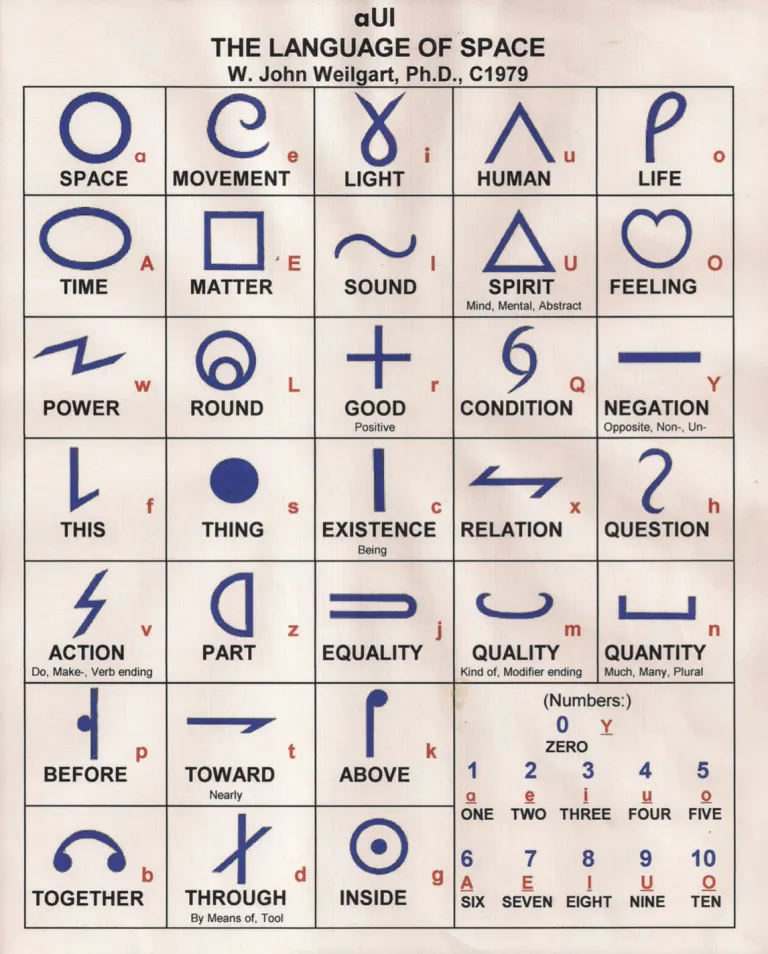
We will find in order:
- the letter in the alphabet aUI
- the value of the morpheme
- and finally the phonetic pronunciation (source : wikipedia)
a : space /a/
e : movement /ε/
i : light /ɪ/
u : person /ʊ/ (* I remove the notion of “human”, after all we talk about the language of space)
o : life /ɔ/
A : time /ä/
E : matter /e/
I : sound /i/
U : mind, spirit, idea /u/
O : feeling, sens, sensation /o/
w : power, capability /w/ (* addition of the notions of power and possibility to confort the intention of the author that we can found in certain words)
L : round /l/
r : good, positive /ʀ/
Q : condition /œ/
y (or Y) : negation/opposite [of the next letter] /y/ (* adding the notion of “opposite”, because to speak negatively is really meaningful …)
f : this /f/
s : thing /s/
c : existence, exist, being, be, true/ʃ/ (* addition of the notion of “truth”, implicit in the notion of existence and being, but it is better to say it)
x : relation indication /x/
h : question mark /h/
v : action, do, active /v/
z : part /z/
j : equal /ʒ/
m : quality [of the previous letter] /m/
n : quantity, plural /n/
p : before, in front, begin/p/
t : toward /t/
k : above, high up, supreme /k/
b : together, with /b/
d : through, by means of, tool /d/
g : in, inside, container/ɡ/ (* I precise the “container”)
0 : 0, nothing, empty /y/
1 : 1 (1) {a}
2 : 2 (2) {e}
3 : 3 (3) {i}
4 : 4 (4) {u}
5 : 5 (5) {o}
6 : 6 (6) {A}
7 : 7 (7) {E}
8 : 8 (8) {I}
9 : 9 (9) {O}
10 : 10 (10) {U}
* The pronouns
We start with the pronouns first, and I will immediately change one of the fundamental rules in aUI…
- fu : this - person ⇒ I, me (convention, because technically it could be “person this one” which means someone else than the speaker … it corresponds to the notion of he/she in my opinion)
- bu : together, with - person ⇒ you (rather logical convention that designates the person who is with the speaker “person with [me]”. This interpretation of the “b” is quite common)
- vu : action, do - person ⇒ he/she (convention already adopted originally for the pronoun “he”, I prefer to generalize it for me in the case of “she” / moreover, I find that it corresponds more to the active subject of a sentence … and therefore to the concept of “I”)
Personally, I prefer to invert “vu” and “fu” we will have:
vu : I, me “active person” the speaker
bu : you “person with [me]”
fu : he/she “person this”
For the rest of this document I will apply this rule.
Construction of simple words
Each letter is in itself a concept and therefore a word. We simply build more complex words from the basic concepts by keeping a reading order going from right to left.
I have a Tokiponist approach to understanding a word in aUI. I do not try to translate a word by a French or an English equivalence. Words sometimes have a very clear meaning, and at other times contain an intrinsic ambiguity that can only be lifted by the context.
And here is a list of quite simple words (I do the decoding from right to left):
- fa : space - this ⇒ here (space that is specified as this one)
- fA : time - this⇒ now (time that is specified as being this one)
- ga : space - in, inside, container ⇒ a room (“A space with an interior / a space in a container”, the translation by “a room” is quite conventional, because after all this could be “a box” …).
- uga : space - in, inside, container - person ⇒ house (by convention, it is the definition of this word by the author of the language, but etymologically it could also be a coffin … because it means “space [in a] container [for] a person”)
- iO : feeling, sens, sensation - light ⇒ the feeling of light ⇒ the view
- iOz : part - feeling, sens, sensation - light ⇒ part [allowing] the feeling of light ⇒ the eye
- IO : feeling, sens, sensation - sound ⇒ feeling of sound ⇒ hearing
- IOz : part - feeling, sens, sensation - sound ⇒ part [allowing] the feeling of sound ⇒ the ear
- na : space - quantity, plural ⇒ large space ⇒ big or large, in the sense of “occupying a lot of space”.
- UI : sound - mind, spirit ⇒ sound that makes sense ⇒ word or language (see aUI)
- yi : light - opposite of ⇒ opposite of the light ⇒ darkness (we note here that the opposition applies on the letter to its right)
- yo : life - opposite ⇒ the death.
After this small series, here is a rather complicated word and we will see that it finally has a pretty clear meaning:
- knuwa : space power person in large quantity ⇒ one can understand that one speaks of a powerful place [by] the large quantity of people. Which is not far from the definition of country or kingdom. It is only during the translation that we will put in our language the word that best suits the context.
“Variations”
There is no mention of this approach in the documentation that I have been able to gather. But often a basic concept can be easily extended by adding other roots, here are some examples with “IO” (hearing):
- IOm adj quality of hearing
- IOv v to hear (tIOv to listen)
- IOvu n someone who can hear something (tIOvu a listener)
- IOu n a person who hears (we should perhaps say better “IO-u” and a deaf person would be “y-IO-u”)
- IOd n an earphone
- IOz n a ear
- IOn n a quantity of listening … does not mean much … but why not … We are sometimes in Lojban to define concepts that do not mean much in our human languages ;)
- IOy … opposite of [nothing] — sensation — sound ⇒ does not make sense, “y” can not be placed at the end of a word because it applies to the letter or group of letters to the right, unless we try to say “inactive / opposite perception of sound” which would mean the noise of inactivity?
Tool concept (d)
The notion of tool is characterized by a termination in “d”.
- gad : through, by means of, tool - space - in, inside, container ⇒ “Tool with a space that has an interior / which is in a container” ⇒ box
Plural concept (n)
We will use the letter “n” to specify the multiplicity of something.
- nga : room - quantity of : piece in quantity ⇒ house (this is the official word, but one could be more precise with “bnga” ⇒ “pieces in quantity sets” which corresponds even better to the definition of a house, because the pieces are not in the four corners of the city) (this root “ga” is found in the official dictionary, but other could be used: “uoa” space of life of any person. It depends on the sensitivity of the speaker)
- 2n-bnga : house - quantity - 2 ⇒ “2 houses” (a priori it is admitted that in this case a more condensed form is possible: “2bnga” will be understood in the same way)
- 2n-ga : room - quantity - 2 ⇒ “A 2 rooms” (or in abbreviated form: “2ga”) (to remove any ambiguity about the fact that we speak of a house we can specify “2ga-bnga” house with 2 rooms or “bnga-2ga” 2 rooms of a house.)
- vnu (vu plural form) ⇒ we (several active people)
- bnu (bu plural form) ⇒ you (several people with [us])
- fnu (fu plural form) ⇒ they (several people these)
Enumeration (n.)
“n” followed by a number corresponds to the nth elements of something.
- n2-ga : “the second room”
- n1-fUI : “the first name”
Construction of compound words (-)
The separator “-” is used to associate words together and to clarify the meaning while keeping the direction of reading from right to left.
- iA ⇒ time - light ⇒ day (we will always look for the simplest “rebus solution”)
- yiA ⇒ time - light - negation/opposite ⇒ time - darkness ⇒ dark time (which could be the night or a dark period / here, “y” only applies to “i”)
- y-iA ⇒ (time - light) negation/opposite ⇒ day - negation/opposite ⇒ night (here, “y” applies to “iA”)
- 2n-bnga ⇒ house in quantity 2 ⇒ 2 houses
Relative positions
We use for this the roots “p” “k” “g” “a” “n” and of course “y”.
- pa : space - before ⇒ front
- ka : space - above ⇒ above
- ypa : space - back ⇒ back
- yka : space - not above ⇒ bottom
- g : inside/container (or “ga” espace in
- yg : inside/container - opposite ⇒ outside/surface
- ba : space - with ⇒ near/close
- nba : space - with - quantity ⇒ very near/very close
- ynba : space together in small quantities ⇒ distant
Note that there is no “left” or “right”, in a pinch you could say :
- rba : space together good ⇒ close, but well (at the right distance? to the right?)
- yrba : space together bad ⇒ close, but badly (at the wrong distance? too close? to the left?)
* The names
There is no rule in Dr. Weilgart’s writings for names. Yet this is a pretty important thing in a text. So I make a simple proposal that makes sense: use only possible characters already defined;) The only limitation is therefore the accents or daring of all kinds and I would say that the consonants must all be lowercase even in first position ( only “Q” and “L” are always capitalized).
- Eric : existence, exist, be - light - good, positive - matter ⇒ real light good material ⇒ what would give something like: “the real good light embodied” …
The official word for “name” is “fUI” (see the dictionary). “UI” as we have seen means “word” or “language”, “fUI” means “word this one” which allows to highlight it. The name is an important word (see “n1-fUI” that we saw earlier). One may prefer “pUI” for “word of front” or “upUI” for “word of front of person” which corresponds better to the notion of “firstname”. In the same way, one could also decline by “ypUI” or “uypUI” for “person’s back word” and thus specify the “lastname” of a person in some way.
Get ebrulato’s stories in your inbox
Join Medium for free to get updates from this writer.
In order not to confuse a name with a word one could postfix with “pUI”: “Eric-pUI” (firstnamed Eric) or “fUI”: “Eric-fUI” (named Eric).
Adjective (-m)
We add the ending “m” (quality) to transform a word into an adjective.
- om : quality - life ⇒ living
- yom : quality - life - opposite ⇒ death
- riOm : quality - feeling - light - good” ⇒ beautiful
- Eric-pUIm ⇒ firstnamed Eric
- vum (vnum) ⇒ my (our)
- bum (bnum) ⇒ your (your)
- fum (fnum) ⇒ his/her (their)
Question (h)
The term “h” can be used to specify that what is on the right is a question.
- hu : person - question mark ⇒ who?
- hs : thing - question mark ⇒ what?
- hA : temps - question mark ⇒ when?
- ha : space - question mark ⇒ where?
- xu (or Qu) : person - relation indication ⇒ it is a strong anglicism, which means “person who is in relation” which corresponds to the notion of “which?”. (In French we may prefer the notion of “qu” which means something like “person condition” “which one” “lequel ?”.) These structures have a kind of incompleteness hence the underlying notion of questioning.
- hbnga : which house?
- sh : question mark - thing ⇒ a question.
* Yes & No
To express yes, 2 roots are very practical: “r” good, positive and “c” real, truth. If it is in answer to a question one can also imagine the classical Anglicism which consists in taking up the verb… Also it would give:
- “c” true / yes, “rc” really good / positive, “Ur” good / positive thoughtful, “Or” good / positive emotional … and for those who have a twisted mind kneaded with Boolean logic: “yy” (opposite of negative) ;)
And for no we will have the following opposites:
- “y” negation, “yc” false / no, “ryc” absolutely not good / positive, “yrc” really wrong, “Uyr” bad / negative thoughtful, “Oyr” bad emotional …
Verbs (-v)
We simply add the ending “v” (action, do) to the end of a word to turn it into a verb:
- iOv : action, do - feeling, sens, sensation - light ⇒ to see (could be translated by “to use the sense of sight”)
- IOv : “to use the sense of hearing” ⇒ to hear
- ov : “to use the life” ⇒ to live
- riOv : “to make the beauty” ⇒ to beautify
- yov : action, do - death⇒ “to use the death” ⇒ to die
- pUIv : action, do - firstname ⇒ “to give/make a firstname [to someone]”
not to be confused with:
- viO : feeling, sens sensation - light - action, do⇒ “seeing active” ⇒ a show, something which can be seen.
- vyo : a murder more precisely a death to do. If we want to clarify that it is the life of a person, we could say “u-vyo”, because “vyuo” means the life of a non-person to be made … to give birth to an animal?
And we can imagine weird verbs like
- IOzv : “use the ear” ⇒ prick up one’s ears?
- bu-iOv : “to see you” (the translation is better in French)
Transitivity
To indicate that a verb has an impact by transitivity on something:
- ev : “to make movement” ⇒ to move (the subject is moving)
- vev : “to make a movement to do” ⇒ to move something by transitivity. eg driving a car: “ged-vev” containing moving tool - moving by transitivity ⇒ driving (a vehicle).
Conjugations
Future (-tAv)
Just finish the word with “-tAv” (action - time - toward) which makes it possible to specify that the action takes place in the future.
- yov ⇒ yo-tAv ⇒ to die conjugated to the future
- vu yo-tAv ⇒ I will die
Past (-pAv)
Just finish the word with “-pAv” (action - time - before) which makes it clear that the action takes place in the past.
- yov ⇒ yo-pAv ⇒ to die conjugated to the past
- vu yo-pAv ⇒ I died / I was dying
Imperative (-rv)
Terminate the word with “-rv” (action - good) which makes it possible to specify that the action is good to do, which is an acceptable approximation of the notion of imperative ;)
- orv ⇒ live! (more fun than “yorv” ⇒ “dies!”)
Passive (-yv)
A very Anglo-Saxon form, the passive is described in the last sheet of Dr. Weilgart which I have: we have “v” ⇒ “active” and thus “yv” ⇒ “not active” but with a termination in “v” which indicates well a conjugation where it would be the complement which would be the main actor of the verb (a kind of inversion of the subject with the complement as with the use of “se” in Lojban). This gives for example:
- brOv : “Action to feel good with [someone]” ⇒ to like
- vu brOv bu ⇒ I like you
so we have,
- vu brOyv [Ud] bu ⇒ I am loved by you (In the original text we see the use of the particle “Ud” (by in English). I think that the “passive” indication is good enough to reconstitute the idea expressed without overloading it with this particule.)
- vu fUIyv Eric ⇒ I am named Eric
* Verb to be (-c)
The documentation on this subject is rare, so I propose the following approach : put “c” at the end of a word for the forms “to be something”.
- yoc : death - existence, exist, being, be ⇒ to be dead
- riOc ⇒ to be beautiful
- fUIc ⇒ to be named / called (vu fUIc Eric ⇒ I am named Eric)
- brOc : to be loved
- bac : to be close
I found on the net a reproduction of pages 24 & 25 of Dr. Weilgart’s book where he uses the verb “c” which approaches my understanding.
Simple sentences
The basic structure of each sentence is SVO : “Subject Verb Object”. Here are some simple sentences based on the previous vocabulary:
- vu iOv bu ⇒ I see you (we could have used here “fu bu-iOv” which is closer to the French version)
- vu upUIc Eric ⇒ I am named Eric
- vu iOv IOv ⇒ I see and hear (not necessarily necessary to repeat the subject)
- vu iOv b vu IOv ⇒ I see and I hear (seems to be the same as the previous one, but It sound odd for me)
For ease of understanding, the subject should be placed at the beginning of the sentence before the verb(s).
* Subordinate proposals (px [ypx])
If we want to use a subordinate sentence “I see you, you whose named marie” we could say “vu iOv bu, bu upUIc marie” but I think that we must be able to specify that it is a sub-sentence to specify “bu”. Also, I propose the px rule:
- px : indicates the beginning of a precision in relation to the word before. If there is a conjugated verb in this clause, the word before may be the subject. If the sentence begins with this marker, then the clause concerns the whole sentence and allows to specify a global context. “px” means begin relation and acts as the opening of a parenthesis.
- ypx : allows to indicate the end of the subordinate sentence. This marker can be ignored if it is the end of the sentence. “ypx” means end relation and acts like closing a parenthesis.
vu iOv bu px fUIc marie. ⇒ I see you, who is named Marie.
vu px fUIc Eric ypx iOv bu. ⇒ me, who is named Eric, I see you.
A phrase like “I’m talking about your name and you do not listen” would be classically of the form:
vu tUIv bu bum fUI b bu y-tIOv.
English would certainly add the words “to” (at) and “about” (UL) to clarify the context, but at the same time it requires the use of multiple linking words that complicate the communication for those who are not english spoken … This would still give:
vu tUIv ta bu UL bum fUI b bu y-tIOv
With the px rule, we have:
- vu tUIv bu ⇒ I’m talking to you (here we see the main verb)
- vu tUIv bu px y-tIOv ⇒ I speak to you who does not listen (we specify what the other person does, the new conjugated verb clearly appears as secondary and associated with the pronoun “bu”)
- vu tUIv px bum fUI ypx bu px y-tIOv ⇒ I speak of your name to you who does not listen.
Note that the word “tUIv” contains a termination “t” meaning “in the direction of”, besides the fact that it implies that the addition of a word such as “ta” is unnecessary because redundant, this verb seems to specify that its complement is necessarily the person to whom we speak and we would have understood that as a result would be the topic of conversation “vu tUIv bu px y-tIOv ypx bum fUI.” would be a pretty valid proposition.
My proposal makes it clear that the subject of conversation “bum fUI” refers to the verb, which removes even better any misinterpretation. It’s a bit, as if we had to think less about how to associate the concepts with each other.
We also could construct a specific verb “talking about your firstname”:
- vu bum-upUI-tUIv bu px y-tIOv. ⇒ I your-firstname-talk-to you who is not listening.
I confess, that here I am inspired by my knowledge in lojban. This mechanism also allows nesting as in lojban.
* Use of adjectives (-m)
Adjectives are added before the words they qualify. There is no detailed rule on the subject in Dr. Weilgart’s writings, so I propose applying a right-to-left approach where the adjective on the left specifies the adjective or the word on the right. This would then give:
- Eric-fUIm vu iOv riOm bu. ⇒ named Eric, I see you, who is beautiful.
- vu iOv marie-fUIm riOm bu ⇒ I see you, Marie the beautiful (but technically “Marie” should specify “beautiful”. The usage of “[I]b” which would give “vu iOv marie-fUIm [I]b riOm bu” is more precise, but at the same time a first name has difficulty to specify an adjective, so my sentence remains understandable)
- vu iOv riOm marie-pUIm bu ⇒ I see you, beautifully named Mary.
- In a more condensed form: “vu iOv riOm marie-pUI-bu” ⇒ I see you, beautiful Marie.
- with one word form : “vu iOv riO-marie-pUI-bu” ⇒ I see you, beautifully named Mary.
- vu riOm iOv marie-pUIm bu ⇒ I beautifully see you Mary (here the adjective applies to the verb)
Well, I confess, here too I have a very agglutinating approach, a lojban way, but I like it, because I find it quite logical with the existing approach with the reading from right to left, and that it allows, by the organization of adjectives, to have a greater range of possibilities, but this can bring some cases a little twisted and need one wording more than another to clarify our thinking.
* Pronunciation
What is certain is that the pronunciation of this language is properly infernal! 2 consonants can easily follow each other, … ok we should get there … but what to do when there are 3! it becomes almost impossible … The rule is often to insert a vowel and the choice is often “u” (in my experience with the dictionary). This is why some words appear unnecessarily very anthropocentric.
Many languages only use consonants. The ancient Egyptian was of this kind, with very few vowels at the base … until the arrival of the Greeks who introduced a whole set of new vowels like the ‘i’ and the ‘o’ of Cleopatra (Kliopadrat) .
Also my proposal is, to include some kinds of “e” between each pair of consonants to facilitate the pronunciation, that would be pronounced like “e” in French for example, while not insisting too much. It may also be simply saying the consonant slightly differently.
rwevu ⇒ rewevu
Vocabulary
The idea here is to study some vocabulary to better understand what the rules of the game of this constructed language might be.
The planets
- ki : “Light in height” ⇒ a star? the sun ? the moon ? a planet ? a bright spot on the ceiling? by default we will retain the term star (because this is the best solution in nature.)
- eki : “Moving light in height” ⇒ “moving star” ⇒ planet
- ne-eki : “A star whose movement is in quantity” ⇒ comet or shooting star
- n1-eki : “First planet” ⇒ Mercury
- n2-eki : “Second planet” ⇒ Venus
- n3-eki : “Third planet” ⇒ Earth
- …
- n9-eki : Well no, it does not exist any more :D Pluton is a dwarf planet which is said “yna-eki” for “little planet”
The senses in aUI
- iO : the sight (perceive the light)
- IO : hearing (perceiving sounds)
- EO : the sens of touch (perceive the matter)
- gO : taste (inner perception)
- kEmO : smell (perceive the quality of what is above the matter, therefore the air and its smells and … its temperature)
The “elements” (Em)
Not very scientific, but practical to talk. It also helps to better understand the structure of certain words and the choices made to represent these concepts as closely as possible with the available roots.
- iE : fire (matter light)
- kEn : air (quantity of what is above the material / kE will be the notion of gas only)
- bEn : the earth (amount of matter together is a convention for the “earth” / bE corresponds to the notion of solid)
- jEn : water (quantity of equal matter / jE corresponds to the notion of liquid)
Durations, days of the week and months
- iA : the day
- iAz : a hour (a part of a day) So it introduces the notion of night time :P with: “y-iA-z”
- iAz-Az or iA-ynz : one minute (part of a day party or a small day party) (officially it’s “ziAz” which I do not understand the first “z”, because in french we don’t say “a day party” but “a part of a day”… and “a part of a part of a day” and so on. As I have introduce that the reading of a word is always from the left to the right then the notation “iAzAz” is more logic and less Englishy :). But my opinion is that the best word is “iA-ynz”)
- iAz-Az-Az ? : a second (I would have said “iA-ynz” as a minute … or at least iA-yknz a low amount part [the smallest] day) (officially it’s “ziAynz” but it have no sense for me. My opinion is that we don’t have to talk about “second”. If you want to talk about a short instant you should say “Aynz”)
- n1-iA : monday (first day)
- …
- n7-iA : sunday (seventh day)
- kniA : summer solstice (the longest day)
- ykniA : winter solstice (the shortest day)
- 7iA : week (“7n-iA”)
- n1-ki or knki : the sun (the first light from above or the very great light from above) (officially it’s “1ki” but it can easily be confused with “1n-ki” a light from above)
- n2-ki or ynki : the moon (the second light from above or the little light from above)
- ynki-A : a month (1 lunation)
- 3-ynki-A : a quarter(3 lunations)
- 6-ynki-A : a semester (6 lunations)
- n1–ynki-A : January
- …
- n12-ynki-A : December
- ki-A : a year
- 100n-ki-A : a century
Conclusion
I think I have, for the most part, completed Dr. Weilgart’s exercise, and I wonder what he would have thought about this approach, tinged with Toki Pona and Lojban :).
As Dr. Weilgart says, this is a game/exercise that can be adapted to your rules, which I did not deprive myself of, but without distorting the language itself. I just tried to to put a little more logic, and an existing reader may read my new interpretation of this language. I hope this will give you some ideas about this language built quite old but which reveals quite a good surprise. If you have constructive criticism I am at your disposal.
I also advise you to read my articles about aUI: aUI 2 Toki Pona which describes how we could translate the aUI basic roots into toki pona. I am writing another post “Toki Pona 2 aUI” which is exactly the opposite: my goal is to have an idea of the flexibility of this language with the very useful word corpus of toki pona.
References
- http://webpages.charter.net/languageofspace/ ancient official site (?). It presents pretty well the language but contains a lot of errors (some letters are incorrect)
- https://auilanguage.org/ : other official website? it is also made with an old design and works very badly. We will find an interesting page where we have the pronunciation of the different letters: https://auilanguage.org/modules/elements-of-meaning/
- http://aui.webonary.org/ a dictionary of 7000 words … but many are pretty far-fetched as we say here (in France). I’ve use it to learn aUI.
- wikipedia : as usual, full of intel, but a lot of inaccuracy if we dig this topic.
- FrathWiki : a wiki with resources in French
- https://www.anomalist.com/reports/language.html a criticism of the aUI language
- https://imgur.com/a/Y5MvX : W. J. Weilgart’s post about the aUI language, where he is describing his therapeutic usage of it (see below)
Dr W. J. Weilgart’s post
We learn that he invented this language when he was a child (really?) and uses it, adult, in a therapeutic use. This document seems interesting to me because it gives many elements that one does not find otherwise and gives interesting perspectives on the system of sign. Personally I like the idea of playing with the graphics of the words moreover if each letter has a strong meaning. I have not written any text with these glyphs yet, and I admit not to find them very aesthetic.