Am I Crazy, or Is the Rest of the World?

Did you watch the movie 2012?
The horrific floods. The avalanches. The gut-wrenching images of an apocalyptic world collapsing around people.
Now pan to Nepal, August 26.
In the blink of an eye, people were swept away. Entire villages disappeared. Thousands of people are missing. Hundreds are already dead.
It looks like a scene from a movie.
But it isn’t.
It is happening in Nepal.
A small, landlocked country that barely has time to recover from one disaster before another one strikes. A country that has contributed so little to the climate crisis yet is increasingly exposed to its consequences.
This isn’t the crazy or the sad part.
You know what is?
People are still in denial that climate change is happening.
What will it take for you to believe it?
Are you waiting for it to reach your own doorstep? Are you waiting to lose someone you love? Is that when you will finally believe that climate change is happening in real time?
How many more lives will it take before you take action?
And by “you,” I mean every person who still refuses to believe what is happening right in front of us.
How much more will we consume before we admit that someone else is paying the price?
How much more do we need to lose before enough is enough?
What’s happening in Nepal is just one small example.
This is happening to so many countries, especially small and vulnerable countries, in real time. I am sure someone, somewhere, died today because they didn’t have enough food to eat. Because it was too hot. Because it rained too much. Because their crops failed. Because they had nowhere to go.
Every year, we say, “This was the hottest year on record.”
The most rainfall on record.
The most snowfall on record.
As if breaking another record is something to celebrate.
But do you know what a record-breaking heatwave actually means for someone living in poverty?
It can mean death.
It can mean crops dying and a family losing its only source of income. It can mean being forced to leave your home because the place you grew up in is no longer livable. It can mean not being able to afford a fan, let alone air conditioning, while temperatures keep climbing.
And what does record-breaking rain mean?
Among many things, it means floods.
And what do floods do?
They destroy homes. They destroy crops. They wash away roads. They separate families. They take lives.
Climate change is not a number on a graph. It is not a record we announce at the end of the year. It is someone’s home. Someone’s livelihood. Someone’s child. Someone’s life.
Get EcoEcho: Chronicles of a Changing Planet’s stories in your inbox
Join Medium for free to get updates from this writer.
And sitting in front of a television, feeling sorry for people in these “poor countries,” and praying for them is not going to fix this.
They don’t need our pity.
They need us to act.
And I know what you might be thinking. “What can I do? I am just one person.”
I understand that feeling. I feel it too.
I am sitting thousands of miles away from Nepal, watching videos of places I know disappear under water. Places that look familiar. Roads I have travelled. People who speak my language. And all I can do is watch.
It makes you feel small.
But maybe that is exactly where we have gone wrong. We have made climate change feel so enormous that we have convinced ourselves that nothing we do matters.
Meanwhile, the people who have the most power to change things keep asking ordinary people to recycle their plastic bottles and turn off the lights.
Yes, individual choices matter. But they are not enough.
We cannot recycle our way out of this. We cannot plant enough trees to compensate for endless extraction. We cannot ask people living in poverty to adapt to conditions they did not create while the rest of the world continues to consume as if there are no consequences.
And this is where climate change becomes more than an environmental issue.
It becomes an issue of justice.
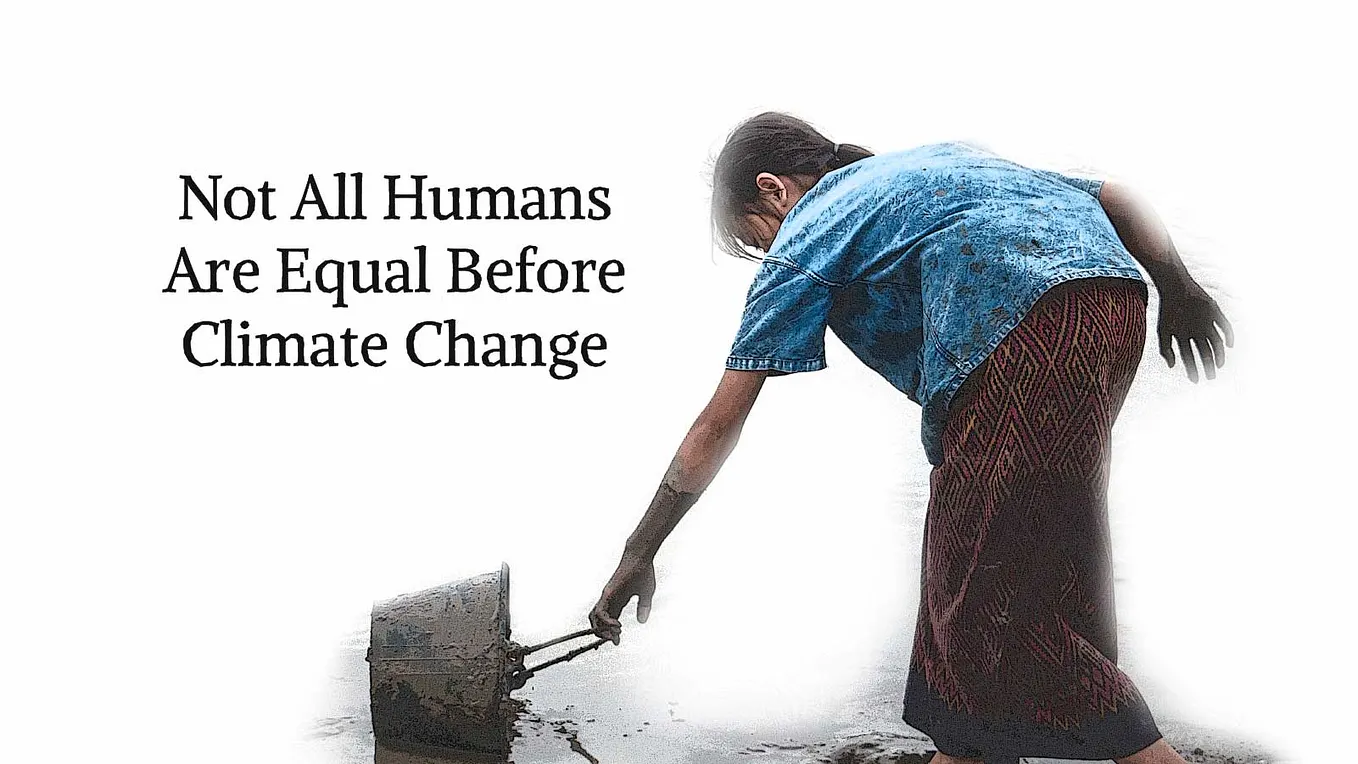
Because the people who contributed the least are often the ones standing in the floodwater.
The people who have the fewest resources are the ones rebuilding their homes.
The people who have done almost nothing to create this crisis are being asked to adapt to it.
And the rest of us?
We watch.
We donate when we can.
We share the heartbreaking pictures.
We say, “How terrible.”
And then we go back to our lives.
Until the next disaster.
Until the next record-breaking temperature. Until the next country disappears from our news cycle. But what happens when the disaster is no longer somewhere else? What happens when it reaches your doorstep?
Because that is the question I cannot stop thinking about.
Maybe I am crazy. Maybe I am crazy for being angry about something that doesn’t affect me directly today. Maybe I am crazy for looking at a flooded village in Nepal and seeing something bigger than one disaster. Maybe I am crazy for believing that what happens to a farmer in Nepal will eventually matter to someone sitting comfortably somewhere else.
Or maybe I’m not crazy at all.
Maybe the crazy thing is watching people lose their homes, their families, their livelihoods, and still convincing ourselves that this is someone else’s problem. Maybe the crazy thing is knowing what is happening and choosing not to act.
Because climate change does not need your belief.
It is happening whether you believe in it or not.
The water does not care.
The heat does not care.
The storms do not care.
And neither will the consequences when they finally reach your doorstep.