California Schools are Sanctuaries (CASAS)
What does it mean to be a Sanctuary School?


Growing up in the early 1990s, I remember many classmates coming and going. Once I started to be friends with someone it seemed that they were getting ready to leave. Since Spanish was my first language, in the beginning I was limited to English as a Second Language (ESL) classes and friends.
“Where is Ferny?”I still remember asking my teacher Ms. Ring in second grade. At the time, I didn’t know why this was happening and it was only much later that I learned that many kids, like Ferny, either got deported, one of their parents were deported so they had to move and change schools to accommodate the lost income, or in some cases they left to their parents’ homeland.
I didn’t understand for a long time. On the television, politicians debated over immigration bills. Although I knew very little about politics I understood that the passing of California’s Proposition 187 in 1994 was a bad thing for much of my family in the United States. Prop 187, signed by Governor Pete Wilson, signified the start of a new anti-immigrant era in California and the U.S. that would later usher in the passage of the “1996 Immigration Reform Laws” that expanded the powers of the immigration detention system. The anti-immigrant discourse that Trump tapped into to win the 2016 presidential election and that his administration is now basing its policies on is a product of more than three decades of political actions and debates that have focused on criminalizing immigration.
The counter-movement to the anti-immigrant campaign has been slow in arriving, but its growth has made it easier to pass governmental policies that were not possible three decades ago. In 2006, I was the president of a club at Santa Monica College called Latino Student Union (LSU) and we organized members to take part in ‘La Gran Marcha’ in which around one-million people gathered in downtown LA to protest what was thought of as a discriminatory bill, HR 4437. Although the movement did die down quite a bit after, the message was loud and clear: the people wanted progressive policies in California.

Everything was not easy though. That same year, in 2006, Los Angeles charter school Semillas was threatened with a bomb by a conservative-right wing Minute Men group bent on stopping anyone who defied assimilation into the U.S.’s anglo-white culture. As one report recalls:
“For a month, KABC in Los Angeles had focused an unrelenting attack against the school — Academia Semillas del Pueblo. KABC at the time was an ultra-right talk radio station that carried Bill O’Reilly and Sean Hannity, one that specialized in xenophobia and a thinly disguised hate-talk format aimed at the paranoids who think George Bush is a sell out liberal and who accused Sen. James Sensenbrenner of not going far enough to rid the nation of Mexicans and other descendants of the indigenous peoples of North and Central America. Let’s make it plain: these are minutemen with microphones, and with the billion-dollar backing of Disney” (Santos).

In a time of xenophobic rhetoric and sentiments of “America First,” Semillas Community Schools fought for the right to be an indigenous based school with indigineous knowledge in the U.S. The organization created a space that was missing for many in the community of El Sereno, located in north-east Los Angeles. Semillas students learn, through Nahuatl classes and Danza Azteca, as well as other indigenous based rituals and activities, the importance of indigenous curriculum which is not readily available at regular public schools throughout the country. As Semillas’s mission statement reads:
“Semillas Sociedad Civil is an indigenous community-based nonprofit organization that organizes youth, parents and educators to advance self-determination, sovereignty and human rights as Indigenous Peoples through autonomous education and advocacy.”
Since its inception, Semillas has been threatened by people who view the school’s autonomy as problematic. In reality, Semillas Community Schools provides a space for people to learn about the lost history of Nahuatl Mexica people in the U.S. and Mexico. Its conscious-building curriculum prepares students to face the realities of society and at the same time it provides students with the tools for them to be able to organize in their community for advocacy in social justice issues.
Enter Me

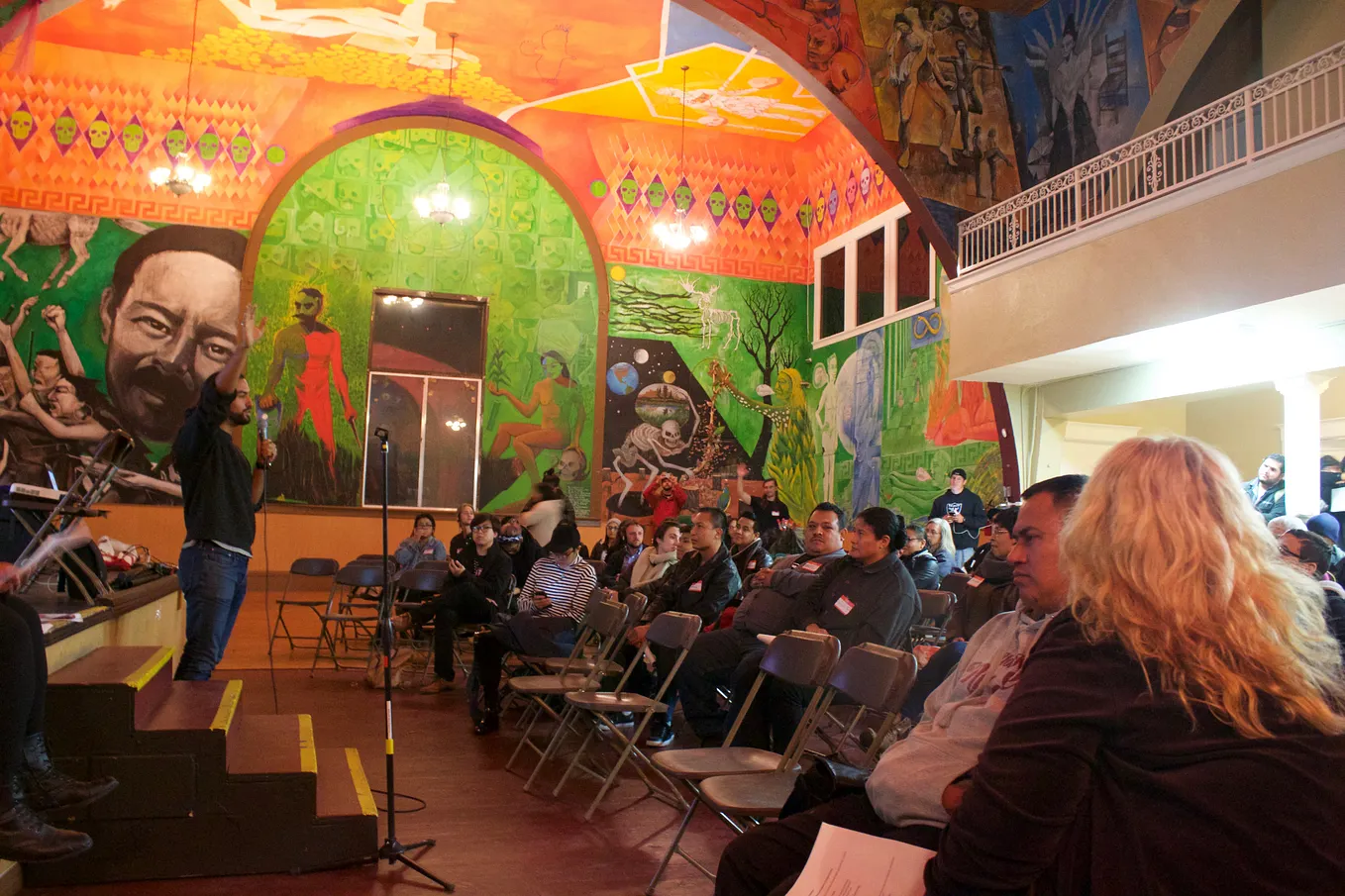
In April of 2017, I had just gotten hired at Semillas Community Schools as an Administrative Assistant with very little practical knowledge and tons of grad school loan debt. Mr. Marcos Aguilar was a seasoned veteran who was heading the meeting between various heads of organizations to organize a coalition to combat the detention of parents and students from K-12 schools in the Trump era. It was intimidating to say the least, to have that many people in one room who could easily have contributed so much to the immigrant movement in Los Angeles. My experience could be compared to an intern’s first day on the job trying to keep composure; although there were no Hollywood names present, I was still in shock.
Several weeks later, LAUSD and then the state of California publicly announced that schools were not places where ICE could arrest and detain people. Thinking back at that day and meeting, I can truly say that I was humbled by the opportunity to just be in that moment and so I naturally sought to write about it, but could not find my voice for months. Different questions popped up in my head:
Get Eduardo Coronel’s stories in your inbox
Join Medium for free to get updates from this writer.
Who should I mention? Who should I not? Is this story even mine to tell? Do the students appreciate what was done for them? Who benefits from this action? It was overwhelming to say the least, knowing that social justice prevailed in the end with the help of everyone in CASAS.
Through organizations like Semillas Community Schools, the ACLU, NCLR, NDLON, and Advance Charter Schools, people’s rights are being defended, in the sense that immigration officials can not just enter schools and detain people because of their immigration status. The members of this broad-based coalition known as California Schools Are Sanctuaries (CASAS), have one thing in common: they believe that education comes first above a persons immigration status. The model for becoming a Sanctuary School was provided by the ACLU. ACLU of California’s director of education equity Sylvia Torres-Guillén says that within a Sanctuary school:
“Every student deserves an equal and equitable educational opportunity. This right applies to students of all races, ethnicities, religions, and immigration status.”

It is true what they say about history; it’s a culmination of moments that shape one event. In the case of CASAS, it could be said that the past three decades of fighting anti-immigrant organizations has led to its formation. CASAS is a broad-based coalition comprised of community-based organizations, public school leaders from traditional and charter schools, and civil rights and immigration advocates fighting to ensure the safety and security of immigrant students. The coalition was formed shortly after ICE agents took parent Romulo Avelica-Gonzalez into custody, when he was dropping off his daughter at Academia Avance in Highland park in March of 2017; Avelica-Gonzalez had lived in the U.S. for more than 25 years (Castillo). Since then, CASAS has pushed for LAUSD schools to be considered “Sanctuary Schools,” a space of safety, so that students do not have to worry about getting deported or having their parents deported when entering a public or charter school in LAUSD. As the second largest school district in the nation, it is an important step for many families in Los Angeles county and it sends a strong message to the Trump administration that ICE does not belong in our schools.
On May 9th 2017, the Los Angeles Unified School District voted unanimously to make all LAUSD schools a safe space from Immigration and Customs Enforcement (ICE) officers. LAUSD Board Member Monica García said:
“We need to ensure we are doing everything we can to support every student there, and that means standing up for them and their families when they feel they are under threat.”
ICE released a statement in response to the so-called sanctuary resolution, which states in part: “Concerns about possible U.S. Immigration and Customs Enforcement (ICE) operations occurring on school property are unfounded” (CBS Los Angeles). As a sanctuary site, LAUSD schools are now required to withhold student-parent information that could potentially lead to a deportation. The status of a Sanctuary School to an LAUSD school is much more than a badge of honor; it insures that both parents and students are able to walk onto school and not feel threatened by immigration agents. This policy means that students can worry more about their education rather than deportation.
The future of immigration policy is yet to be unveiled, but the counter-movement is building and states like California are leading the way. It’s more important now than ever for us to lead the way for youth who are coming of age in an era in which hate trumps love — but we can change that.

All photographs by author Eduardo Coronel, a writer in Los Angeles.
References
“LAUSD Board Votes to Pass a Binding ‘Safe Schools Resolution for Immigrant Students and Families: Broad-based Coalition of Community Groups and Public Schools Pressed for the Action.” American Civil Liberties Union, May 9, 2017.
Castillo, A. “Immigrant arrested by ICE after dropping daughter off at school, sending shockwaves through neighborhood.” Los Angeles Times, March 3, 2017.
“LAUSD Votes To Prohibit Releasing Immigration Status On Students And Family.” CBS Los Angeles, May 9, 2017.
Rodriguez, G. Reaffirmation of Los Angeles Unified School District Schools as Safe Zones for Families Threatened by Immigration Enforcement. LAUSD Resolution Meeting, Los Angeles, CA, May 9, 2017.
Santos, J. “Minutemen Target Children: The Attack on Academia Semillas del Pueblo.” Los Angeles Indy Media, June 7, 2006.
“Mission and Vision Statement.” Organizational Statement, Semillas Community Schools, 2017.
Wick, J. “LAUSD Board President Steve Zimmer answers questions at a November press conference.” LAist, May 9, 2017. Los Angeles, CA.