Edgar Fouche and the Triangles

The Case for Reverse-Engineering Success — Part 2

In Part 1 of this series , I introduced a question that divides even insiders: whether elements of the U.S. defense establishment successfully reverse-engineered non-human technology. The first case (in which an industrial designer, Brad Sorensen, described disc-shaped craft at a classified aerospace exhibition) proved stubbornly difficult to explain away. If the Sorensen interview is a clean and contained piece of evidence, the next case we’ll examine, that of Master Sergeant Edgar Fouche, is messier and more sprawling. It is also, in certain respects, harder to dismiss than you might expect from a man who gave UFO conference presentations, co-wrote a novel called Alien Rapture , and was once caught on a secretly recorded video appearing to admit the whole thing was a lie.
Stay with me.
The Man
Edgar A. Fouche was a United States Air Force Master Sergeant who served from the late 1960s through the early 1980s , followed by roughly eight years as a defense contractor . His military career began with intelligence communications and cryptological training during Vietnam . He was subsequently assigned to a series of bases — Edwards AFB, Nellis AFB, and Kadena AFB in Okinawa — working on avionics, electronic countermeasures, and classified test equipment for aircraft including the F-111, the F-15, the A-10, and the B-1 .
This much is not in dispute. When skeptics filed Freedom of Information Act (FOIA) requests to debunk Fouche’s credentials, the documents that came back matched what Fouche himself had been showing people for years. His AF Form 77 confirmed his assignment to the 57th Component Repair Squadron at Nellis . His records showed assignment to Det-3 AFFTC — the Air Force Flight Test Center detachment responsible for operations at Groom Lake, the facility inside Area 51. Fouche also claimed to have worked at a facility he called the Defense Advanced Research Center, or DARC, which he described as a ten-story underground laboratory near Papoose Lake, south of Groom . A declassified ARPA historical study , unearthed by researcher UAP Gerb , references the Defense Advanced Research Center by name as a proposed DOD institution linked to advanced aerospace projects (although it does not confirm the existence of the facility). In 1998, at the International UFO Congress in Laughlin, Nevada, Fouche showed approximately 200 military and contractor documents to representatives from MUFON and other investigators.

So: a real military career, real assignments to real classified facilities, and real expertise in the specific kinds of avionics and electronic systems that populate the world of black programs. Whatever else you think of Fouche, he did not invent his military background from scratch.
The Claim
The TR-3B, as Fouche described it, was 600 feet across in its operational version . Its defining feature was a circular plasma-filled accelerator ring, the Magnetic Field Disruptor, that ran around a central crew compartment. This ring contained mercury-based plasma, pressurized to 250,000 atmospheres, supercooled to 150 degrees Kelvin, and spun at 60,000 rpm . The effect, Fouche claimed, was an 89% reduction in the apparent mass of everything within the ring ; not anti-gravity in the propulsive sense, but a dramatic lightening of the vehicle that allowed conventional rocket thrusters mounted at the triangle’s three corners to move it with extraordinary agility. A craft that should weigh hundreds of tons could be pushed around like a sports car.

Fouche was explicit that this was reverse-engineered technology derived from studying recovered non-human craft and that the circular accelerator was essentially a partial reproduction of the disc-shaped vehicles’ propulsion, bolted into a triangular airframe because the full capability couldn’t be replicated.
The Details
Listening to Fouche is a very different experience from reading the Sorensen interview. Where Sorensen is reluctant, terse, and impatient to get to the bank, Fouche is expansive, anecdotal, and clearly enjoying the stage. He tells jokes and name-drops. He plugs his book and his “neurosync” behavior modification software. If Sorensen’s credibility comes partly from his obvious discomfort with the subject, Fouche’s presentation style sets off every alarm you’d expect.
And yet.
Threaded through the showmanship are details that have the same stubborn quality as Sorensen’s landing gear and carbon smells — details that cost nothing narratively but ring with the specificity of lived experience.
Take the goggles, for instance. Fouche describes being issued restrictive eyewear at Groom Lake that he compares to welders’ goggles: polarized lenses, no peripheral vision, everything past 30 feet blurred to uselessness. He says wearing them made him nauseous. He comes back to them multiple times throughout the presentation, with visible irritation, and issues a challenge: anyone who claims to have worked at Groom should be asked about the goggles, because “no matter how much technology you work, how many times you talk to people, you forget things, but you never forget discomfort.”

This is the kind of detail that sticks. It’s Sorensen’s asbestos-coated landing gear in a different register: mundane, sensory, narratively useless, and therefore difficult to explain as fabrication.
Similarly, his description of the bus ride to Groom — blacked-out windows, two security police with M-16s, the fine silted dust seeping in through the window seals as they drove into the desert, a single instruction (“ do not speak “) — has the compressed sensory precision of a real memory. You can almost taste the dust.
He describes finding, inside a satellite communications bay at Groom, a sealed unit labeled “ Direct Orbital Communications Link “ containing integrated circuit chips running at 1 billion cycles per second. At that time, the commercially available Cray-1 supercomputer ran at 80 million clock cycles per second -well below the billion-cycle speeds Fouche claimed to have encountered. He says he measured the clock speed himself with a frequency counter through a synchronization jack on the back panel . This is an oddly specific and verifiable kind of claim: either the BNC connector was there and labeled, or it wasn’t. It’s the sort of detail a technician remembers because it floored him professionally.
Secondhand Sources
Here is where Fouche’s case diverges fundamentally from Sorensen’s, and where intellectual honesty requires a downgrade in evidential weight. Sorensen describes what he personally saw, touched, and smelled. The exotic claims in his interview are firsthand observations.
Fouche’s firsthand experience, by contrast, covers the structure of classification: the bus rides, the goggles, the mess hall conversations, etc. When it comes to the TR-3B itself, virtually everything traces back to his “five friends”: Gerald (an NSA investigator, later found dead of a heart attack) , Sal (an NSA electronics intelligence specialist, who broke contact with Fouche after a warning call ), Doc (an SR-71 and test pilot) , Dale (a Vietnam-era friend whose father spent more than 25 years at NSA) , and Bud (a defense contractor engineer, who died of a brain tumor within 30 days of diagnosis) .
These people are identified only by first names or pseudonyms. Fouche says he protected their identities as a condition of their cooperation, and that protecting sources was something he’d staked his career on. He describes refusing a two-star general’s direct order to reveal a Westinghouse engineer’s disclosure rather than break confidence. But the effect is that the most extraordinary claims in his account rest on a chain of trust that the audience cannot independently verify.
Fouche was aware of this vulnerability. He emphasized that he required at least two sources for anything he published, that every one of those sources was someone he or his sources knew personally for fifteen to thirty years, and that he deliberately excluded anyone who hadn’t been vetted through long-standing personal relationships. This is good tradecraft, but it’s also unfalsifiable. You have to take Fouche’s word that these people exist, that they said what he claims, and that they were in a position to know.
The Controversy
The case against Fouche centers on three things.
Get Émile’s stories in your inbox
Join Medium for free to get updates from this writer.
First, a video from around 2013, allegedly recorded in secret, in which Fouche, sitting next to UFO researcher Dan Benkert, appears to admit on camera that his story was fabricated. This video, edited by (who runs the “Alien Scientist” channel), was widely circulated as definitive proof of fraud. Around the same time, a researcher named David Hilton, who had filed FOIA requests for Fouche’s military records and initially presented himself as a friend, posted his own video accusing Fouche of faking documents , though the FOIA results he received ended up matching what Fouche had provided all along. Dan Benkert — the man sitting next to Fouche in the recording — later stated publicly that the apparent “admission” was something he himself had asked Fouche to say, in order to provide cover in case they were being monitored. This counter-explanation is itself unverifiable. The original unedited footage has apparently never been released. But there is a further wrinkle: both Hilton and Rys subsequently unlisted and removed their debunking videos from YouTube — an odd move if the case was airtight. And in a 2012 Skype conversation surfaced by Dan Benkert, Hilton made remarks that cast the entire episode in a different light. “ Actually I work for an agency that monitors things ,” Hilton allegedly told Benkert. “ I now control Ed, not you. Funny how things work out, isn’t it. “ If those quotes are genuine, the controversy around Fouche starts to look less like a straightforward debunking and more like something murkier. If they aren’t, they’re just one more layer of noise in an already opaque story. Either way, anyone citing either the video or the rebuttal as conclusive is overstating their case.
Second, Fouche co-wrote Alien Rapture: The Chosen , a novel that embeds his factual claims inside a fictional narrative. He consulted military Judge Advocate General (JAG) lawyers who told him he could write fiction as long as he didn’t name real individuals with real clearances or discuss specific programs he’d personally been assigned to. The novel’s existence gives skeptics an easy frame: he’s a storyteller monetizing his material. This is fair as far as it goes, but the fiction/disclosure hybrid was a deliberate legal strategy, not evidence of fabrication in itself. Fouche also sold a “neurosync” behavioral modification product at the same conference where he presented on the TR-3B, which does not enhance the overall picture of scholarly detachment.

Third, and most substantively: the TR-3B has never been independently documented in any verifiable way. The specific technical claims (mercury plasma at 250,000 atmospheres, 89% mass reduction…) have not been replicated or validated by any known physics. The vehicle remains, after more than two decades, entirely a matter of testimony and elusive sightings.
The Ultimate Question (Again): What Would Have to Be True for Fouche’s Account to Be False?
The falsification test works differently here than with Sorensen , because the structure of Fouche’s claims is different. We’re evaluating a career-long accumulation of secondhand intelligence from named-but-unverifiable sources, presented by a man whose credentials check out but whose presentation style invites skepticism.
If Fouche fabricated the TR-3B entirely , he did so while possessing genuine expertise in exactly the kinds of systems such a craft would require. He embedded his fabrication inside a framework of verifiable career details that have withstood FOIA scrutiny. And he provided technical specifics that are either meaninglessly precise (a hallmark of fiction) or drawn from actual program knowledge (a hallmark of disclosure). The problem is that these two possibilities are genuinely difficult to distinguish from outside the classification barrier.
If Fouche’s sources were real but were themselves misinformed or lying to him , then a group of career intelligence and defense professionals with decades of combined experience in black programs independently decided to feed their trusted friend a consistent, technically detailed, and entirely fictional account of a reverse-engineered triangular spacecraft — and several of them subsequently died or vanished, which is either suspicious or coincidental depending on your priors.
If Fouche was a deliberate disinformation agent (a theory some in the UFO community have advanced) then a government that wanted to conceal the existence of exotic aerospace technology chose to do so by sending a charismatic, verifiably credentialed Air Force veteran to UFO conferences to describe that technology in considerable technical detail, while simultaneously having him sell a novel and behavior-modification software to undermine his own credibility. This is not impossible but it requires a theory of government competence and incompetence operating simultaneously in the same person.
What Are We to Make of This?
Fouche is not Sorensen. His evidence is weaker in almost every respect: secondhand rather than firsthand, presented in a commercial context, clouded by the video controversy, and resting on sources that cannot be checked. If the Sorensen interview is the case you present to a skeptic, the Fouche presentation is the case you present to someone who’s already past the first gate and wants to understand the broader landscape.
What makes Fouche worth including is the convergence. Here is a man with verified access to classified aerospace facilities, describing a reverse-engineering program that produced a triangular craft using partially replicated non-human propulsion technology, and his account, developed independently through an entirely separate network of sources, dovetails with Sorensen’s in its broadest strokes. Both describe recovered non-human technology and reverse-engineering success. And both place the programs within the classified ecosystem of the U.S. Air Force and defense contractor ecosystem, with the same general geographic nexus: Nellis, Edwards, Area 51, and Plant 42.
Where they diverge is also interesting. Sorensen describes disc-shaped craft that appear to fully replicate the original technology. Fouche describes a triangular craft that represents a compromise: the propulsion principle partially reproduced but bolted into a conventional airframe because the full capability couldn’t be achieved. These can be viewed as complementary accounts, describing what might be different stages or branches of the same program.
Corroboration
There is also a corroborating thread that runs entirely outside Fouche’s network. In 1992, illustrator and forensic reconstruction artist Bill McDonald met with four engineers — two from Northrop, two from Lockheed — at a Denny’s in Antelope Valley, California. All four were frustrated by the security constraints governing their work and wanted their story told. Between them, they described a reverse-engineered triangular craft they called the XF-131 Super Sentinel, developed at facilities including Lockheed’s Helendale plant and Northrop’s Tehachapi Ranch . Both were in the same high-desert corridor as Edwards and Plant 42. McDonald, who has maintained the testimony was genuine , produced a detailed illustration of the craft. That illustration was subsequently contracted by Fox for the first regular-season episode of , “Deep Throat,” in which the plot centers on a reverse-engineered triangular vehicle at a military base. McDonald had no connection to Fouche, and the engineers had no connection to Fouche’s five friends. Yet the broad contours — a triangular craft, reverse-engineered from non-human technology, developed within the Lockheed/Northrop ecosystem in the Southern California desert — converge with striking consistency.

In the decades since those engineers met at a Denny’s in Antelope Valley, the triangular craft has become arguably the most persistent recurring form in the UAP record .
The Belgian wave of 1989–90 was the first major case to bring the triangular form to international attention. Over roughly eighteen months, thousands of Belgian citizens ( including police officers, military personnel, scientists, and engineers ) reported enormous, silent, black triangular craft moving low over cities and countryside. The Belgian Air Force scrambled F-16 interceptors , and radar recorded apparent changes in speed and altitude beyond the capabilities of known NATO or Warsaw Pact aircraft. The Belgian military ultimately concluded publicly that the sightings represented a real phenomenon it could not identify. According to Wilfried De Brouwer, then chief of operations of the Belgian Air Force, SOBEPS, the Belgian civilian UFO research organization, conducted more than 650 investigations and recorded more than 400 hours of witness testimony — a substantial body of testimonial evidence that any comprehensive explanation of the Belgian wave must account for.
Since then, the same form has kept surfacing.
Dylan Borland, a former Air Force geospatial intelligence specialist, testified under oath before Congress on September 9, 2025 . During the summer of 2012, at Langley Air Force Base, Virginia, he observed an approximately 100-foot equilateral triangle fly from near the NASA hangar on base and approach within one hundred feet of where he stood. The craft interfered with his telephone. It produced no sound. The material the craft was made of appeared “fluid or dynamic.” He was beneath it for several minutes before it ascended to commercial jet altitude in seconds, displaying what he described as “ zero kinetic disturbance, sound, or wind displacement .”
Daniel Gockerell saw something strikingly similar six years earlier, at a different base. In early 2006, Gockerell was attending Ranger school and recovering from a spinal fracture at Eglin Air Force Base, Florida . One night a deep mechanical cycling shook his medical building and woke him. He made his way outside. Roughly three to four hundred yards away, in a clearing ringed by portable generator lights, Humvees, and black SUVs, a jet-black triangular craft hovered fifteen to twenty feet off the ground. He estimated it at roughly 300 feet long and fifteen to twenty feet thick. No cockpit, no fuselage, no engine housing. It rose straight up with zero oscillation, banked, and accelerated out of sight at what he called “ the most violently fast thing that I’ve ever seen .” No sonic boom either . The only sound was the generator lights buzzing on the ground below. He watched it return and depart several more times in what appeared to be test runs. The staff duty specialist told him it was the Aurora project — just the Air Force testing something. He was later vetted and authorized to testify before Congress , provided testimony to the FBI , and at a gathering of whistleblowers near Pentagon City found that at least two others independently described the same craft , matching its characteristics point by point .
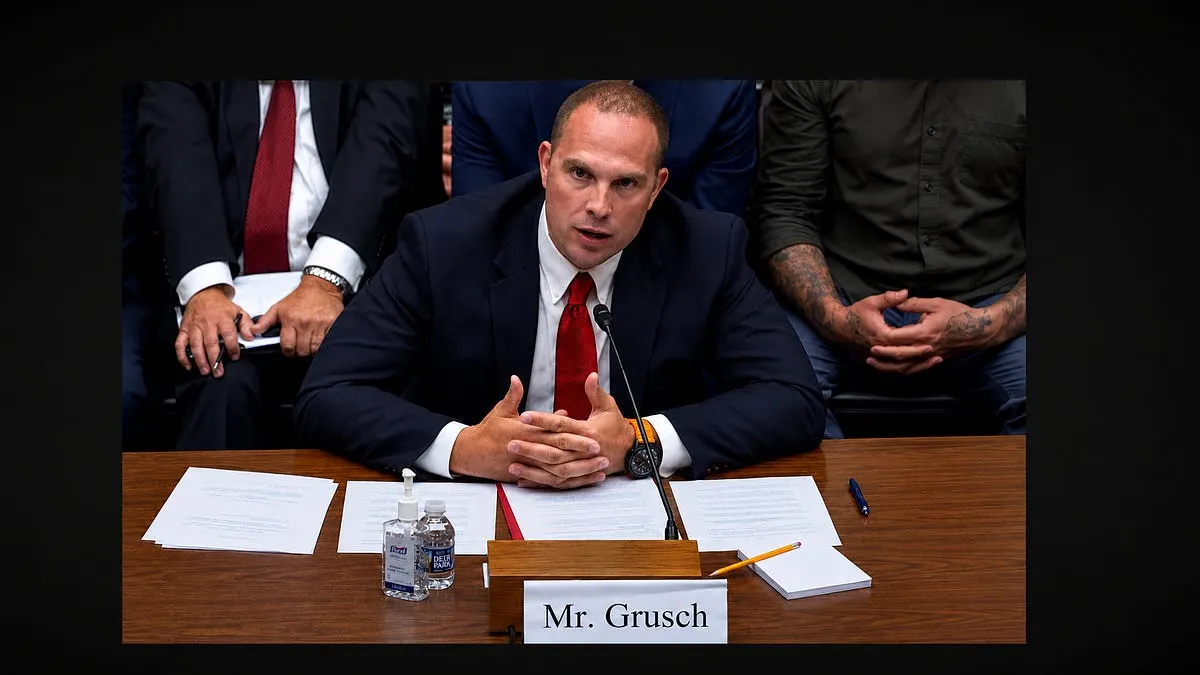
David Grusch, the former intelligence officer and UAP Task Force member who became a federal whistleblower in 2023, described a nother case during his appearance on Joe Rogan’s podcast and in conversation with Jesse Michels . A thirty-year senior Navy officer told Grusch that a 300-foot triangular craft had hovered over his car as he drove to work at a naval facility in the pre-dawn hours. It was darker than the sky, with plasma-like purplish edges and three omnidirectional lights. The upward-facing surfaces of his car subsequently turned milky white. Grusch confirmed he had viewed both the photographs and the accompanying documentation.

Further, the fifth tranche of UAP files released under PURSUE in August 2026 included multiple FBI investigations and reconstructions of triangular craft encounters. Richard Dolan, reviewing the tranche , identified a pattern of recurring forms: large structured triangles appearing across different years, locations, and witness pools. In June 2002, two military pilots at Bagram Airfield, Afghanistan , watched an equilateral triangle roughly 500 feet across drift overhead, totally dark and silent, blotting out the stars as it passed. Near Colorado Springs in 2023, a former Department of Defense employee and his wife saw a translucent triangle at roughly 300 feet altitude, surrounded by a haze like ripples around an underwater object. In a separate Colorado Springs encounter the same year, a witness watched a solid black equilateral triangle emerge from what he described as a pixelated cloud-like mass and accelerate to an estimated Mach 1 or 2 without a sound. And in 2011, two former military service members observed a 200-foot black triangle emitting a low pulsing hum as it moved slowly overhead, a bright white light at each corner.
Then, in mid-August, the that two additional classified videos -cellphone recordings made on consecutive nights in 2023 by a service member near a Colorado military base — allegedly show a 100-foot black triangular craft zooming over mountains and actively camouflaging in clouds. The videos are reportedly held by the Air Force Office of Special Investigations under specific file numbers. The Department of War confirmed it is “actively investigating” and stated it would release what it finds through PURSUE, though no timetable has been given. Dylan Borland, in an interview with Jesse Michels on the American Alchemy podcast, stated that he knows for a fact that cellphone video of triangles exists within the government — footage taken within a hundred feet of the craft that, in his words, would end the conversation “once and for all.” He did not identify the specific recordings, but the description is consistent with what the sources described.
Fouche died on May 11, 2017, in Texas. He was 69. Whatever he knew or didn’t know, the record he described is no longer his alone.
The Fouche case won’t convince a hardened skeptic, and I wouldn’t expect it to. But it widened the picture in ways that are hard to dismiss: the triangle as a human workaround for incomplete reverse-engineering is either a brilliant piece of fabrication or an uncomfortably coherent explanation for what people have been seeing in the sky for decades. Next, we’ll move from secondhand intelligence to something more visceral: a firsthand encounter in a jungle, at gunpoint. Part 3 coming soon.
Originally published at https://theclassifiedblindspot.substack.com on September 12, 2026.