Intersectional Reflexivity: Doing Fieldwork as a Minority Woman

Research is often presented as a process of observation and analysis. Methodology sections show data collection as orderly, linear, and frictionless: the researcher enters the field, gathers information, and exits with data. My fieldwork experience differed. I was continuously interpreted, positioned, and evaluated. Therefore, what disappears in such accounts that fail to engage with positionality are the conditions that make knowledge possible, including the researcher’s social position.
Feminist authors have long challenged the assumptions of neutral objectivity. Sandra Harding (1991) argues that claims to value-free objectivity obscure the social locations from which knowledge is produced. Similarly, Donna Haraway (1988) critiques what she terms the “god trick” , the illusion of seeing everything from nowhere and instead advances the idea of situated knowledge: partial, embodied, and accountable forms of vision. Knowledge, in this view, is always produced from somewhere. Acknowledging one’s layered identity across gender, religion, caste, and age can be perceived as risking scholarly credibility. This article argues that positionality does not distort research, it structures the very conditions under which knowledge becomes possible.
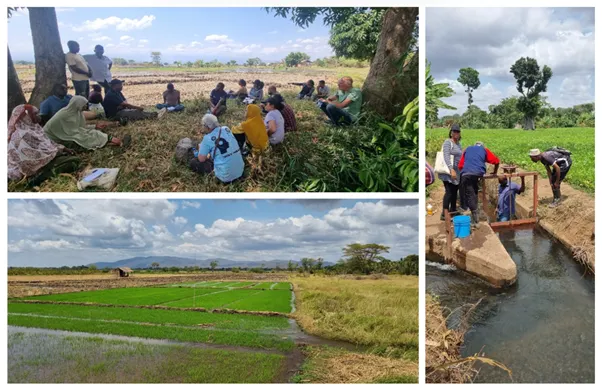
This research contributes to the project EPIC (Equity Perspective in Irrigation Care or Control), a multi-country project with case studies in India, Tanzania and Ethiopia which aims to understand and operationalize equity and fairness in irrigation water distribution. Drawing on fieldwork conducted for one of the case studies within this project in eastern India, focused on the evolution of irrigation practices. I reflect on how my position as a young Muslim woman wearing a headscarf shaped access, interaction, interpretation, and ultimately, the production of knowledge itself.

Whose Knowledge Counts?
Irrigation related research is historically dominated by men. Meetings with government officials, farmers, and local leaders were overwhelmingly male dominated. Decisions about when to travel, whom to meet, and whether to go to certain sites were informed by considerations of safety. On several occasions, discussions about irrigation practices were preceded by elementary conceptual questions directed at me less as genuine inquiry and more as subtle tests of competence.
My positionality probably because I am young or I am a woman also influenced how my research approach was received. On one occasion, an individual in positions of authority attempted to redirect my research approach. I was repeatedly advised not to engage with women associated with JEEVIKA. The argument was that jeevika women are not connected to the traditional irrigation system. Despite clarifying that my research centred on equity and therefore required engagement with women. I also clarified, I needed JEEVIKA women support for fieldwork. I was told upfront that I did not know how to approach my own research.
These interactions reflected more than disagreement. They suggested an assumption that I required instructions. I should follow guidance without questioning it. These moments reveal that positionality also shapes who is recognised as a legitimate knower and who must continually justify her decisions.
Even before reaching the field, visibility preceded speech. While travelling to the railway station in Delhi, a cab driver asked if I was Muslim. This felt unnecessary, given that my headscarf had already signified my religious identity. In the field, similar dynamics persisted. On several occasions, people hesitated to offer me food. When I declined food due to motion sickness or personal preference, the refusal was interpreted through a religious lens. These interactions revealed that research encounters were never neutral exchanges. They were mediated by visible markers of identity that shaped assumptions before dialogue began. Continuing the research despite these emotions became an integral, though often unacknowledged form of research labour
Relational Positionality
As Crenshaw (1991), and hooks (2014) have argued, individuals simultaneously hold multiple identities that interact in contextualized ways. For instance, the presence of colleagues significantly altered how I was positioned in the field. When working alongside male teammates, my identity was often read relationally to them. Their presence facilitated access and eased initial rapport building with the villagers. I observed how my male colleagues could initiate conversations casually and build rapport with ease, while my interactions required careful calibration. Rapport-building for me involved negotiating a delicate balance between openness and restraint, familiarity and professional distance. These differences shaped not only interactions but also the kinds of narratives and silences that became accessible to each of us.
I remember one day travelling back alone from the field, when an auto driver, recognizing me from my repeated visits, asked about my work. I explained my research and then asked if he was from the same village. He said he was from the next village and then, almost without pause, the conversation turned to religion. Such moments made me wonder what enables people to cross into that space of familiarity so easily. Was it my visible Muslim identity that invited the exchange? Or my gender, which perhaps made me appear more approachable, or less confrontational?
Get Equity Perspectives in Irrigation Care or Control’s stories in your inbox
Join Medium for free to get updates from this writer.
These two encounters reveal that identities do not operate uniformly across the fieldwork. In the presence of male colleagues, my gender was foregrounded relationally to them. I was positioned as a woman in contrast to male. When alone, gender and religion were read together, shaping the interaction differently.
While my gender and religious visibility sometimes complicated the data collection process however, other aspects of my identity simultaneously facilitated access. Affiliation with IIT, encouraged government officials to engage with my research. Additionally, in a Muslim-majority village, my religious identity generated religious familiarity. I was repeatedly referred to as “daughter,” a kinship framing that eased rapport building. These moments reveal that positionality does not operate solely through exclusion but also through forms of recognition and institutional privilege
Care and Support
The field was not solely a site of scrutiny or constraint. It was also marked by care. People offered directions, hospitality, and assistance. These gestures complicate any singular narrative of marginalisation.
Acknowledging vulnerability does not erase the support I received. Rather, it underscores the complexity of field relations. Marginalisation and support coexisted.
Conclusion
As Haraway (1988) argues, vision is always partial. England (1994), also argues that reflexivity is essential not because researchers are biased in a simplistic sense, but because they are positioned within social relations. Objectivity in social science cannot mean detachment from social location. It must involve reflexive awareness of how knowledge is relationally produced. In Harding’s terms, reflexivity enables “strong objectivity” rather than undermining it. My fieldwork experience suggests a similar understanding. Gender, religion, age, and social positioning did not distort an otherwise neutral process, they made me aware of what data is accessible to me. What questions I could ask, what answers were shared, and what silences persisted were shaped by my positionality. Therefore, in the field I was simultaneously an observer, participant, and subject of interpretation.
References
Crenshaw, K. (1991). Mapping the margins: Intersectionality, Identity politics, and Violence against Women of Color. Stanford Law Review, 43(6), 1241–1299. https://doi.org/10.2307/1229039
England, K. V. L. (1994). Getting Personal: Reflexivity, Positionality, and Feminist Research. The Professional Geographer, 46(1), 80–89.
Haraway, D. J. (1988). Situated Knowledges.
Harding, S. G. (1991). Whose Science? Whose Knowledge? : Thinking from Women’s Lives. Cornell University Press.
Soedirgo, J., & Glas, A. (2020). Toward Active Reflexivity: Positionality and Practice in the Production of Knowledge. PS: Political Science & Politics, 53(3), 1–5.
Uzma Anjum is a Project Scientist at IIT Delhi, working on the EPIC (Equity Perspective in Irrigation Care or Control) Project. Her research focuses on the intersections of water governance, irrigation, and gender aiming to influence policies that promote equity and sustainability.